Want more from Front Office Sports
in your search results?
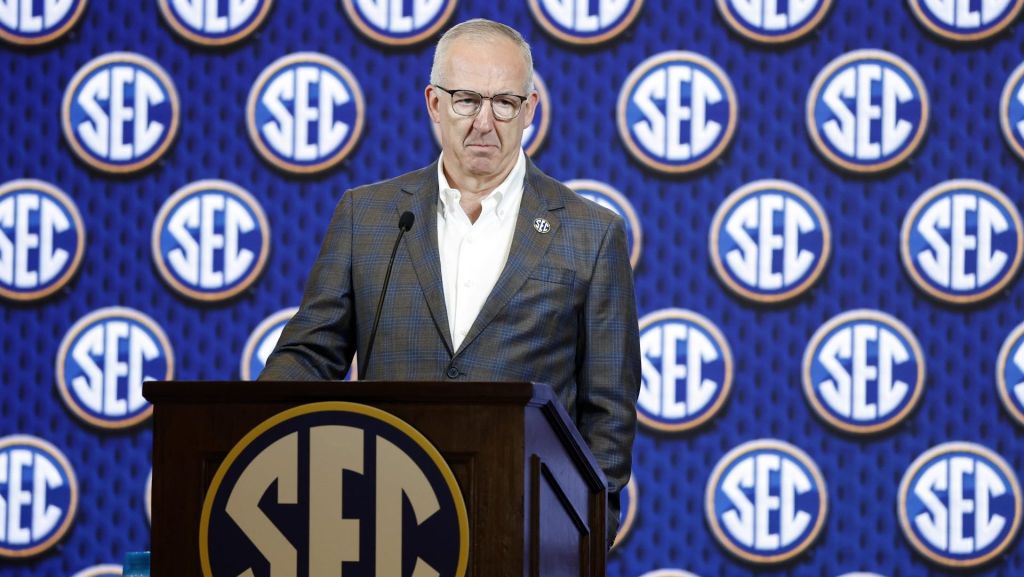
Hours before the SEC publicly endorsed the Protect College Sports Act (PCSA), Republican Senate Commerce Committee staff director Brad Grantz sent a memo to Greg Sankey that warned conference leaders they needed to back the bill or risk a Democrat version with collective bargaining and employee status for athletes.
“There is no legislative alternative that gets better for the SEC,” he wrote.
“After the election, because of who is likely to win the House, you won’t see this bill…being considered,” Grantz wrote in the July 31 memo, obtained via public records request to the University of Texas. “The asks from the Democrats begin with employee status, collective bargaining rights, and end with private right of action. Let’s get this done.”
Klein/Johnson Group, the SEC’s lobbying firm for the PCSA according to disclosures reviewed by Front Office Sports, sent the memo to SEC commissioner Sankey on July 31 with the subject line “From Brad via Schmitt’s office,” referring to Sen. Eric Schmitt (R., Mo.).
The email asked that the memo be shared “directly with the SEC presidents and board members.” Sankey forwarded it to SEC university leaders soon after, calling it “one additional email provided by the Commerce Committee.”
Less than two hours later, the SEC and Big Ten publicly released a joint statement endorsing the bill.
SEC Associate Commissioner Herb Vincent responded to FOS’s request for comment stating the conference’s support followed “several weeks of discussions and negotiations with legislators and staffs.” He described Grantz’s email as “only one unsolicited point of input” among many the conference received from government relations professionals.
Neither Grantz nor the Senate Commerce Committee responded to FOS’s requests for comment.
The PCSA would establish nationwide rules for college athletes’ compensation, eligibility, and transfers while granting the NCAA, conferences, and schools antitrust protections. The Senate passed the bill 77-22 on Sept. 28, but it’s still awaiting a House vote.
Much of Grantz’s memo was devoted to explaining how far lawmakers had already gone to accommodate the SEC, writing bluntly: “The Committee has moved substantially in the SEC’s direction.”
Among the concessions he highlighted were a fund schools could use to retain athletes, increased disclosure requirements for name, image and likeness (NIL) deals, antitrust protection for enforcement, and new certifications for NIL deals arranged through multimedia rights holders.
Grantz also addressed the SEC’s concerns about media rights. He said schools would not be required to join an entity selling broadcast rights collectively, that schools outside such an arrangement would retain control over scheduling, and that the bill would prohibit lawsuits seeking to force schools or conferences to participate.
But he warned that lawmakers could go only so far without jeopardizing the bipartisan support needed to pass the bill.
“The reason why we cannot adopt tightened language [regarding a revenue-sharing cap] is not because we’re unwilling to continue drafting. It is the political limit of what can be enacted,” Grantz wrote. “Further requests cannot produce a bill that gives the SEC every provision it might prefer while retaining the bipartisan coalition necessary to pass federal legislation.”
“Let me be clear—the PCSA has a hard cap,” he continued.
According to the memo, payments involving associated entities, including collectives, would count against that cap. Grantz argued that Section 114 would prevent schools from routing additional roster payments through collectives, booster networks or marketing affiliates, while Section 118 would provide antitrust protection for enforcing those restrictions.
“The result is not a voluntary aspiration,” he wrote. “It is a federally protected enforcement structure.”
Grantz presented those protections as an improvement over the existing House v. NCAA settlement governing athlete compensation.
“The cost of throwing away those wins is continued litigation and the existing settlement structure,” he wrote.
The memo came as Saving College Sports (SCS), the advocacy group established by billionaire Texas Tech booster Cody Campbell, was mobilizing university leaders and conference commissioners to support the legislation. FOS previously documented the group’s lobbying campaign.
On July 30, Dary Stone, a former Baylor board chair working on behalf of SCS, emailed the group’s contacts urging them to reach out to their university presidents ahead of conference deliberations.
“There will be a vote amongst the Conferences on PCSA today. Please contact your Presidents and ask them to vote in favor. Very important. This is it.” he wrote, according to records FOS previously obtained.
Among the recipients were Randy Lawson, chair of the Arkansas Board of Trustees, and Gary Pierson, former chair of the Oklahoma Board of Regents.
A Warning About Athletes as Employees
Grantz’s most pointed warning concerned what might happen if Democrats gained control of Congress, particularly the possibility of college athletes becoming employees with collective bargaining rights.
To assess Grantz’s warning about athlete employment and collective bargaining, FOS consulted Michael LeRoy, a law professor at the University of Illinois Urbana-Champaign who specializes in labor and employment relations.
The memo is “unduly alarmist about Democratic control of Congress,” LeRoy told FOS in an email.
Even if the Democrats take control of Capitol Hill in November, the Senate filibuster and President Donald Trump’s likely veto of any Democrat-passed bill would blunt any radical reforms. LeRoy also challenged the notion that treating athletes as employees would necessarily be worse for college sports.
“Employment is feasible but more costly than revenue sharing and NIL,” LeRoy said. “That said, when the costs and consequences of constant antitrust litigation are factored into this equation since 2021, the employment option offers less exposure to lawsuits, more stability, and better cost controls.”
He suggested that collective bargaining could provide another way for the NCAA to protect its compensation rules from antitrust challenges.
“If collective bargaining is added to employment, this would create an antitrust labor exemption for the NCAA—exactly what it needs to end its chaos,” he said.
The Senate-passed bill also contains provisions addressing private lawsuits, one of the concerns raised in Grantz’s memo.
Section 119 allows private lawsuits over specified protections, including certain NIL, academic and medical provisions, while preserving the antitrust protections in Section 118. Courts could award actual damages and other appropriate relief.
LeRoy said the ability to privately enforce those protections “may explain why the bill passed with so many Democratic votes.”
He pointed specifically to athletes’ ability to enforce their NIL compensation rights and protections against losing eligibility or scholarships for participating in NIL deals.
Download the FOS App
The business of sports, in your pocket.



Scan the QR code to get the app now.