Want more from Front Office Sports
in your search results?
A jury has never ruled on whether the NCAA is liable for negligent concussion protocol — whether it has failed to protect athletes from concussions, traumatic brain injuries, lifelong illness, and even death.
The NCAA has faced a handful of lawsuits in the past decade from athletes who endured long-term injuries stemming from concussions, but the cases have all been dismissed or settled. One made it to trial but was settled three days in.
That’s about to change. Next week, pre-trial proceedings will begin in Los Angeles Superior Court for the case Alana Gee v. NCAA.
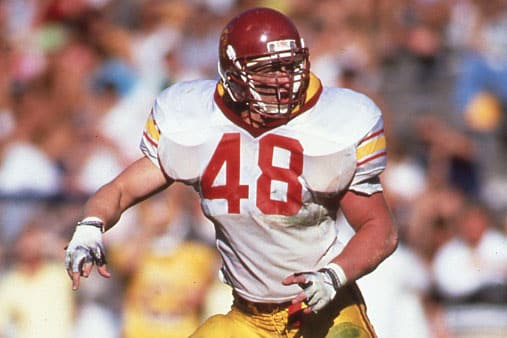
Gee is the widow of former USC linebacker Matthew Gee, who played between 1988-92. Gee died in 2018 — and was subsequently diagnosed with CTE. Alana Gee is alleging wrongful death and negligence, saying the NCAA failed to educate Matthew Gee on the dangers of concussions — of which it was well aware — and failed to protect Gee from them.
The trial will span multiple weeks and will feature a star-studded witness list — from NCAA officials like President Mark Emmert and General Counsel Scott Bearby to concussion-era celebrities like Dr. Bennet Omalu (the doctor whom the film “Concussion” was based on). The trial will also be livestreamed.
Experts told Front Office Sports that if the NCAA loses, it would potentially owe hundreds of millions in damages and face a deluge of future concussion lawsuits — just like the NFL.
“This trial will begin to shed a light on the NCAA’s wrongful conduct, and we believe that light will only get brighter as hundreds more former NCAA football players finally begin getting their days in court,” Todd Logan, a partner at Edelson PC and a member of the legal team prosecuting the case, told Front Office Sports in early October.
The NCAA did not respond to a request for comment for this story, though it denies allegations in court documents.
The Tragedy of Matthew Gee
Matthew Gee never played in the NFL but was a major contributor to a successful USC team in the late 1980s and early 1990s. After his playing days ended in 1992, he lived a “relatively normal” life — until five years before his passing, according to the original complaint filed in Nov. 2020.
In 2013, Gee began to experience confusion, rage, and depression.
One harrowing detail: “In March 2018, he reported to a physician that long periods — even days — sometimes went by without his having any memory of what had happened.”
He died on Dec. 31, 2018 in his sleep at age 49, according to the Concussion Foundation. Gee, who had previously been sober, had alcohol in his blood at the time of his death. He was posthumously diagnosed with CTE.
The suit argues that Gee’s death resulted from the repeated head trauma he suffered while playing for USC. It says the NCAA is responsible.
“For decades, Defendant NCAA knew about the debilitating long-term dangers of concussions, concussion-related injuries, and sub-concussive injuries … that resulted from playing college football, but recklessly disregarded this information to protect the very profitable business of ‘amateur’ college football,” the complaint said.
“Defendant failed to implement adequate procedures to protect Gee from the long-term dangers associated with them. It did so knowingly and for profit.”
In court documents, the NCAA thoroughly denied all allegations.
- Gee must have “assumed the risk” of playing football when he stepped onto the field, the NCAA said.
- It noted that NCAA bylaws make clear schools are liable for any mishandling of injuries, not the national office.
- As part of its legal defense, the NCAA also said it has not made football more dangerous.
“Collegiate football was not a substantial cause of Gee’s death,” the NCAA wrote.
The NCAA’s Potential Culpability
Sports attorney Dan Lust, who has years of experience with personal injury cases, told FOS that an NCAA loss “could be a watershed moment for college sports.”
The NCAA would face two major consequences: massive financial liability and a flood of future lawsuits.
Lust noted Gee’s attorneys are asking not only for damages, but also “disgorgement:” giving back the profits it earned as a result of negligence. That’s hundreds of millions in potential liability — plus the legal fees and additional damages from future lawsuits.
But there’s no guarantee the NCAA will lose, of course.
“I think everyone’s going to agree, whether you’re the NFL or the NCAA, that more should be done to prevent head trauma and concussions, and the harm that’s been caused,” Lust said. “There is likelihood of a finding of negligence, that the NCAA should be doing more for concussions. But you’re still going to have to prove causation.”
- The jury must agree Gee’s CTE resulted from playing college football and that it led to his death.
- Then, it must agree that the medical problems Gee suffered resulted from the NCAA’s alleged negligence — rather than the actions of USC or the then Pac-10.
Lust pointed to Brenner v. NCAA, which was tried in Oregon this past spring. Former Oregon offensive lineman Doug Brenner sued the governing body for an injury he incurred during practice in January 2017. A jury found the NCAA to be negligent — but that wasn’t enough to prove it caused his injury.
If history is any indicator, though, the case’s geography could work in Alana Gee’s favor. California is a traditionally hostile environment to the NCAA.
The Alston case, which found the NCAA illegally restricted educational benefits, and the O’Bannon case, which found athletes should be compensated for NIL rights, both went through the Ninth Circuit Court in California. State legislatures also passed the nation’s first-ever state NIL law.
The Future of NCAA Concussion Protocol
Last week, “the whole nation saw what happened to Tua,” Ramogi Huma, the executive director of the National College Players Association and a decades-long advocate for college athlete safety reforms, told FOS. “That happens on the regular in college sports.”
The NCAA’s current protocols, after all, are only slightly more sophisticated than they were during Gee’s era.
The verdict could spur significant change. If the NCAA is found liable for negligent concussion protocols, it could be incentivized to improve them — and maybe even enforce them — in order to protect itself.
- By now, the NCAA has funded research and provided medically based suggestions for how to better protect athletes.
- Since 2010, it has required that each school implement a concussion protocol, Huma said. But it only gives suggestions for what that protocol should entail.
- In January, the NCAA ratified a new constitution that largely leaves this structure in place.
In practice, this program is weak at best. When a trainer attempts to follow protocol, for example, there’s often pressure to eschew it. In 2015, a survey of 789 NCAA athletic trainers and 111 team physicians found that 64.4% were pressured by athletes and 53.7% were pressured by trainers to “prematurely clear [athletes] to return to participation after a concussion.”
If a school violates its own rules, the NCAA currently has no enforcement mechanism to punish it. Huma went so far as to call the concussion protocols “voluntary.” He noted there are also no outside watchdogs to investigate — no player’s union, no federal legislation.
The controversy over how to handle concussions — and the question of the NCAA’s role in protecting athletes from them — will not end with this case. If Gee wins, the floodgates open. But if she loses, there are more cases to be tried — and potentially other parties, like the schools, who could be held responsible.
“This lawsuit is not a one-off,” Huma said. “It’s not something that used to happen and got cleaned up.”
Download the FOS App
The business of sports, in your pocket.



Scan the QR code to get the app now.