Want more from Front Office Sports
in your search results?
Despite concerns that a New York court order could effectively shutter Kalshi across the U.S., the prediction-market platform avoided any immediate disruption Monday when a state justice opted to hold off on granting the state’s request for emergency relief.
Late last week, Kalshi filed a letter with New York’s Supreme Court saying the language of the request for a temporary restraining order (TRO) from the office of the New York Attorney General was so broad that, if granted, it could “shut down operation of Kalshi’s federal derivatives exchange not only in the state but nationwide.”
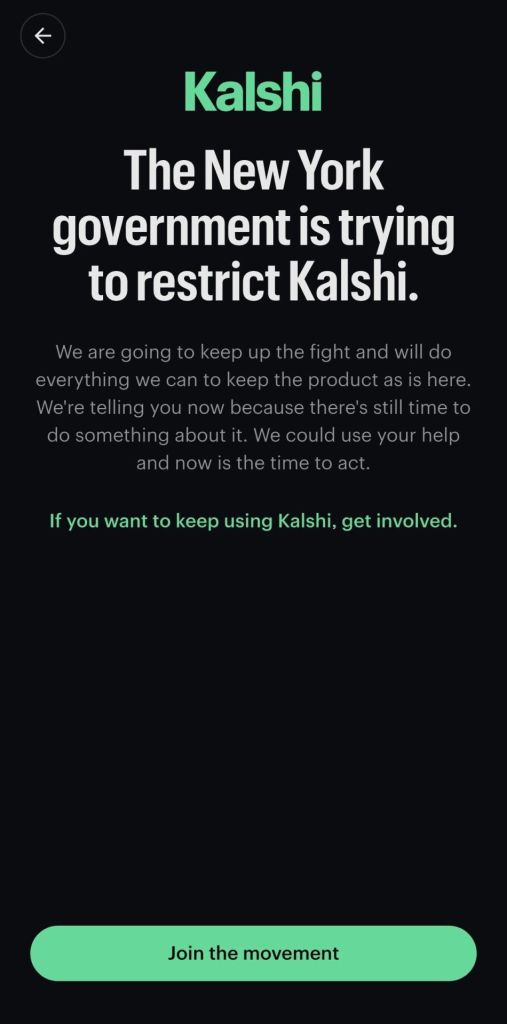
On its platform, meanwhile, Kalshi has been informing New York users that “the New York government is trying to restrict Kalshi,” while linking to a petition to “protect your freedom to trade.” As of Monday afternoon, the petition had more than 326,000 supporters, according to the website. At the bottom of the petition, it says “paid for by Kalshi Inc.”
The New York AG’s office responded with its own Friday filing that said Kalshi’s letter was “but the latest in Kalshi’s continuous efforts to delay enforcement while it continues to profit from offering illegal gambling in New York.”
During Monday’s virtual hearing—which almost didn’t happen due to a procedural issue—Brent Tomer, a former CFTC trial attorney who is currently the assistant attorney general for New York’s investor protection bureau, said “we’re not seeking to shut down Kalshi entirely.”
Tomer argued that an immediate ruling prohibiting Kalshi from offering sports and other event contracts in the state was necessary for multiple reasons, including that Kalshi does not have the same safeguards in place to protect users that licensed sportsbooks have. He also noted that licensed sports gambling is taxed at a rate of over 50% in New York, and that those funds go to the likes of school funding, sports programs for underserved youth, and problem gambling education and treatment.
“I don’t have the precise numbers on how much Kalshi has cut into that revenue,” he said. I think it’s pretty obvious that would have an impact.”
New York County Supreme Court Justice Melissa Crane was not convinced. Toward the end of the hourlong hearing, she decided not to grant New York’s TRO request, which does not mean she has ruled on the merits of the legal battle. Instead, it means that both sides will now file full briefs arguing their cases and then hold oral argument.
Crane was also skeptical about New York’s request for a TRO considering the issue of sports event contracts seems destined to reach the U.S. Supreme Court. “That ultimately will bind me,” she said. “So isn’t it prudent to wait and see what happens there?”
Following the hearing, Kalshi spokesperson Elisabeth Diana issued the following statement: “The judge denied the State’s request for a TRO, recognizing that there are complex questions about derivatives and preemption. We remain committed to working with the State on a path forward that works for our 1.5 million customers and for the state of New York.”
An in-person hearing will be scheduled for either Jan. 7 or 8, Crane said. That hearing will feature oral arguments on New York’s request for a preliminary injunction blocking Kalshi from offering event contracts on sports, culture, elections, and other areas in the state without obtaining necessary gambling licenses.
Crane was particularly focused on the fact that Kalshi allows users as young as 18 to trade on its platform, something she cited as a “concern.” The age limit is one of the factors New York pointed to in seeking emergency relief. The justice asked Kalshi attorney Grant Mainland of Milbank LLP if the company would be willing to consider a compromise that would see Kalshi no longer allow users under 21 to use its product in the state; Mainland said he would need to check with the client. A little later, a different Kalshi attorney, Colleen Sinzdak, also of Milbank, said Kalshi had informed its attorneys it “would be able to perhaps come to a compromise” with regard to users under 21 betting on “sports and culture contracts.”
She asked the parties to inform her whether they have reached a deal on that point by Nov. 30.
New York and Kalshi have been going at it since October 2025, when the New York State Gaming Commission issued a cease and desist order. Kalshi responded by suing in federal court, and that case reached an appeals court, which ruled Kalshi could not stop the state from enforcing its gambling laws while the case played out. After that ruling, New York AG Letitia James sued Kalshi in state court over the summer, seeking at least $36 billion damages. There has been jurisdictional jockeying, with Kalshi removing the suit to federal court and New York remanding it back to state court, which led to Monday’s procedural issue.
New York is just one of many states where this same battle is playing out. Some states, like Nevada and Michigan, have successfully gotten court rulings compelling companies like Kalshi and Polymarket to stop offering event contracts there and implement geofencing to ensure users are not illegally accessing their platforms.
When informed that Nevada had secured such a ruling, Justice Crane said “that’s interesting,” and noted she “would think” that Nevada courts would be “experts on gambling.”
Download the FOS App
The business of sports, in your pocket.



Scan the QR code to get the app now.