Want more from Front Office Sports
in your search results?
The anticipated prediction-market reckoning following the midterm elections arrived almost immediately.
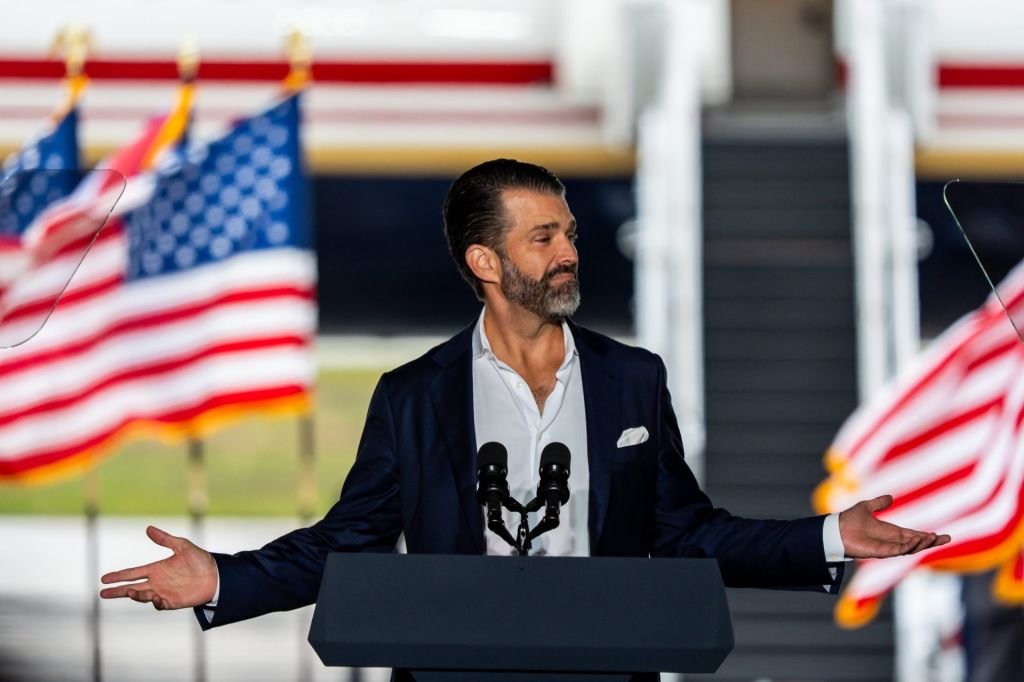
Donald Trump Jr. is out at Kalshi. The Republican attorney general of Louisiana sued 10 prediction-market operators. The White House nominated a bipartisan duo of commissioners to the CFTC. And Novig’s argument that it differs from traditional sports betting was emphatically rejected in federal court.
Those developments, all of which happened last week, are part of a broader fight over whether the federal government or states get to regulate the industry.
The flurry of activity underscores the likelihood that the U.S. Supreme Court will weigh in on prediction markets, New England Law professor Melinda Roth tells Front Office Sports.
“Everything is pushing in that direction,” she says.
Roth, who teaches business, sports law, and corporate finance, says the fight is about far more than sports event contracts. It’s about whether states can regulate products offered by exchanges that fall under federal oversight, and whether sports can be carved out and treated differently from the other markets on platforms like Kalshi and Polymarket.
One of the central issues in the lawsuits winding through the U.S. court system is whether sports event contracts should be treated as swaps, which are contracts where two parties exchange money based on how something else changes—for example, the result of a game. Swaps generally fall under the CFTC’s authority.
Roth says the legal fight raises a difficult question: If event contracts tied to elections, weather, and other events fall under the CFTC’s jurisdiction, why should sports be treated differently?
“I just don’t understand the potential world where sports event contracts aren’t considered swaps and can’t be regulated by the CFTC, but there’s all these other products that are considered swaps,” Roth says. “How can everything else be swaps and sports not be?”
Roth says sports are at the center of the fight for one simple reason: money. States with legalized sports betting collect tax revenue from the industry, giving them a financial incentive to challenge prediction markets that operate outside the state-level regulatory systems. Native American tribes, meanwhile, have their own gaming operations and revenue streams to protect.
“Let’s face it, this is all about the money,” Roth says.
“The question is no longer ‘will prediction markets exist?’ It’s ‘how will they exist?’”
The opposition to prediction markets is not confined to one political party. Several Republicans in Congress have already pushed for greater oversight. Rep. Adrian Smith (R., Neb.) and Rep. Blake Moore (R., Utah) have introduced bills addressing the industry, and Sen. Ted Cruz (R., Texas) has plans to propose legislation that would ban prediction-market platforms from offering sports event contracts unless they have received authorization by a state or tribal government.
“This has really been a bipartisan issue,” says Peter Dugas, CEO of regulatory and government-affairs advisory firm Regulatory Intelligence Group. “Has this been ugly and painful for everyone involved? Yes, but that’s the reality with unsettled law.”
Former CFTC lawyer Carl Kennedy, who now works at law firm Dechert LLP, tells FOS the two new CFTC commissioner nominees could have a significant effect on the agency’s approach. Until now, under the current administration, chairman Michael Selig has been the agency’s sole sitting member, giving him wide latitude to steer its response to prediction markets. If confirmed, Republican Nathan Anonick and Democrat Matt Rowland will bring the commission to three members.
Their arrival could slow the rulemaking process, though potentially in a positive way. Selig will need to hear out his fellow commissioners and build consensus around the agency’s approach, Kennedy says.
“He is going to have to go to a [Capitol] Hill controlled by Democrats, so he’ll have to work collaboratively,” he tells FOS. “He’s savvy and has been resolute in wanting durable rules that are technology neutral and innovation-friendly. I think he will want buy-in from the other commissioners.”
Experts generally agree that prediction markets aren’t going away, even if a Supreme Court ruling ultimately determines that sports event contracts must be regulated on a state-by-state basis. The question has shifted from whether the industry will exist to how it will ultimately be regulated, according to Chris Grove, co-founding partner of sports betting-focused Acies Investments.
“The question is no longer ‘will prediction markets exist?’” Grove says. “It’s ‘how will they exist?’”
Grove acknowledges that some of the recent developments, such as the CFTC commissioner nominations, appear to be directly tied to the midterm results. But he cautions against viewing last week’s activity as an entirely new phase for the industry.
“The important grounding here is that it was not the first wild week in prediction markets, and it won’t be the last,” Grove tells FOS. “Wild weeks have been the status quo for this category for the better part of a year and a half now.”
Download the FOS App
The business of sports, in your pocket.



Scan the QR code to get the app now.