Want more from Front Office Sports
in your search results?
The Braves remain one of MLB’s most successful teams, on and off the field. Atlanta’s latest earnings report, however, emphasizes just how critical the club’s real estate ventures are.
The club reported $324.6 million in total revenue during the third quarter, up 4% from the same period in 2025. Operating income shrunk by 78% from $38.9 million in last year’s third quarter to $8.67 million.
Within those topline results, the dichotomy in the club’s business model continues to grow. For the first nine months of 2026, The Battery, the Braves’ mixed-use development, generated $55.8 million in adjusted operating income, up 11%, off of $84 million in revenue. The Braves’ baseball business, conversely, posted an operating loss of $12.5 million for the same period, down sharply from a comparable gain of $62.5 million a year ago.
“What made this season special showed up across our business,” Braves chairman Terry McGuirk said Wednesday in an earnings call with analysts. “The results we saw are a clear example of how a winning team, an engaged fan base, and the ecosystem we’ve built around Truist Park and The Battery reinforce one another.”
The growing financial success of The Battery also highlights the labor argument from the MLB Players Association about how clubs are profiting heavily outside of core team operations. The union is resisting the ardent push from team owners for a hard salary cap and floor, and is seeking to retain the core of the sport’s current, market-based economics system.
Management has made the cap and floor the centerpiece of an aggressive bargaining platform that also includes significant restrictions on free agency, a retooled draft, and a 154-game regular season.
Owners are expected to lock out the union when the current labor deal expires Dec. 1. Braves officials, however, declined to wade publicly into the ongoing labor talks in the quarterly earnings call.
“Given what we’ve seen yesterday [in a revised salary cap offer from management], these are truly fluid conversations, and it makes little sense to comment along the way while they’re happening,” McGuirk said.
That stance differs from the growing chorus of team owners openly pushing for a salary cap in baseball, including the Brewers’ Mark Attanasio, Yankees’ Hal Steinbrenner, and White Sox’ Mat Ishbia. MLB commissioner emeritus Bud Selig has done the same thing.
TV Replacement Income
The Braves, meanwhile, are narrowing the gap in its large-scale effort to replace its prior local media rights revenue from the now-defunct Main Street Sports Group with its new BravesVision network.
The latest earnings report detailed $76.1 million in media-related revenue for the quarter, down 4% from the comparable period in 2025. That decline is improved from a 10% decrease in that category during the second quarter of 2026. For the entire year to date, the Braves have generated $151.5 million in media-related revenue, down 8%. That drop has also shrunk from a 12% decrease after the first six months of this year
Braves president and CEO Derek Schiller told Front Office Sports earlier this year that he had very high confidence that BravesVision would ultimately surpass the club’s revenue from Main Street Sports. That full revenue transition should be clear by spring 2027, club officials said Wednesday.
“In a very short period of time, we were able to create a network which we expect will exceed the annualized revenue of our prior local rights arrangement, while building a direct relationship with our fans,” Schiller said Wednesday.
Investing in Success
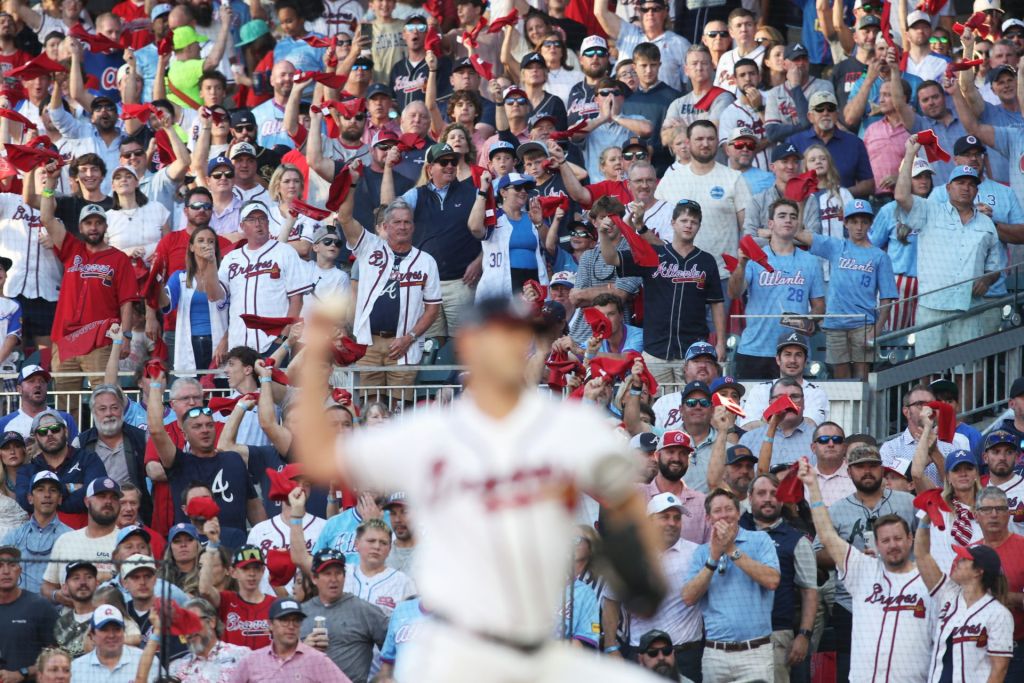
More broadly, the Braves lauded a 2026 season that included a playoff berth for the eighth time in the last nine seasons, ending with a four-game loss in the National League Division Series to the Dodgers.
There was a cost to that success, though. The Braves had a $257.5 million luxury-tax payroll for the 2026 season, up from $234.8 million in 2025, and higher baseball operating costs drove the broader quarterly decline in profitability.
“We’re pleased with where this organization is headed, and we’ll keep working to build on it in 2027,” McGuirk said. “That progress didn’t happen by accident. Coming into this season, we made a deliberate decision to invest in our roster, and our major-league payroll was meaningfully higher as a result. We’re proud of what that investment delivered: a division title, a return to the postseason, a ballpark full of fans, and millions more watching their team compete and win on BravesVision.”
The Braves are the only publicly traded, U.S.-based team, providing a unique window into the financial state of the sport.
Download the FOS App
The business of sports, in your pocket.



Scan the QR code to get the app now.