Want more from Front Office Sports
in your search results?
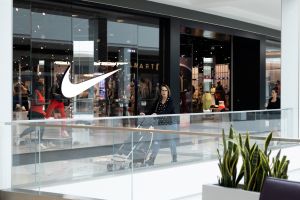
Nike’s upcoming removal from the S&P 100 index is not by itself a major concern, but it represents the latest reminder of how far the sportswear giant has fallen, and how much work remains to turn the company around.
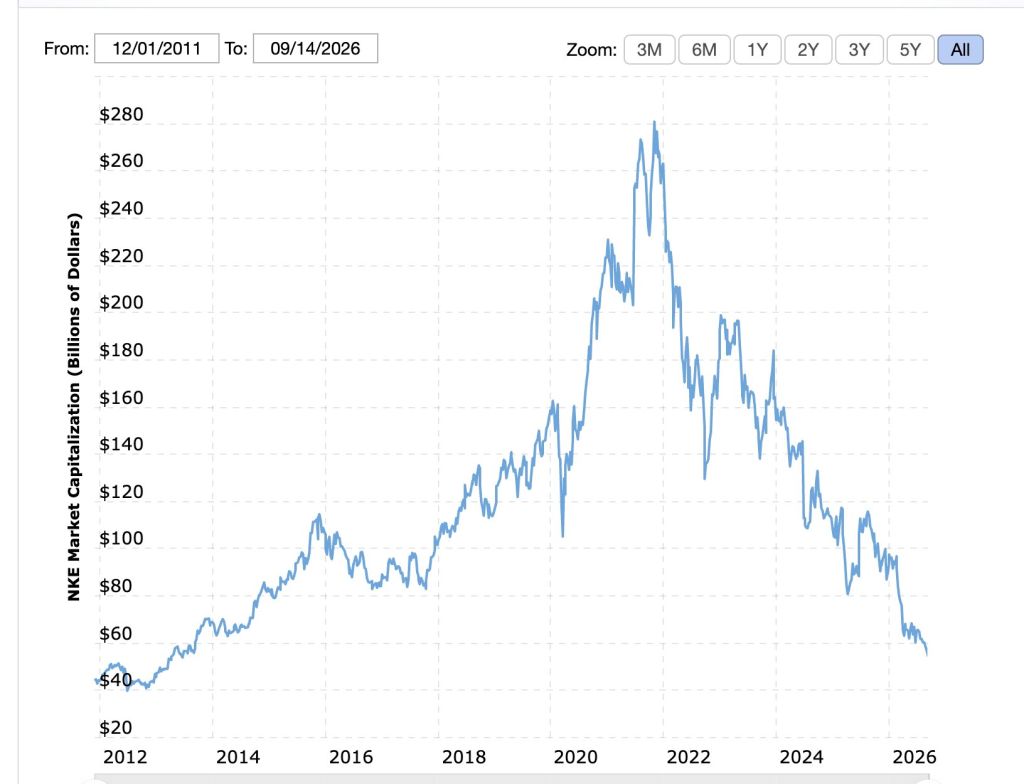
Nike has been part of the S&P 100 for roughly 18 years, but starting Sept. 21 it will no longer be part of the index, which tracks 100 of the largest publicly-traded U.S. companies. The removal comes as Nike’s stock is down almost 40% year-to-date, while its market capitalization has plunged by 78% over the past five years, from a high of $276.7 billion in 2021 to $58.6 billion as of late August.
The exit is “a bit embarrassing, but otherwise irrelevant, in my opinion,” Morningstar analyst David Swartz tells Front Office Sports. Because the S&P 100 is so exclusive, it is not uncommon for well-known companies to be replaced, and falling out of the index isn’t necessarily a sign of a company’s demise (indexes are rebalanced on a regular basis to ensure member companies’ market capitalizations are in a certain range). As examples, Sept. 21 will also see the removal of defense tech provider Honeywell Aerospace, consumer staples giant Colgate-Palmolive, and beer maker Molson Coors.
Analysts say it would be far more significant if Nike fell out of the better-known S&P 500, which tracks 500 of the largest publicly traded U.S. companies, is used as a snapshot of the broader stock market, and the basis for many index funds and exchange-traded funds.
Swartz doesn’t think Nike being dropped from the S&P 100 “will have any effect on its stock price at all.”
“It doesn’t affect Nike’s business, either,” he says. “It’s a reflection of its diminished market cap and current problems, but those are well known to everyone anyway.”
Telsey Advisory Group analyst Cristina Fernández shares a similar view, telling FOS that “from an investment perspective, this doesn’t change our view of the company one way or the other.”
Laurent Vasilescu of BNP Paribas tells FOS “the S&P 100 is more symbolic.”
“It reminds investors how much equity has been destroyed since, unfortunately, the highs of 2021,” he says. “This has been a long, painful downward spiral.”
Bigger Problems
When Elliot Hill took over as CEO of the beleaguered company two years ago, his main priorities were to clean up excess inventory and improve the business. Hill’s predecessor exited or reduced the brand’s presence in many of its wholesale retail partners like Dick’s Sporting Goods, DSW, and Big 5 Sporting Goods. Hill sought to reverse those moves, so in 2025 he worked with Nike’s wholesale partners to rebuild those relationships, which led to them ordering more products for 2026 than they could sell.
Nike planned to release new and innovative products, but Nike and its retail partners are now saddled with too much inventory and significant discounting. Analysts at Bernstein wrote in a Sept. 8 research note that while the breadth of markdowns on Nike products have been improving, they’re still very high in absolute terms, in particular at Dick’s Sporting Goods and Foot Locker, which Dick’s bought in May of last year.
“We expect the broader promotional environment, particularly around legacy silhouettes, to remain challenging at least through the fourth quarter,” JPMorgan analysts wrote in a recent note.
Analysts have generally said the company is making measured moves and meaningful progress under Hill, but the turnaround has been slower than expected.
Analysts at BMO Capital Markets wrote in a Sept. 8 research note that while Nike is considered to be underperforming, it “remains the largest, most important athletic brand despite recent challenges.”
According to Telsey Advisory Group analyst Cristina Fernández, investors “remain interested in Nike, but sentiment is soft.” That’s not just a Nike problem, though. Recent results from Nike, JD Sports, Dick’s, and other retailers have “raised concerns that demand for athletic apparel and footwear has softened recently, and consumers are shifting to dressier styles,” she tells FOS.
“Nike is attempting a complex global turnaround at a tricky time, with lifestyle demand slowing and competition heating up,” the BMO analysts wrote. They project fiscal 2027 North American sales to decline by about 5.5%.
What’s Going on in China?
Earlier this summer, Nike initiated a significant strategy shift in China to try and turn its business around there, a move some analysts cautioned could be a significant misstep. Beginning Jan. 1, the company will no longer allow most third-party online vendors in the country to sell Nike products online.
The goal is to push consumers toward Nike’s own digital storefronts and give the company greater control over pricing and inventory (Greater China revenue fell 12% in the fiscal fourth quarter and 11% for the full fiscal year, according to Nike’s most recent results).
Vasilescu isn’t sure the change in strategy will pay off in the long run. As he sees it, Nike’s new strategy doesn’t account for China’s shopping culture, which is different from the U.S. In China, Nike products are sold at Nike branded storefronts that are actually owned and operated by two primary players: Topsports and Pou Sheng. Surplus inventory has historically been sold online through wholesale websites.
“China doesn’t have department stores,” he says. “In China, livestream shopping is the thing to do. Nike is cutting off that channel. From my standpoint, it’s the wrong decision.”
A Nike representative told FOS in June that the strategy change is “nuanced,” and the company is “not pulling out of online” in China. Nike has 16 partners in the region who own and manage thousands of Nike stores; those partners currently operate more than 1,000 digital storefronts in China, and many of them are using the brick-and-mortar stores to fulfill online orders.
“All these digital storefronts have created an overly complex and fragmented consumer experience,” they said.
Nike did not respond to a request for additional comment on Wednesday.
Download the FOS App
The business of sports, in your pocket.



Scan the QR code to get the app now.