Want more from Front Office Sports
in your search results?
The US Open late-night problem has hit another level.
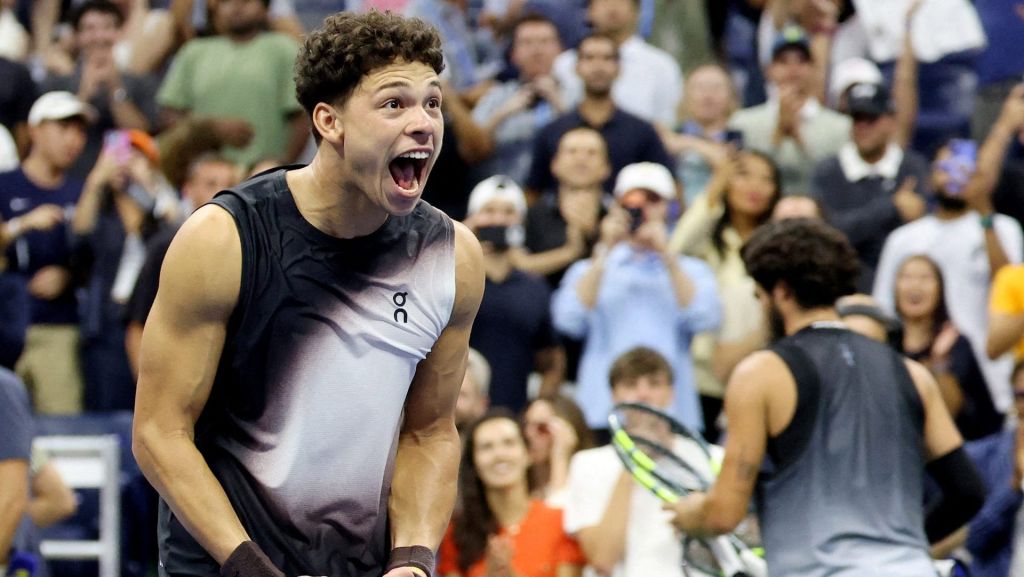
Tuesday night’s quarterfinal match in Arthur Ashe Stadium between Ben Shelton and Carlos Alcaraz, a five-set thriller that Shelton won in a last-set tiebreak, ended Wednesday at 3:34 a.m. ET—the latest finish for a match in the tournament’s history.
The match started after 11 p.m. local time Tuesday and ran for four hours and 28 minutes. It followed three other matches Tuesday in the tournament’s center court that also went the distance.
Aryna Sabalenka defeated Linda Nosková in the first match of the day that started at around 11:30 a.m. ET. The three-set shootout ran for two hours and 22 minutes, finishing in a final set tiebreak.
The second match of the Arthur Ashe Day session saw Frances Tiafoe come back from down two sets to defeat Alex Michelsen. The match ran for four hours and 39 minutes, finishing at around 7 p.m. ET—which is when the night session matches usually start.
Jessica Pegula and Emma Navarro’s match led off the night matches at around 8:30 p.m. The three-set match won by Pegula—the only one of the four that didn’t finish in a 10-point tiebreak—ran for two hours and 21 minutes.
Shelton had little complaints about the late finish after knocking out the defending champion. Alcaraz said he was “really tired” in the third set, but didn’t blame the time for his finish.
But other players have complained.
Venus Williams was upset about the 12:13 a.m. start time of her first round match against Sofia Kenin last Sunday, the latest in tournament history.
“I just don’t know any other sport where you have to start that late,” Williams, a seven-time Grand Slam champion, after the match, which ended at 2 a.m.. “I definitely think there’s room for improvement there.”
Easy Fix?
Wimbledon has a strict 11 p.m. curfew. However, the curfew does result in matches sometimes getting cut off and forced to resume the following day.
The French Open has seen some late nights, most recently in 2024 when the third round match between Novak Djokovic and Lorenzo Musetti finished after 3 a.m. Similar to Tuesday’s US Open finish, the match started late because other matches extended at Court Philippe-Chatrier, the tournament’s center court.
The night session at Roland-Garros starts at 8:15 p.m., more than an hour later than the US Open, so some matches bleed past midnight. However, there is only one night match compared to two at Arthur Ashe and another two at Louis Armstrong Stadium in the early rounds.
The Australian Open’s night sessions have the same format as the US Open, which also makes it susceptible to late finishes. The tournament has even had several matches finish later than Tuesday’s Shelton–Alcaraz contest, including the 2023 second round match between Andy Murray and Thanasi Kokkinakis that ran past 4 a.m. local time
On Monday, new Tennis Australia CEO Andrew Abdo suggested that Grand Slams may eventually consider tweaking match formats to address match length.
“Maybe in the future, Slams at different rounds or at different lengths of duration. Maybe we’re not playing best-of-five all the way through. Maybe the point-scoring system changes,” Abdo said at a conference. Abdo is the successor of Craig Tiley—who is now running the USTA and US Open.
Djokovic, a 24-time Grand Slam champion, made a similar suggestion when speaking to a creator at Fanatics Fest in July: “We should change the format of the scoring. Not play up to six games a set, play up to four, possibly no ad, best of five sets, keep the matches within the two-hour window. It’s best for everyone.”
Tennis Channel CEO Jeff Blackburn told FOS that he “doesn’t anticipate” any major scoring changes, but knows tournaments are talking about ways to address scheduling issues. However, said there are “many things” for tournaments to consider when tweaking schedules, including tickets and concessions.
The US Open market differs from other Slams given the late-night culture in New York City. Arthur Ashe still had a healthy crowd Tuesday for Shelton and Alcaraz.
“The city of New York, they showed up tonight ‘til 3 a.m.,” Shelton said after the match.
Still, Blackburn believes players’ health needs to be paramount.
“Having the players play that deep into the evening—that’s a defect that needs to get addressed,” Blackburn said.
Pegula had similar sentiments as Blackburn, citing “different aspects” including broadcasting commitments that make it difficult for tournaments to adjust. But she still believes the late finishes are not great for all parties.
“Some people stay, but there is a lot of people that need to go home. I definitely question whether there isn’t just a better way or just starting an hour earlier or just something different,” Pegula said last week.
Download the FOS App
The business of sports, in your pocket.



Scan the QR code to get the app now.