Want more from Front Office Sports
in your search results?
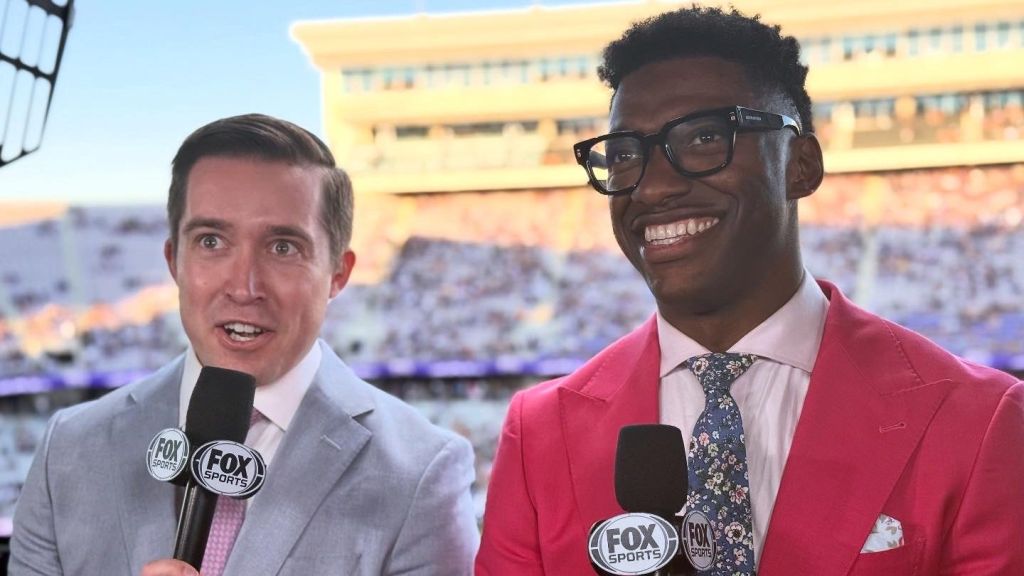
Connor Onion will call his first game as a fixture on Fox’s No. 2 college football broadcast team as Fresno State plays at USC on Friday night. Onion will be working alongside color commentator Robert Griffin III and sideline reporter Alexa Landestoy.
Ahead of Friday night’s game, Onion spoke to Front Office Sports about working with an unconventional analyst in RG3, the ascent of Ball State’s sports production program, his favorite venues in college sports, and what he hopes to accomplish in the next several years.
Front Office Sports: As you approach this new opportunity to be on one of the top college football announce teams nationally, what are your thoughts about how this culminates a dream or anything along those lines?
Connor Onion: The nice part of it about this is that I got to fill in on this crew once last year when Jason Benetti went up to the NFL for a week. So, relationships with Robert and Alexa, who I’ll be working with this year, are already kind of in place. It’s not going to feel entirely new when we take the air on Friday night, because we had a TCU-Colorado game together last year.
I’ll always remember this: Robert and Alexa, after that game last year, both pulled me aside and said, “Hey you belong. Like, you fit right in with us, and this did not feel like a fill-in game for you.”
So, I appreciated them pumping me up after that first one together, but it makes me that much more excited to build on that and have a full 15, 16 games played together rather than just the one we did together last year.
FOS: Robert is, as you know, a pretty quirky color commentator. He doesn’t really color inside the lines, so to speak. Benetti did a really good job making it look easy playing off of that. As you approach the season, how is working with somebody like that different than maybe a more traditional color analyst?
CO: I’m very, very excited about that style. You nailed it, Robert, does not color in between the lines. It’s very improvisational, and I think that made me better and more flexible from working with him last year, because it’s not just hardcore X’s and O’s for three hours. There’s going to be a pop culture reference, there’s going to be four or five different things that we haven’t talked about throughout the week that are going to be unexpected that make their way into the broadcast.
But I do feel prepared to go with the flow. I’ve done a couple games with Bill Raftery, and he’s very off-the-cuff in a different way than Robert, but it’s similar stylistically in that you don’t know what’s coming from Raft. It’s going to be quick-witted humor. It’s going to be something hardcore X’s and O’s the next time where you might not know it’s coming. So I do feel prepared, but I’m also excited about the possibilities of where this could go because I don’t know where it’s going to go exactly.
FOS: What is a good college venue that you’ve called a game in that you’re adamant everybody needs to check out on their bucket list?
CO: Colorado, when it was full a couple years ago when I was there, is—the attention that Deion Sanders has gotten obviously played a part in it—but I think that’s an underrated one. I still haven’t been to Ohio State or Michigan for a game, but, at some point I’m hopeful that we’ll get to do ones there.
The other one I’m really excited for that I haven’t been to yet is Provo, Utah. I haven’t been to BYU yet, and that’s actually where we go Week 2. I’ve heard great things. But Colorado, a couple years ago, I’d say people need to get there simply for the scenery, but when they’re good and that place is full, that’s an underrated one for sure.
FOS: What about in basketball?
CO: I always think of three in the Big Ten that popped to mind right away. The Breslin Center at Michigan State, Mackey Arena at Purdue, and then Assembly Hall at Indiana.
And I don’t want to leave the Kohl Center out. I know you’re a Wisconsin fan. But especially the way that those guys are playing now, playing more up-tempo than I’m sure when you were interacting with Wisconsin basketball as a student.
FOS: You’re a Ball State guy and this program is having a moment with guys getting some big jobs. Noah Reed just got the Nuggets job. Jack Kizer just got named to the team you were on at Fox last year. What is this program doing that is making it almost start to rival the Syracuse’s of the world?
CO: It’s interesting because we always looked at Syracuse when we were in school as the North Star of something that we’d like to turn the program into. So I think Syracuse deserves a lot of credit for setting the standard on what Ball State took on philosophically and how we approached play-by-play and how our professors taught it. Chris Taylor, the director of the program, deserves a ton of credit because he basically built that program from scratch starting in 2009.
Ball State has the history of David Letterman and the creator of Garfield, Jim Davis, that have gotten into entertainment, but didn’t really have a strong foundation of pushing people out into the sports world. But Taylor built it from the ground up, and deserves all the credit in the world for basically being an entrepreneur, but for sports media at Ball State.
FOS: How do you handle your brain when you’re calling four or five different sports at different levels and you’re crisscrossing the country and have to keep the facts and research on all of them straight?
CO: That question is very timely, especially this month. Most people think of the college crossover season being November when college football and college basketball intersect. But for me, doing MLB, college volleyball, and college football, I do feel like this is the core of my crossover season, and we’ll get there again in November, too. Like last year was college basketball, the NBA with the Bulls [filling in for Adam Amin on CHSN], and college football. But this time of year, I’m sneaking in excerpts of the rules on volleyball during one part of my flight, and then reading about Lincoln Riley and USC on another part of my flight, and then checking in on some of the baseball highlights throughout the day on the other part of the flight.
To your point earlier about being flexible when I’m with Robert in the booth, I think that’s helpful too, is being worldly and having my finger on what’s going on in a lot of different areas. That helps me on the air with partners, but that also helps me when it comes to managing three sports at the same time.
FOS: In the next three years, what’s your attainable dream event to call?
CO: I’d love to call an NFL game. And I think the other one is that at some point I’d like to be the voice of a team. I got a little taste of that with the Bulls last year filling in for Adam, and I love that connection locally that you get to have being there on a day-to-day basis. So I think those would be the two things in the near-term: an NFL game and then being the voice of the team.
FOS: The market has reset a bit as far as the money calling these local teams, whereas the pay on national-level contests is still pretty robust. Does compensation factor into those goals?
CO: I mean, it definitely does. It definitely influences what opportunities you pursue. I will say, when I first got into this, I was working in minor league baseball and making $600 a month. That was nowhere within the realm of my decision-making when I was 22.
But now I’m in a long-term relationship, and eventually we’re going to get married. So there are life goals that factor into what opportunities you pursue. But when it comes to the local jobs, I’ve had conversations with teams about possibly being their voice. But it does have to match with the national opportunity just because I love what I’m doing at Fox.
And to what we were just talking about, I love doing multiple sports too. So I’m looking for that good fit of being able to keep doing national stuff while also finding a franchise—we obviously have to mutually agree to be a partnership—but a place that will also allow me to continue to do some national stuff too.