Want more from Front Office Sports
in your search results?
At the Masters merch shop, tournament-goers wait for hours for garden gnomes, drinkwear, and Christmas ornaments. But apparel is at the heart of the $70+ million souvenir business each April. In recent years, the shop in Augusta has offered an orange hat emblazoned with the word “PIMENTO”: a reference to the cheese sandwiches served at the tournament.
It caused a frenzy on social media. Did it belong among the traditional green hats that have become a staple on and off the course? Who would go for something so bright and, in the eyes of many people, obnoxious? Not only did the hats sell out, but PIMENTO lids became so coveted that some are currently listed on resale sites for hundreds of dollars, and tens of knockoffs are also available.
Across the country, golf courses and driving ranges are now peppered with a certain, similar kind of headwear. These hats are pastel or neon, and feature cheeky sayings that are often positioned askew on a structured forehead panel. Semi-flat bills and rope accents are usually involved, too. Like the PIMENTO cap, photos of retail displays bearing these styles routinely go viral online, where commenters debate.
Headwear designers, retailer leaders, and golf professionals loosely date the look’s arrival on the sport’s scene to 2021 or 2022, when golf’s pandemic boom was at its height.
Now, headwear preference has become something of a dividing line in the golf community, separating the old guard from the influx of recent joiners, who skew much younger and more female. And with golf’s growth still very much ongoing, demand for fresh styles shows little sign of slowing. Industry players are doing what they can to keep up and cash in.
Hats are uniquely divisive due to their status as entry-price-point apparel for new players. The most controversial style is what Mark Kliethermes, senior creative director at headwear designer and supplier Ahead, which provides hats for several PGA Tour events, calls the “B.U.D.”
It’s an acronym for how the text on this kind of lid appears: backward or upside down. Dallas-based streetwear outfitter True Brvnd claims to have invented this specific design in 2020, when, per its website, “everything felt flipped.”
The look picked up steam after pro athletes including Dak Prescott and Klay Thompson were spotted sporting B.U.D. caps of their own. After a while, inverted text was appearing on all kinds of hats, including ones produced by golf brands. (Headwear, after all, “is a copycat league,” says Dave Zaleznick, GM at ‘47 brand.)
Good Good is one of the first brands that brought offbeat hat styles to golf. The Frisco, Texas–based company began as a YouTube channel in July 2020, documenting the humor and trick-shot antics of a group of regular-guy friends. The format took off, captivating an eager audience of new casual golfers who, besides hitting the course, had little else to do but scroll social media amid the pandemic. By 2021, Good Good rolled out a merchandise business, with pithy hats as the hero product.
“We’ve gone from roughly 800 to 4,000 retail doors in just the last year alone, and headwear has been a big reason for that,” says Good Good’s VP of brand and marketing Jeffrey Lefkovits. He adds the company claimed “a majority” of the top-10 best-selling hats at both Dick’s Sporting Goods and Golf Galaxy in 2025. “Hats are sort of a billboard for your identity on the golf course—even more than polos. We haven’t been afraid to experiment there, and our fans respond every time.”
Other brands, including Bad Birdie and Malbon, have also found success by appealing to a similar consumer base. So has the PGA Tour.
“The 2025 WM Phoenix Open was the first time we carried upside-down hats in one of our merchandise tents, and we sold out by the first day of the tournament,” Ariana Sypert, a headwear buyer for the Tour, tells Front Office Sports. (The hat featured the word “Sixteen,” a nod to the event’s famous party hole.)“We brought in additional inventory this year and sold out quickly again. For 2027, we’re adding even more.”
So far this year, similar styles have been snapped up at most of the tournaments the Tour has handled merch for. Like golfers themselves, Tour-event attendees are getting younger and more diverse, Sypert says, and “they’re finding the fan shop and shopping a lot.”
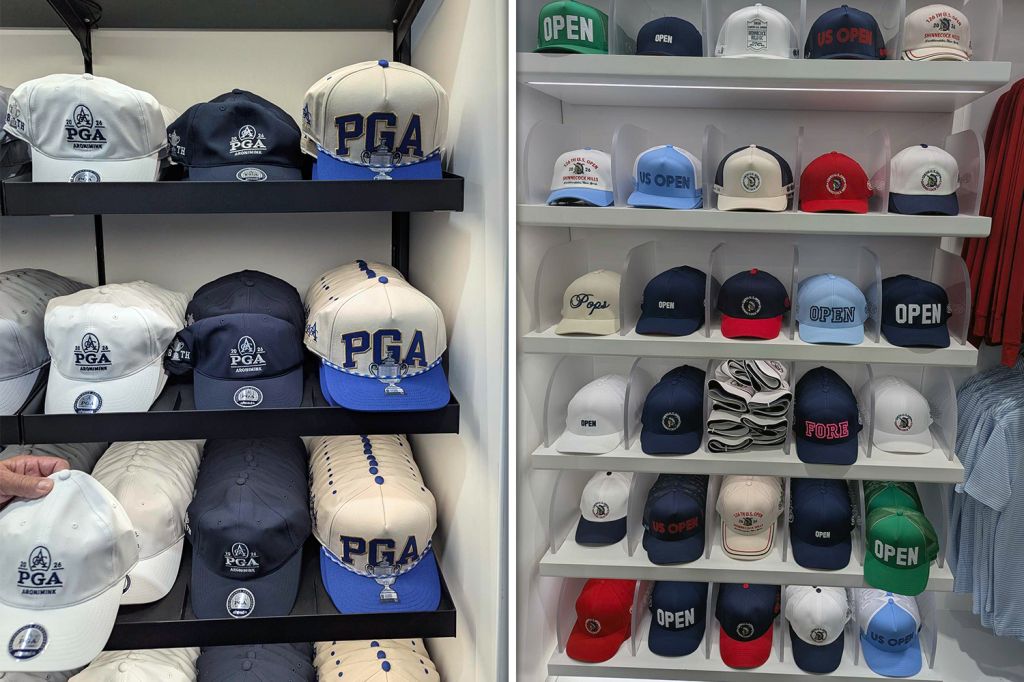
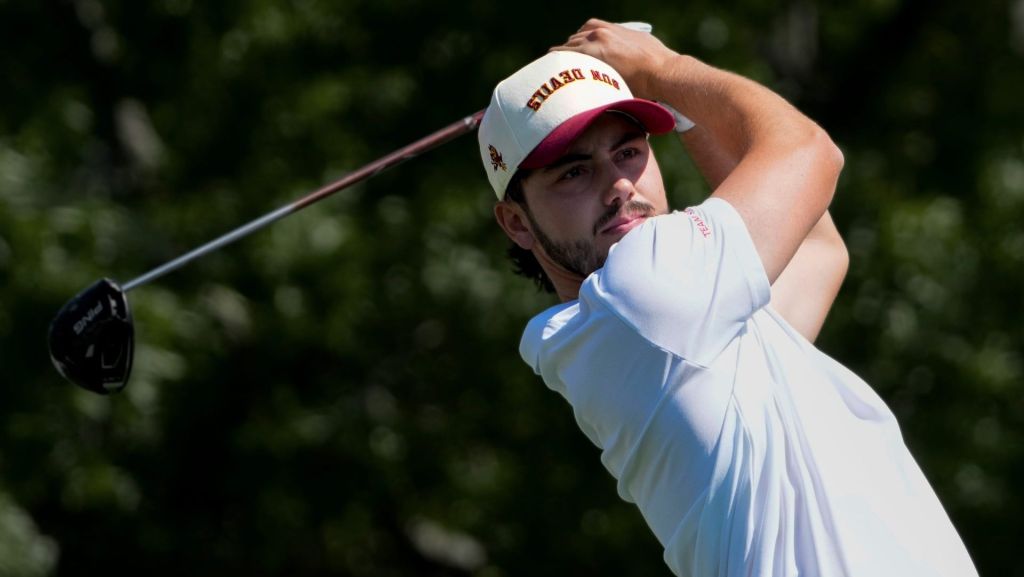
Tour events, however, are also when online discussion about headwear trends tends to heat up. An especially impassioned flashpoint came at last year’s Masters, when then-amateur Arizona State golfer José Luis Ballester wore an upside down “Sun Devils” hat.
Nick Stavas, a digital producer for Golfweek who identifies as a “golf traditionalist,” recalls the moment with some contempt: “The style is just so loud and obnoxious. The fact that it reached someone actually playing at the Masters, the pinnacle of the game—I think a lot of people, myself included, were like, ‘What are we doing here?’”
Golfers like Stavas were relieved when the tournament merch shop at July’s 2026 British Open was free of “weird block letter hats.”
Still, although The Open may have eschewed the trend, designers and buyers tell FOS that while newer player and fan segments—especially women—keep spending big, they’ll continue to create with their preferences in mind. That’s especially the case with hats, which are much cheaper and quicker to churn out than other types of apparel, and often at the forefront of trends.
Camo, PVC patches, and “flat embroidery” styles are on Sypert’s purchase radar for the 2028 season. But she adds that Tour-event fan shops will keep carrying “plenty of inventory suited to the more serious golfer.”
That divide will stick around, according to Kliethermes of Ahead. “In this new era, there are always going to be people that are comfortable with a louder, more fun aesthetic, and some people who want to keep things more polished,” he says. “It’s why brands like Bad Birdie and Peter Millar can both be hugely successful. The golf tent is only getting bigger, which is what makes it such a fun category to design into.”