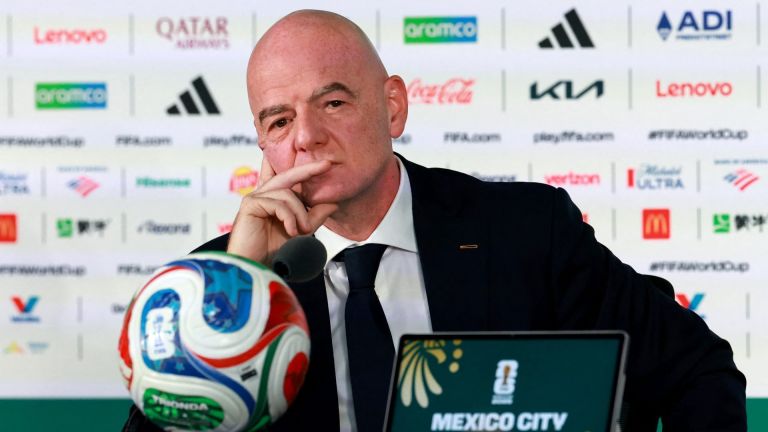
FIFA president Gianni Infantino is throwing out his plans to commercialize the World Cup with outside investors.
FIFA announced in a press release on Friday night that Infantino’s $20 billion vision of FIFA Forward Enterprise will not move forward in its current form. The three continental soccer bodies representing Europe, North America, Central America, the Caribbean, and Asia all came out against the plan to varying degrees: UEFA said it would boycott all FIFA tournaments, CONCACAF said its members “rejected” the plan, and the AFC said it joined the others “in expressing serious concern.” Two top FIFA officials also spoke out against the plan on Friday.
The New York Post first reported the news that the plan was off, while Sky Sports was the first to report Infantino’s comments.
“Having listened carefully to all the views, it has become clear that the project has created divisions of a nature that, regardless of the level of support, are no longer in the interest of the objective set out in the first place,” Infantino said. “Our purpose has always been – and will always be – to unite and improve. As a result, this proposal will not proceed.
“Moving forward, my intent is to bring all interested parties back together in the coming days and weeks in the spirit of shared interest in our game, and with the objective to continue growing football everywhere, and particularly in those countries that mostly need our support.”
Thrive Eternal, the holding company of Joshua Kushner that was set to lead the 20% stake in FIFA Forward Enterprise, did not return requests for comment.
Even with the plan dead, Infantino’s previously ironclad grip on FIFA may be loosening. On Saturday morning, UEFA put out a lengthy statement saying that its members had lost confidence in Infantino, saying the president had “failed to deliver” and been “anything but transparent” about the investment scheme.
“We cannot keep going on like this with secret schemes on fast track timescales, cooked up by faceless individuals and of dubious benefit to the game,” the statement read. “We must identify those responsible and hold them to account.” The statement pointed out that FIFA has enormous cash reserves—more than $5 billion—and that Infantino “has also failed to use associations’ money for the benefit of the game.”
CONCACAF also expressed its members’ reservations about Infantino’s reign.
“A proposal of this magnitude does not reach that stage by accident. It is a symptom of leadership that has stopped putting football first,” the body said in a statement. “This recent unilateral and egregious act of poor governance and leadership follows a pattern of missteps and similar behavior. A comprehensive reckoning with this presidency is imperative.”
A Whirlwind Week
On July 26, Infantino shared an obscure 15-slide Instagram post blasting people who were “hating” FIFA and on the World Cup, and falsely claimed the tournament had “zero incidents, zero hostility, zero violence.”
Two days later, media reports forced FIFA to announce its plan for FFE, which would have combined its media rights, partnerships, ticketing, licensing, and tournament operations into one $20 billion entity. FIFA wanted to raise $4.2 billion from outside capital, roughly a 20% stake in the business, led by Kushner’s Thrive Eternal, and claimed those investors would have minority stakes with no “operational role.” FIFA said the plan would increase payouts for its 211 member associations by millions of dollars, starting with $20 million in the upcoming World Cup cycle.
Reports then emerged that Infantino in a letter had told national federations they had until Sept. 19 to accept the proposal. Infantino also sweetened the deal, promising an additional $20 million for member associations that would accept, bringing their total for the upcoming World Cup cycle to $40 million.
Backlash was swift. UEFA immediately put out a statement condemning the plans, while CONCACAF and the AFC said they were concerned about how they had been blindsided by the announcement. The Confederation of African Football said it planned to “assess and evaluate” the proposal, while the Oceania Football Confederation said “the proposal will be considered.”
Several experts in law, corporate governance, and sports business told Front Office Sports they were concerned about FIFA’s lack of transparency, the notion of investors possibly having outside influence, the impact on fans, and possible antitrust violations.
On Thursday, UEFA held an emergency meeting in which all 55 national federations agreed to boycott all FIFA tournaments as long as the FFE proposal was still on the table. On Thursday afternoon, CONCACAF held a similar meeting, and announced its membership had “rejected” the proposal, though it didn’t go as far as a boycott. The two confederations amounted to 90 votes against the proposal; Infantino would need 106 for it to pass.
Late Thursday, FIFA released a list of “clarifications” that blamed “incorrect media reports” for getting in the way of its “planned consultation process.” This press release angered the AFC, which said Friday that despite FIFA’s clarifications, “the central concerns surrounding governance, institutional process and meaningful consultation remain unanswered.”
Rising Chorus Against Infantino’s Plan
Also on Friday, two key FIFA leaders came out against the plan.
The first was Carlos Cordeiro—Infantino’s top advisor, the former president of U.S. Soccer, and a major link between FIFA and the Trump administration—who resigned from his role due to the proposal. Cordeiro, a former Goldman Sachs banker, said the proposal was “a bad deal for football,” the sport’s future, and the member associations. He also questioned the need to raise outside capital after the most lucrative World Cup ever, and said the lack of answers to “fundamental questions” was “most troubling of all.”
The other was FIFA COO Kevin Lamour, who told the Associated Press that senior staff had been “deceived” by FIFA’s “project of one person.”
“Not only must this project not go ahead,” Lamour said, “but the time has now come for football political leaders to ask themselves the right questions and make the right decisions.”
Infantino’s close ally, U.S. president Donald Trump, essentially brushed off a question about FIFA from a reporter at Camp David on Friday. When asked if he had spoken to FIFA or Infantino about the proposal, Trump said, “No, I never spoke to him,” then turned to take the next question.
U.K. Prime Minister Andy Burnham said the proposal demonstrated Infantino is the “wrong man” to lead FIFA.
The continental bodies criticized FIFA’s lack of due process and said they were unaware of the proposal until it leaked in the media. The AFC said “football should never have been placed in such a position” where World Cup boycotts would be possible, and that FIFA needs to “undertake an urgent review of its governance and decision-making framework.” Even Cordeiro, despite being close to Infantino, said he had “no involvement” in the proposal.