Want more from Front Office Sports
in your search results?
FIFA is planning to create a commercial arm for the several revenue-generating parts of the nonprofit’s business, and sell roughly 20% of that new entity to investors.
The announcement of the $20 billion FIFA Forward Enterprise, seeking to raise $4.2 billion from outside investors this year, sent shockwaves through the soccer world Tuesday.
The strongest response came from Europe. The continental confederation, UEFA, released a statement condemning the plan, and member nations are reportedly holding an emergency meeting this week to consider boycotting future World Cups.
FFE still needs approval from the majority of the 211 national soccer federations that make up FIFA’s membership, and approvals from FIFA council. Infantino sent a letter to the member organizations saying they have until Sept. 19 to accept, according to The Times.
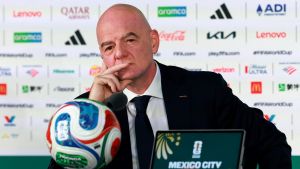
The plan would see the World Cup and other FIFA tournaments’ media rights, sponsorship, ticketing, licensing, and tournament operations all housed under the FIFA-owned company. The lead private investor would be Thrive Eternal, a holding company owned by venture capitalist Joshua Kushner, a minority owner of the Miami Heat and San Francisco Giants, and brother of U.S. President Donald Trump’s son-in-law, Jared Kushner. FIFA confirmed to The Athletic that president Gianni Infantino, who is up for reelection next year, “will and must have” a major role in leading the new entity.
FIFA’s initial announcement said each member association could make up to $20 million for the upcoming World Cup cycle, an increase from the planned $8 million. Those payouts would increase to $22 million and $24 million for the next two World Cup cycles, ensuring additional millions for each federation through 2038.
In his letter, Infantino said countries that accept by the September deadline would get an additional $20 million “fast forward” incentive, bringing their total earnings for the cycle up to $40 million. If the plan doesn’t pass, each country would get $10 million for the next cycle, which is how much he said they would receive from World Cup profits anyway.
UEFA released a new statement on the deadline and enhanced offer, saying the cutoff says “everything you need to know about this plan.”
Front Office Sports spoke with experts in law, corporate governance, and sports business about FIFA’s plan, what questions it raises, and what it could signal for the future of soccer.
‘Exclusive Objective Is Profit’
Several of the experts say it’s concerning that venture capital investors could potentially hold sway over FIFA.
“The interests of FIFA and of private equity investors hardly overlap,” corporate governance expert and Harvard Law professor Lucian Bebchuk tells FOS. “The latter’s exclusive objective is profit and this … should not be the case with FIFA.”
During the World Cup, UEFA and its member countries fumed about potential political interference after Trump openly bragged about calling FIFA to reverse U.S. striker Folarin Balogun’s controversial red card, which FIFA eventually did.
Bringing in investors invites a similar type of scrutiny, Villanova sports business professor Bret Myers tells FOS.
“If there were people that had high business stakes and they didn’t like a soccer decision, do they now have the influence to have a say in some of those kinds of decisions?” Myers says.
FIFA said in its announcement that the investors would hold a minority stake and would “not play any operational role.” But if they’re providing cash flow and demanding returns, “an investor can have leverage without having formal power,” UCLA law professor Steven Bank tells FOS.
A Lack of Transparency
FIFA said the new entity would distribute its money to member associations, then “all net benefits of FFE will be reinvested back into football worldwide.”
It did not offer any specifics or criteria for those reinvestments, and the organization did not respond to questions about where that money would go or how FIFA would decide who gets those funds.
FIFA’s critic and sometime competitor, UEFA, said in its statement that FIFA’s plan offers “zero transparency as to who gains financially.”
Bloomberg reported before FIFA’s official announcement on Tuesday that investors are not expected to see any cash returns while they are owners in FFE, and will only make money by selling their stake in the company.
In a list of frequently asked questions on its website about what FFE’s investors would receive as a return, FIFA said: “Investors would hold a stake in FFE itself, which they could sell during future tender processes overseen by FIFA. The vetting process prioritises patient, long-term capital over short-term returns, so that investors are aligned with FIFA’s long-term mission to grow the game.”
In 2015, the U.S. Department of Justice indicted dozens of FIFA officials and sports marketing executives on wire fraud, racketeering, and money laundering for illegal behavior reaching back decades. The DOJ got 31 guilty pleas and four trial convictions from the scandal.
“The worry of course with FIFA, because of its history, is that there’s some corruption going on,” UCLA’s Bank says.
Sepp Blatter, the president of FIFA at the time, was not indicted in that scandal but still stepped down. Infantino became FIFA’s next president; Blatter is now one of his successor’s loudest detractors. Blatter posted Tuesday: “The close relationship between the FIFA President and the US President has reached a financial dimension that is deeply damaging football. No one has the right to sell our game.”
Impacts on Fans
Private-equity investment is becoming increasingly common in major sports properties. While European teams eventually dropped their plan for a PE-backed, closed-off Super League after a fan revolt, leagues in France and Spain have sold stakes in new commercial entities to raise cash.
“I think on principle for them to have this approach, I don’t think that’s fundamentally wrong,” Villanova’s Myers says, “but I think they just have to be careful to make sure the business decisions don’t jeopardize the game, and the experience for the fans.”
FIFA said Tuesday that ticketing will be part of the new commercial entity, meaning that investor concerns could factor directly into ticket pricing. FIFA heavily leaned in to dynamic pricing this summer, sending ticket prices skyrocketing compared to previous World Cups—and nearly any sporting event ever.
Then there’s broadcasting rights. While Fox and Telemundo kept the vast majority of World Cup matches on free broadcast television in the U.S., FIFA is about to enter a bidding war for rights in the U.S., and subscription services could come out on top. The governing body already has a deal with Netflix for the next two Women’s World Cups.
FIFA also said that licensing would fall under FFE, potentially affecting consumer products like trading cards, video games, and other memorabilia and collectibles.
Supporters of the plan would argue individual federations getting more money would be a good thing for fans, because it builds up the sport in smaller, less historically successful soccer countries. “This is about the democratisation of football worldwide,” Infantino said.
But England, for one, is not happy. New U.K. Prime Minister Andy Burnham came out against FFE, posting, “Football belongs to the fans.” The Football Supporters’ Association, the official group representing soccer fans in England and Wales, put out a statement saying they are “furious” at FIFA’s “new low.”
“This cannot become another step in Gianni Infantino’s attempt to reshape football without regard for supporters or the wider game,” the FSA said.
Antitrust Element
Brian Anderson, who co-leads the sports practice at law firm Sheppard Mullin, tells FOS that from FIFA’s perspective, it’s a “smart move” to try to capture more of its value. But one risk factor he sees is a potential antitrust complication.
In its statement Tuesday, FIFA said that in addition to owning FFE, it would hold on to “exclusive authority over football governance, competitions, the international match calendar and all regulatory and sporting decisions.”
Anderson says that “being the regulator and also being the commercial operator within the area you’re regulating” often raises questions, and even if FIFA doesn’t have an antitrust problem with FFE, “that fact pattern usually gets some attention.”
One of the commissioners of the European Union’s executive body, Glenn Micallef, also said FIFA’s proposals “raise important competition law considerations.”
FIFA may have already been dancing in this territory anyway, says Marc Edelman, an antitrust expert and sports law professor at Baruch College and Fordham University.
“I believe that FIFA has antitrust exposure irrespective,” Edelman tells FOS, “both under the old structure and under the new structure.”
Download the FOS App
The business of sports, in your pocket.



Scan the QR code to get the app now.