Want more from Front Office Sports
in your search results?
Spain is home to soccer royalty.
Real Madrid and Barcelona are the two biggest clubs in the world by revenue. The winner of the Ballon d’Or, the award for the world’s best player, typically belongs to a Spanish club. Catalonia-born Pep Guardiola is the most influential coach of the past 40 years. And on the national level, Spain’s side has won three of the past five European Championships.
But Spain is not one of the World Cup’s historically dominant teams.
Its record does not compare to those of Brazil, Germany, or Argentina. Between 1950 and 2010, Spain won a total of three knock-out matches, and never progressed beyond the quarterfinals. Then, in 2010, it made the leap to World Cup winner.
What Spain has achieved in the past two decades is unprecedented. It has not only made the leap from fodder to frontrunner, but also completely changed the way its national team plays—setting itself up as the favorite going into Sunday’s World Cup final against Argentina.
Transitioning Tactics
Throughout its lean years at the World Cup, Spain sought to make itself a physical, aggressive team. It was known as la furia roja, an echo of the name given to Spanish lootings of cities now in Belgium and the Netherlands in the 16th century.
Domestically, Spanish soccer was tough.
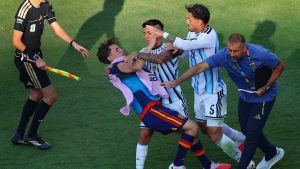
When Argentina’s Diego Maradona arrived in Barcelona for a world-record fee of £5 million in 1982, he was treated mercilessly. In a match at home to Athletic Bilbao, defender Andoni Goikoetxea, also a regular for the national team between 1983 and 1988, tackled Maradona from behind and broke his ankle. Athletic won LaLiga in each of Maradona’s two years in Spain while playing la furia style. They also defeated Barça in the final of the domestic cup in 1984. Aggrieved by further rough treatment, at full-time, Maradona’s patience ran out and he instigated what became a mass brawl.
César Luis Menotti, who coached the victorious Argentina team at the 1978 World Cup and managed Barcelona and Atletico Madrid, later said that Spanish football improved when it realized it was better to be the bullfighter than the bull. But it took another foreigner—a Dutchman, Johan Cruyff—to show Spain how it could be done.
Art and Science
Cruyff had played for Barcelona with distinction for five years in the 1970s. But it was his appointment as the club’s coach in 1988 that proved most influential. He remade the club from the ground up.
At the time, Barça was down on its luck, having won just one league title in the previous 15 years. It did have one advantage, however, which Cruyff was determined to exploit. A decade earlier a forward-thinking scout had sought to build the best cantera (academy) in Spain. La Masia did not just offer after-school training and weekend matches for local kids. It drew in the most talented boys from further afield by offering accommodation and a traditional education in parallel.
But Cruyff believed La Masia, like the rest of Spanish soccer, was looking for all the wrong things. He wanted to recruit smaller players, as he believed their physical disadvantages forced them to be better with the ball. He scrapped strength training and endurance runs and replaced them with ball drills. Cruyff’s influence transformed La Masia into what soccer writer Simon Kuper described as “the university of the pass.”
It took a full generation for Barcelona (and then the Spanish national team) to fully embody Cruyff’s vision. Pep Guardiola spent six years at La Masia, played for the first team for a decade, and took over as coach in 2008. His team—built around 10 La Masia graduates—redefined how football could be played, a possession-heavy style that came to be known, to Guardiola’s irritation, as tiki-taka.
The Royal Spanish Football Association (RFEF) awoke to the possibilities that the change brought.
It encouraged the progression of coaches from youth teams to senior sides, and ensured that the cost of qualifications was affordable. “The respect shown for coaching as an art and a science is all part of this mix,” explains Alex Stewart of Analytics FC, a soccer data consultancy. “You can see the long-term impact of this in the recent Spanish dominance of elite level coaching.”
For the national side, a veteran coach, Luis Aragonés, did much of the difficult work.
He pushed the golden boy of Spanish football in the 1990s and 2000s, Real Madrid striker Raúl, into international retirement and introduced more La Masia boys into the team. A hybrid side, featuring Xavi, Andrés Iniesta, and Cesc Fàbregas from La Masia, alongside more traditional types, such as Carlos Marchena and Joan Capdevila, won Spain’s first senior title of the modern age at Euro 2008.
His successor, Vincente del Bosque, added three more from La Masia—Gerard Piqué, Sergio Busquets, and Pedro—to the team for the 2010 World Cup. This side lacked the goals that Lionel Messi brought to Guardiola’s Barcelona, but they were so good at denying their opponents the ball that they were able to win each of their knock-out matches 1–0. La Roja dropped the “furia” and became the best in the world.
Ascending to Dominance
The dominance of tiki-taka at both club and international level forced Guardiola’s rivals to try to bring it down.
Portuguese coach José Mourinho decided he was content for his teams to have minimal possession, provided that their defense was stout and they were lethal on the counter-attack. Germany’s Jürgen Klopp showed it was possible to press Guardiola’s teams so incessantly that they would cough up possession and leave themselves exposed.
Spain clung dogmatically to tiki-taka for too long. There was a group-stage exit from the World Cup in 2014, and round-of-16 defeats to inferior teams on penalties in 2018 and 2022. A spark was relit in 2024, when the team added Nico Williams and Lamine Yamal and swapped sterile possession for a greater attacking threat.
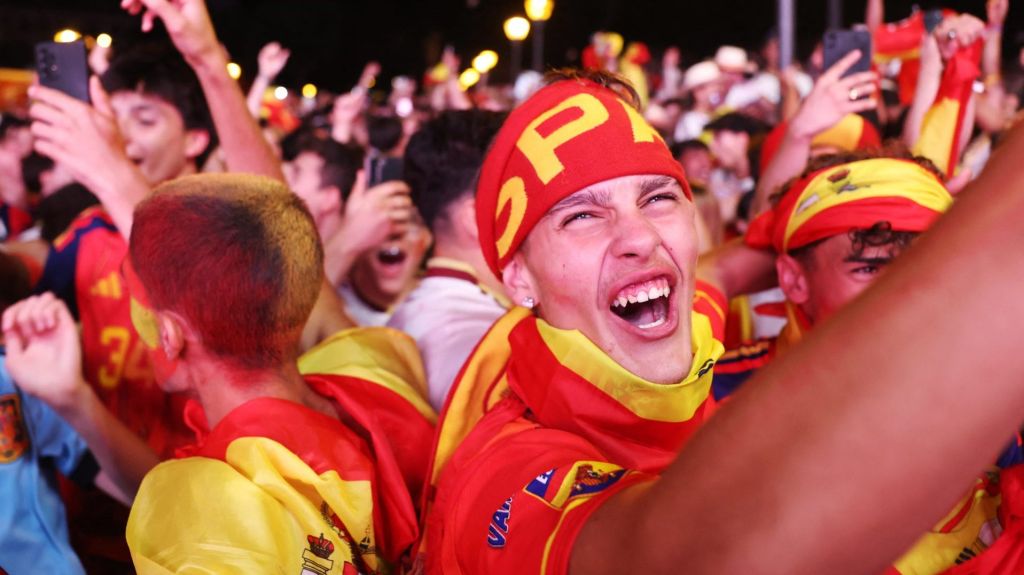
It worked effectively, and Spain became continental champions for the first time in 12 years.
The 2026 Spanish iteration has made a virtue out of necessity. Neither Williams nor Yamal has been fit enough to start regularly. The team has reverted to hogging the ball—no side that has reached the round of 16 has a higher possession percentage than Spain—and exploiting the moments that their passing pulls their opponents out of position. It was this approach that produced the second goal in the semifinal against France, and sealed Spain’s passage to their second World Cup final.
Their coach, Luis de la Fuente was in the Athletic squad for those brutal matches against Maradona’s Barcelona in the 1980s. He managed Athletic against Guardiola’s Barça at the end of the 2000s. And since 2013, he worked for the RFEF as a youth-team coach, until being promoted to lead the senior team in 2022.
There is no coach at the World Cup who has known his players for longer. It would be fitting for de la Fuente, who himself neatly encapsulates 50 years of Spanish football, to put Spain back on top of the world.
Download the FOS App
The business of sports, in your pocket.



Scan the QR code to get the app now.