Want more from Front Office Sports
in your search results?
ATLANTA — Players and coaches tried to downplay the emotional and political tensions ahead of the semifinal between England and Argentina.
Players said it was just a football match, and the contentious rivalry of the late-20th century was before their time.
But the moment the final whistle blew, Mercedes-Benz Stadium turned into an emotional and politically charged gathering.
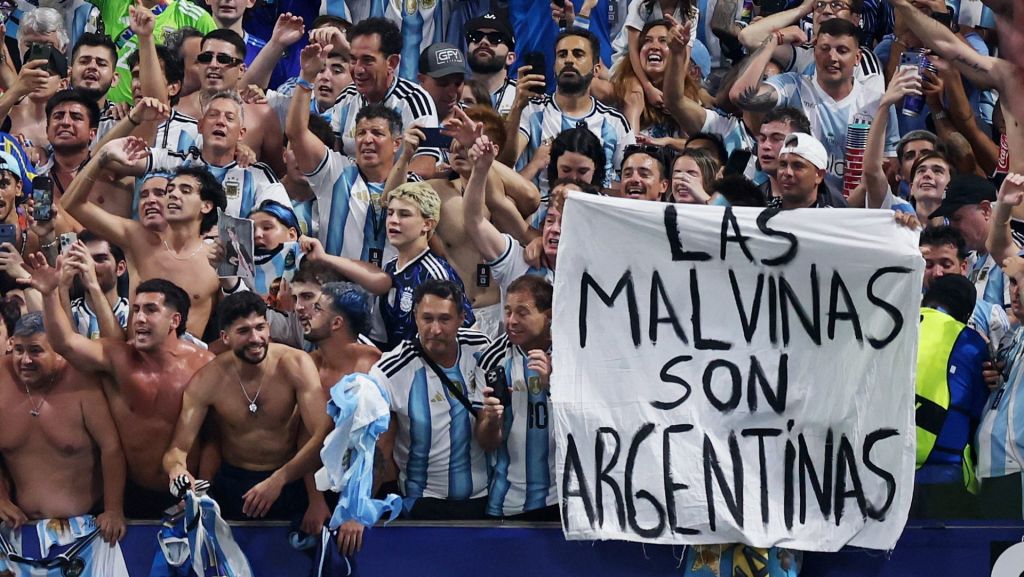
Decades before Wednesday’s match, England and Argentina fought in the Falklands War, after Argentina invaded and unsuccessfully tried to take over the Falklands Islands in 1982. In England, arguably the bigger sore spot with Argentina is Diego Maradona’s “Hand of God” goal, but the two-month war looms large in Argentine memory. The islands, called “Las Malvinas” in Spanish, are frequent themes in soccer supporters’ songs, and signs littered throughout the country read “Las Malvinas Son Argentinas.”
Even Maradona called his handball goal “symbolic revenge” for the war.
After the win, as Argentine supporters sang and danced in the stands, the Argentina players laid down a banner on the pitch reading “Las Malvinas Son Argentinas” (“The Falklands Are Argentine”). Thousands of fans joined the players in jumping and singing “El que no salta, es un Inglés!” (“Whoever doesn’t jump is English!”).
FIFA said in a statement on Thursday that it is looking into the post-match demonstration.
“As is standard procedure, FIFA’s independent Disciplinary Committee is currently assessing the match reports and considering the relevant circumstances before deciding on potential further steps based on the FIFA Disciplinary Code,” a spokesperson said.
FIFA previously didn’t punish players for singing a popular supporters song that includes lyrics about the Falklands after the win over Egypt.
FIFA’s stadium code of conduct for the 2026 World Cup bans any items including banners and flags that are of a “political, offensive and/or discriminatory nature” that use any words that discriminate on account of “political opinion or any other opinion.” It also says people in the stadium cannot “curse or chant in a political, offensive and/or discriminatory manner or use foul or abusive language or obscene gestures.”
As players celebrated in the locker room after the match, defender Lisandro Martínez was draped in an Argentine flag featuring the outlines of the Falkland Islands above the word “Nuestra” (“Ours”).
Midfielder Leandro Paredes was asked about the “Malvinas” banner after the match and said in Spanish that the islands “will always be Argentine.”
Outside the stadium, videos emerged on social media of several physical altercations and verbal clashes between fans.
The Falklands and the roughly 650 Argentines who died during the war are constant fixtures in the songs chanted at matches, fan celebrations, and the players’ locker room:
- “El que no salta, es un Inglés!” (“Whoever doesn’t jump is English!”)
- “En Argentina nací, tierra de Diego y Lionel, de los pibes de Malvinas que jamás olvidaré” (“In Argentina I was born, land of Diego and Lionel, of the boys of the Falklands that I will never forget”)
- “Por Malvinas, por el Diego, por la última de Leo” (“For the Falklands, for Diego, for Leo’s last one”)
Years after the war, the Falklands are still part of the United Kingdom, but Argentina continues to contest the U.K.’s claim. Politicians from both countries made dueling statements about the territory in the lead-up to Wednesday’s match.
After the final whistle, the Argentine government’s foreign ministry posted a statement on social media that did not acknowledge the semifinal, but denounced what it claimed were recent unannounced movements by an “illegal” British ship in its waterways, which Great Britain denies. The statement, written in Spanish, said the government “reaffirms” its right over the Falklands, and ended with the same four words as the players’ banner: “las Malvinas son argentinas.”
Download the FOS App
The business of sports, in your pocket.



Scan the QR code to get the app now.