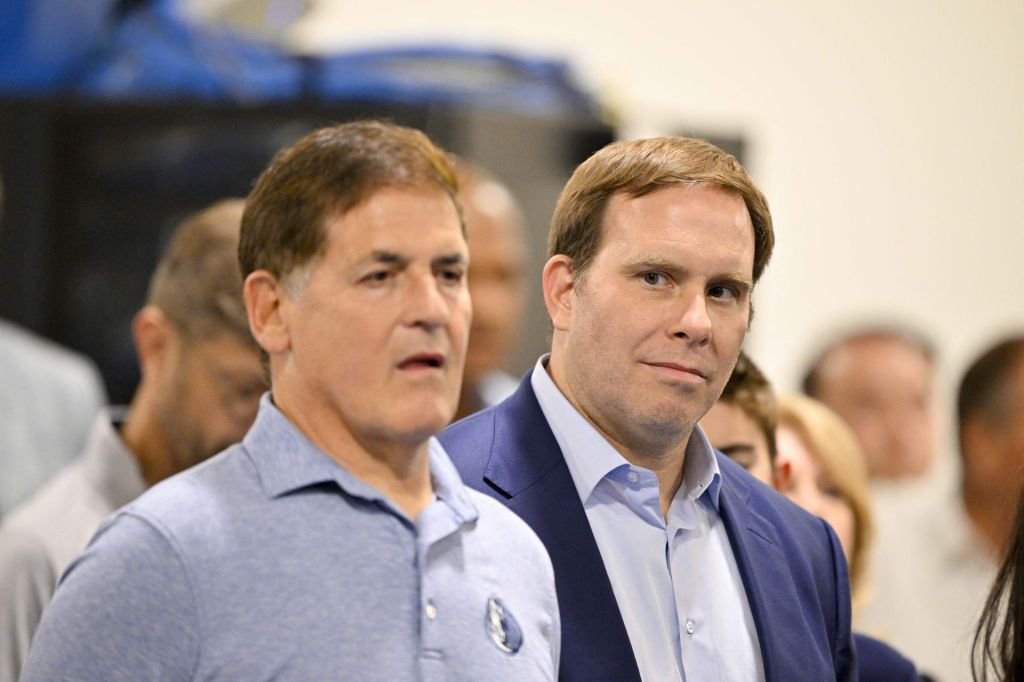
Mark Cuban is laying the groundwork for a potential lawsuit over plans for a new Mavericks home arena. His recent legal filing, first reported by Mavs Roundtable, aims to obtain information he says could show that new Mavs majority owner Patrick Dumont unlawfully cut him out of opportunities after he sold his majority stake.
Cuban’s Rule 202 petition, filed in Texas state court, is not a lawsuit. It’s a precursor to a potential lawsuit.
The filing mentions multiple issues, with a focus on the Mavericks’ new arena plans, and seeks to compel the deposition of a “corporate representative” for Arena Development Intermediate (ADI), the Delaware-incorporated entity that Dumont’s ownership group formed to pursue a new arena. The petition also asks for “one narrow set of documents” related to that pursuit.
“If Cuban is considering suing for fraud, then he will have to prove the other side’s intent—that they intentionally misled him,” says David Coale, a partner at Texas-based law firm Lynn Pinker Hurst & Schwegmann LLP.
“That’s always tricky to do and even more challenging if you don’t have visibility into what the other side’s thought process really was,” Coale tells Front Office Sports. “This way, you get some of those cards on the table without beginning a full-blown lawsuit.”
According to Coale, it’s going to be at least “several weeks” before any potential lawsuit is filed. First, there must be a court hearing on the petition. Then, if Cuban’s requests are granted, the Dumont side will get time to respond with the requested material. Finally, Cuban and his advisors will look through those materials to determine whether or not to file an actual lawsuit.
For Cuban to get the information he wants, he has to convince the judge he is “not just fishing around, but looking for something specific that really would influence whether a suit is filed or not,” Coale says.
“Dumont did not live up to his end of the bargain”
Cuban agreed to sell his majority stake in the Mavericks in 2023 at a $3.5 billion valuation; he still owns a 27% stake in the NBA team.
This is his first legal action over selling the team, but hardly the first time he has expressed frustration with the sale. In March, he said on a podcast that while he doesn’t regret selling, “I regret who I sold to.” In April, he told Front Office Sports he would like to buy back majority control, but that Dumont and the Adelson family aren’t selling: “What happened was a bunch of people had contacted me; they weren’t happy with the way things were. And I was like, ‘Look, if you can get them to sell, I would be more than happy to contribute my equity… But I didn’t expect that to materialize. I told them I didn’t think it would happen, that I didn’t think the Adelsons had any interest in selling. And they don’t.”
The petition reiterates something Cuban has said publicly: that the deal originally called for him to continue overseeing basketball operations for Mavericks while Dumont would be in charge of the business side of the franchise, including real estate development.
NBA commissioner Adam Silver has said “any decision as to what Mark’s role would be in basketball operations was a function of an arrangement to be made between Mark Cuban and Patrick,” and that there was no provision in the final deal stating Cuban would continue to oversee basketball operations.
According to Cuban, he and Dumont had a “handshake agreement” that Dumont later went back on.
“Unfortunately, Dumont did not live up to his end of the bargain,” the petition says. “Contrary to their agreement, Cuban did not retain control over basketball operations, as the Luka Dončić trade disappointingly confirmed. Instead of honoring his handshake deal, Dumont effectively turned control of the team over to former General Manager Nico Harrison, telling Cuban: ‘Why would I give you control of a $4 billion asset?’”
But Cuban’s petition is not meant to relitigate whether he had a handshake agreement to oversee basketball operations. It uses that and other examples—such as the lawsuit Dumont filed against the NHL’s Stars in a dispute that was also related to a potential new arena—to illustrate his claim that Dumont is cutting him out of the new arena deal.
Cuban’s filing comes just over one month after the Mavericks announced they have “entered into option agreements for the potential purchase of approximately 104 acres at the former Valley View Mall site” in Dallas.
The petition says Cuban was not notified of the Valley View Mall opportunity, and notes that Dumont formed ADI in Delaware, which “does not require” public disclosures that would be necessary in other jurisdictions. Cuban says ADI has continued to pursue additional opportunities related to the potential arena site, including trying to buy a nearby Chuck E. Cheese.
“Petitioners have been unable to ascertain the scope of ADI’s involvement in the New Arena and business opportunities related to it, as well as the corporate structure and ultimate ownership of ADI,” the petition says.
Cuban is seeking court intervention before Arena Development Intermediate can complete any deal, saying “once the transaction closes, unwinding it will be difficult or impossible. Petitioners will be left with only a damages remedy for a unique investment opportunity in which they were contractually entitled to participate.”
A representative for Dumont declined to comment, and Cuban declined to comment beyond what is included in his petition.