Want more from Front Office Sports
in your search results?
MLB will not discipline the Giants pitchers who wrote Bible verses on their caps during a recent Pride Night, with the league pointing to a “lapse in communication” between the team and its players that created a political issue for the league.
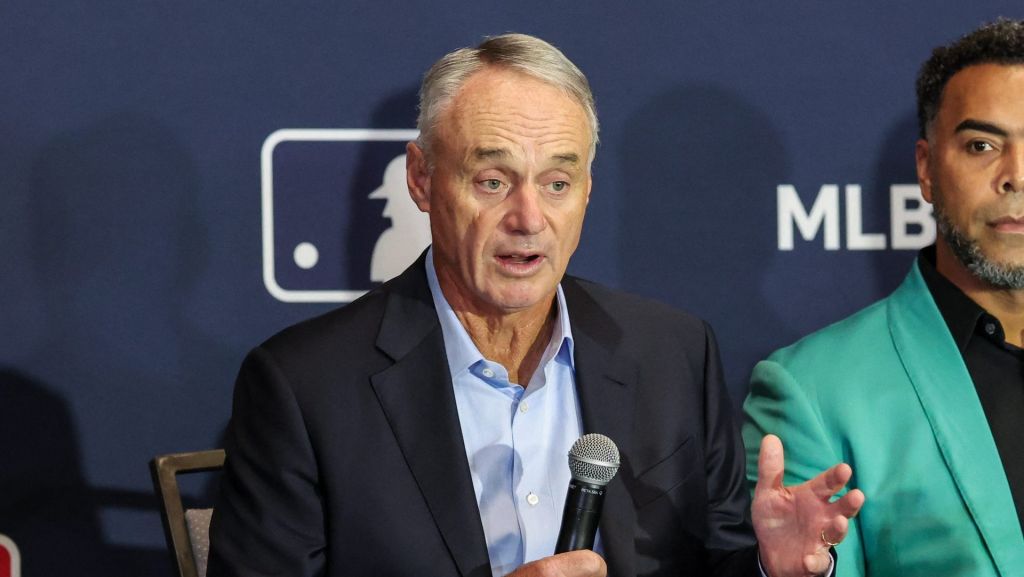
In a response letter to Sen. Josh Hawley (R., Mo.), league commissioner Rob Manfred said the Giants did not outline to its roster that participation in the June 12 Pride Night was voluntary. What wasn’t permissible, though, was adding personal messages to their uniforms—something that is a collective bargaining issue between MLB and the MLB Players Association.
The league issued warnings to those players, a move that prompted Hawley to accuse MLB of a “pattern of discrimination” against Christian players. The U.S. Department of Justice also initiated an investigation into the issue, and referred it to the Equal Employment Opportunity Commission. Manfred, however, insisted Hawley’s claims weren’t accurate, and blamed the Giants for not correctly explaining uniform rules to their players.
“Unfortunately, this year the Giants’ communication with players was inadequate and not clear,” Manfred wrote in the three-page letter that was shared by Hawley on social media late Monday. “Some players apparently did not understand that they had the option to wear their normal uniform and elected to add messages to their hats bearing the pride logo as a result.”
The players were not punished or fined, and Manfred said “nor will they ever be.”
Broader Landscape
The back-and-forth between Hawley and Manfred highlights the league’s delicate dance around Pride Night events, which involves anti-discrimination policies, the free speech rights of individual players, and uniform policies that are collectively bargained.
In 2023, the league adopted a policy that prohibited clubs from using special uniforms, caps, or equipment outside a dozen designated events during the season such as Mother’s Day, Father’s Day, and Lou Gehrig Day. The only generally permitted exceptions to that are patches honoring recent deaths and milestones.
The Dodgers and Giants, however, obtained grandfathered exceptions to that rule, in part because of their long history of doing events with their local LGBTQ communities. Those exceptions were allowed under the provision that no player or uniformed staffer that wished to not wear the Pride Night emblem would not be forced to do so—a nuance that Manfred says the Giants did not properly tell their players about.
“We believe that a policy permitting our clubs to celebrate or honor segments of its fanbase, yet does not require players or other on-field personnel to directly participate in the celebration in ways that make them uncomfortable, strikes the right balance,” Manfred said. “We also believe that is crucial to maintain our policy prohibiting uniform alterations of any type, no matter how positive, to avoid the problems associated with censoring some messages but not others.”
Download the FOS App
The business of sports, in your pocket.



Scan the QR code to get the app now.