Want more from Front Office Sports
in your search results?
Ten professional sports unions—led by their umbrella organization, the AFL-CIO—have come out with major criticisms of the Protect College Sports Act, according to a statement shared with Front Office Sports Thursday.
The statement came in the middle of a Senate Commerce Committee markup to consider amendments to a fresh version of the bill. The Commerce Committee voted 19-9 to send it to the full Senate floor Thursday morning.
The bill, introduced by Sens. Ted Cruz (R., Texas) and Maria Cantwell (D., Wash) and co-sponsored by Sens. Eric Schmitt (R., Mo.) and Chris Coons (D., Del.) would codify NIL and revenue-sharing rights, as well as health and safety standards and Olympic sports protections. But it would also establish limits on player compensation, transfers, and eligibility, give the NCAA and conferences antitrust protections to enforce these rules, and overrule any conflicting state laws.
College athlete advocacy groups have come out against the bill, saying it would implement restrictions on players that would normally be negotiated through collective bargaining.
And until this week, professional sports unions had refrained from taking a stance.
The AFL-CIO, the largest federation of labor unions in the U.S., said more work needs to be done on the bill. “As written, the bill further silences college athletes’ voices on the job, undermines their right to collective bargaining to improve their workplace conditions, jeopardizes fair compensation and stops states from passing laws that would protect and advance their rights,” the group wrote. It was signed by the NFLPA, WNBPA, MLBPA, NHLPA, MLSPA, NWSLPA, USLPA, PHPA, NLLPA, and PWHLPA.
The statement outlined a few critiques. First, it says the bill limits athlete compensation “without any negotiations or collective bargaining,” doesn’t go far enough to preserve Title IX, and prohibits states from passing laws “that would advance college athletes’ worker rights.”
In an interview Thursday, NWSLPA executive director Meghann Burke told FOS she opposes the bill because “it’s an anti-union, anti-worker bill.” She added: “Any union that supports collective bargaining rights is going to oppose any bill that restricts workers of those rights. And that’s exactly what this bill does.”
On Tuesday the NFLPA and NBPA sent a joint letter praising aspects of the Protect College Sports Act. In that letter, the unions wrote they “appreciate the bipartisan effort that has gone into developing the Protect College Sports Act … and believe that the bill includes several important provisions designed to protect college athletes, including guaranteeing NIL rights and providing medical and healthcare benefits.” The statement did not explicitly endorse the bill, adding: “We encourage continued meaningful stakeholder engagement and negotiations to further strengthen the bill as it moves through Congress to ensure college athletes are protected and empowered.”
Still, the Senate Commerce Committee counted it as an endorsement. The committee posted a list of organizations they described as “supporting” the bill, which included the joint statement. The AFL-CIO statement made Thursday took a stronger stance against major provisions in the bill.
It’s not the first time these league unions have come out in favor of college athlete collective bargaining rights. In 2023, the NFLPA and NBPA—along with the player unions for the NHL, MLB and MLS—endorsed collective bargaining rights.
Collective bargaining efforts have been slow. To start, college athletes have not been declared employees. Two cases at the National Labor Relations Board that may have resulted in players being able to unionize were dropped after President Donald Trump took office. Meanwhile, multiple college athlete advocacy groups have spent years jockeying for the ability to become a bargaining unit.
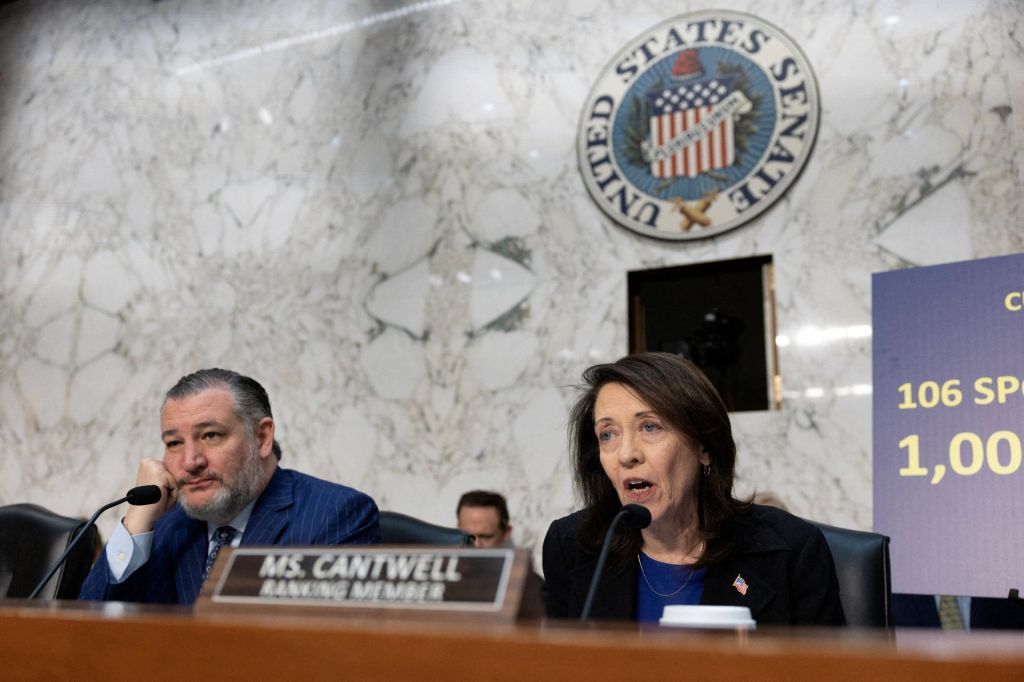
During the markup, Cantwell said she’s “supportive of a concept” of collective bargaining. But she added she didn’t think it was workable at this point, given that many believe it would require state employees to be allowed to collectively bargain. “Having a bottom-down approach here in the U.S. Senate, where someone thinks we’re going to pass a mandate by the federal government that state employees would be mandated by the federal government to collectively bargain, wouldn’t happen anytime soon,” she said.
Coons previously told FOS he believed the athletes rights protections offered in this bill were better than waiting for collective bargaining, which could be years away. “Do you want the opportunity to get these protections right now?” he said. “Or do you want to wait for a future potential opportunity to collectively bargain over those same protections? I think, get those protections now.”
Of Coons’s comments, Burke said: “From where I sit that sure sounds a whole heck of a lot like what we heard in the old days of the NWSL, when owners told players to be grateful for what we’re willing to give you.”
To date, no professional sports unions have engaged in athlete organizing efforts of their own—at least publicly. But for now, they’re publicly supporting it. “We stand ready to support workers in organizing themselves and believe we can provide strategic advice and support for them to do it themselves,” Burke said. “I can assure you that question is an ongoing conversation, not just at the NWSLPA but writ large.”
Pro Leagues Support the Bill
The NFL, NBA, and MLB released statements praising aspects of the bill.
In a statement Tuesday, the NFL said it “applauds” the bipartisan efforts of the senators who authored and sponsored the bill. “By utilizing proven models like the voluntary pooling of media rights under the Sports Broadcasting Act, which supports broad, fan-friendly distribution of NFL games, this legislation will support college athletics and ensure fans will be able to access their favorite games across today’s changing media landscape. The league looks forward to continue working with Congressional leaders as this bill moves through the legislative process.”
On Wednesday, MLB chimed in. “On issues such as player eligibility, the Protect College Sports Act will help to ensure its continued growth, which is good for all levels of the sport,” MLB said in a statement shared with FOS. “We congratulate Senators Cruz, Cantwell, Schmitt, and Coons for coming together in a bipartisan fashion to address issues facing college sports.”
On Wednesday night, the NBA followed suit, calling the bill “a positive step.”
In a statement to FOS, the NHL says it “supports the bipartisan Protect College Sports Act. The NHL has a longstanding interest in the continued strength of the college hockey ecosystem and supports efforts -like this bill – that promote competitive balance, protect educational opportunities, and provide certainty around student-athlete participation and eligibility.”
Representatives for the WNBA, NWSL, and MLS did not respond to requests for comment.
Download the FOS App
The business of sports, in your pocket.



Scan the QR code to get the app now.