Want more from Front Office Sports
in your search results?
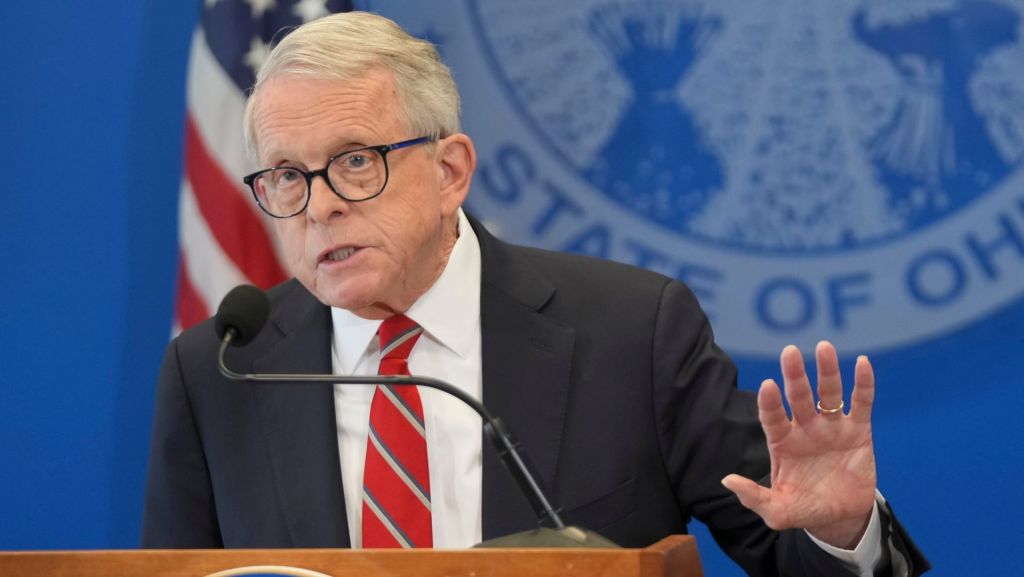
The NCAA is suing Ohio Gov. Mike DeWine.
On Friday, the organization filed a 39-page federal complaint in the Southern District of Ohio challenging the legality of DeWine’s recent executive order over college athlete eligibility. The lawsuit asks a federal judge to declare the EO unconstitutional and against state law, and to prevent DeWine’s office from enforcing it.
DeWine’s order, signed Tuesday, came in response to the NCAA’s new age-based eligibility policy, which allows players five years to complete five seasons of competition starting on their 19th birthday or when they enter college, whichever comes first. But because the NCAA chose not to allow players who started college in 2022 and completed four years a fifth season, hundreds have begun suing.
DeWine’s EO said schools in Ohio could not prevent this class of players from having a fifth year, so long as they fell within the age requirements and did not have experience playing professional sports.
“If state courts—or governors—can unilaterally change the rules to give certain schools competitive advantages, it will become impossible for all schools to compete on a level playing field,” NCAA president Charlie Baker said in a statement Friday. He also noted he believed the EO violated state law. “I know something about this,” said Baker, himself the former governor of Massachusetts.
Representatives for DeWine’s office and the office of Ohio Attorney General Andy Wilson did not immediately respond to requests for comment.
The NCAA’s lawsuit, which the governing body said was filed at the direction of its Board of Governors and Division I Board of Directors, calls the EO a “misguided attempt to give Ohio colleges and universities an unfair, unprecedented, and unwarranted competitive advantage in stadiums and arenas throughout the country.”
In its court filing, the NCAA argued the executive order “cuts at the heart of fair competition,” and said that if the order were allowed to stand, it would give schools in Ohio a “decided competitive advantage” over other schools across the country by allowing a group of athletes eligibility only for Ohio schools. The court filing also acknowledged a concern that other state governors could follow DeWine’s lead—something the NCAA is trying to prevent.
The case also acknowledges that DeWine’s executive order has already had a direct impact on Borovicanin v. NCAA, the first lawsuit filed by players from the freshman class of 2022 seeking a fifth year. Though they initially obtained an injunction to play, the NCAA was successful in getting the ruling overturned at the appeals court level. But on Wednesday, the Supreme Court of Ohio took notice of DeWine’s order, asking for an explanation of how it might influence the ultimate decision in the Borovicanin case.
Also on Friday, the NCAA used the Ohio legal battle to lobby for the Protect College Sports Act, sweeping bipartisan legislation that passed the Senate in September and will be taken up by the House in November. The PCSA wouldn’t moot litigation filed before it passes, but it would enshrine the NCAA’s age-based eligibility policy into federal law and give the NCAA an antitrust protection to enforce it in the future.
“While we are confident our complaint will succeed in federal court, the answer to this state-by-state and court-by-court race to the bottom is the bipartisan Protect College Sports Act,” Baker said. “I encourage every NCAA member to contact their Representative in Congress to pass this bill now so college athletes can be sure they’re playing with the same rules as their opponent.”
Download the FOS App
The business of sports, in your pocket.



Scan the QR code to get the app now.