Want more from Front Office Sports
in your search results?
Last week, the Big 12 board—consisting of all 16 university presidents and chancellors—voted to approve a five-year business partnership between the conference and RedBird Capital Partners, Front Office Sports has learned.
The goal of the deal, which was first reported in December, has three components. First, the two will work together on commercial development to source extra revenue for the conference. Second, the conference will receive a $12.5 million capital infusion to aid with revenue generation; this will also allow the Big 12 to become an investor in other companies to earn revenue. Third, individual schools will have access to up to $30 million each.
Private investment firm Weatherford Capital is also an investor in the deal. Moelis & Co. assisted with brokering the deal.
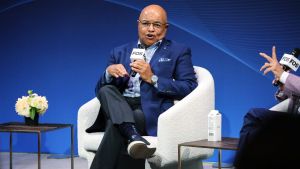
“I do believe in times of uncertainty you want to have a strong bench behind you,” Big 12 commissioner Brett Yormark told FOS. “And we’ve got a strong bench now.”
RedBird Capital is a private-equity firm, but the deal doesn’t constitute a private-equity investment. RedBird won’t take an ownership stake in the Big 12 or a stake in its revenues, nor will it have any operational oversight into the Big 12.
Last May, Yormark told FOS that the conference’s presidents and chancellors were not interested in a private-equity deal. But because this deal did not offer equity or ownership stakes, many Big 12 members were in favor of it, a source previously told FOS.
The first part of the deal: RedBird will provide expertise and assistance with procuring additional revenue streams for the conference, including things like sponsorships or more involved investment opportunities. These deals could include both opportunities within RedBird’s existing portfolio or outside of it: For example, in an informal capacity last year, RedBird helped the Big 12 finalize a deal with the nonconference basketball tournament Players Era, a company owned by EverWonder Studio, which is owned partially by RedBird.
In addition, RedBird will give the conference $12.5 million to be used for revenue-generation opportunities. In essence, the league can use some of the capital to become an investor in its own right, striking deals with companies it believes will provide additional revenue streams for the conference.
The third part of the deal: Individual schools can get a capital infusion akin to a line of credit. RedBird is offering up to $30 million in investment for any Big 12 school. None is required to take the money, but if they do, the deal would be between RedBird and the school. The conference would withhold a portion of their annual school distribution for RedBird on an annual fixed repayment schedule. (However, these withholdings would theoretically be covered by the extra revenue RedBird would help generate at the conference level, sources previously told FOS.)
Between December and April, the Big 12 negotiated more favorable terms for this deal than were previously reported, a source familiar with the matter told FOS. The repayment schedule for the Big 12’s capital infusion will be at a fixed rate over the five years of the deal. The conference office will also pay a $1.25 million annual retainer fee. All of these fees are considered standard industry practices.
Finally, the deal includes a noncompete of sorts: RedBird has also agreed to not partner with any other power conferences in a commercial development capacity.
“We’ve had great success to date partnering with RedBird informally,” Yormark said, “and we look to duplicate and replicate that success moving forward with a more strategic and formal partnership.”
Editors’ note: RedBird IMI, in which RedBird Capital Partners is a joint venture partner, is the primary investor in Front Office Sports.
Download the FOS App
The business of sports, in your pocket.



Scan the QR code to get the app now.