Want more from Front Office Sports
in your search results?
President Donald Trump isn’t a fan of the world becoming a “casino.” But the head of the Commodity Futures Trading Commission tells Front Office Sports it’s not the government’s role to decide what Americans can trade, only to regulate those markets.
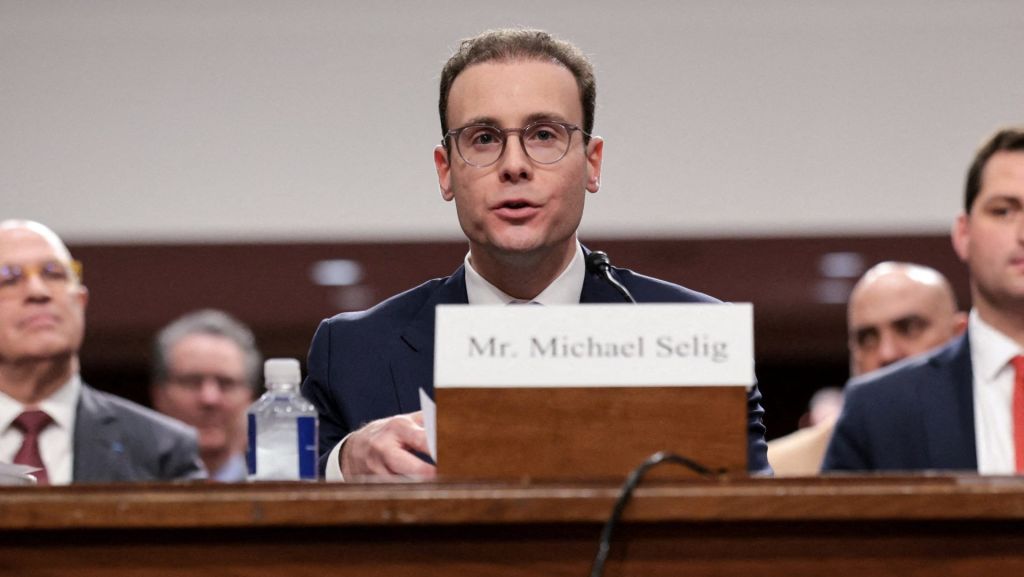
“It’s certainly the case that we need to put rules and regulations around these markets,” CFTC chairman Michael Selig told Front Office Sports in an interview at its Washington, D.C., headquarters on Friday. It was the day after a U.S. soldier was indicted for insider trading tied to the military operation to capture Venezuelan president Nicolás Maduro—which prompted Trump to criticize the rapidly growing prediction-market industry.
“We can’t have them be the Wild West,” Selig says. “That’s why we’re taking action. That’s why we’re moving quickly to make sure there’s guardrails.”
Selig, who was confirmed as CFTC chairman in December, believes in the power of prediction markets. He’s also emphatic about a federal law called the Commodity Exchange Act that gives his agency both “broad authority” to regulate the industry and exclusive jurisdiction over it, including with regard to sports event contracts. Whether he’s right about that is the question at the center of more than 20 lawsuits winding through the U.S. court system. Experts say the issue will likely be decided by the U.S. Supreme Court.
In March, the CFTC issued an advisory reaffirming that it is the regulator in charge of policing prediction markets and soliciting public comments as it prepares to introduce new rules; anyone can submit comments until the end of this month. After that, the regulator will “move pretty aggressively to get proposals out there,” Selig tells FOS, although following those proposals there will be another period during which the public can offer comments.
Selig says the agency “will consider all the comments. We’re statutorily required to do it.” But the CEA provides a “very broad definition of commodity,” which “includes sports events.”
He didn’t rule out changes that could include restrictions or even prohibitions on markets that mirror prop bets or parlays, “but that has to be done through rulemaking.”
“We’re not going to, by staff discretion, decree this product is valid and this one’s not,” Selig tells FOS. “We’re not a merit regulator. Our job is not to tell people in a paternalistic way ‘you can trade this but not that.’”
He acknowledges Congress could amend the CEA if it wants to change the scope of the CFTC’s authority, including to make clear that sports event contracts don’t fall under the regulator’s jurisdiction. But while more than a dozen lawmakers have introduced bills—some aimed at curbing sports and others targeting insider trading—the proposals remain piecemeal and fragmented, with no unified legislative approach taking shape.
As the law currently stands, his agency has authority over sports event contracts, Selig says. That leaves prediction markets free to expand—for now—under the watch of an agency focused on setting guardrails rather than limiting what contracts can exist.
Download the FOS App
The business of sports, in your pocket.



Scan the QR code to get the app now.