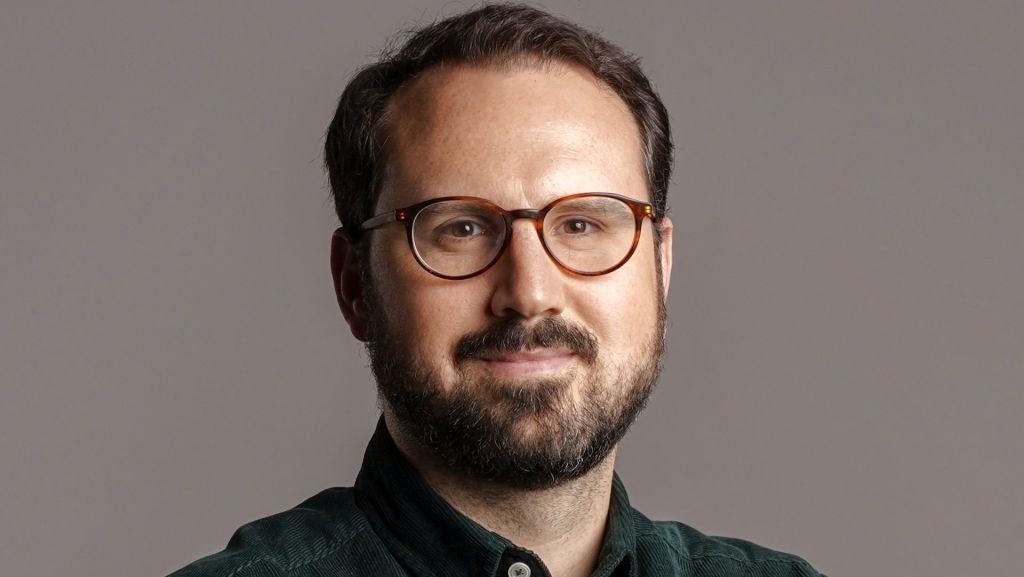
Ben Strauss got the bad news that The Washington Post was laying him off while covering Super Bowl LX last month. It was the kind of awful notice that’s become far too common in the industry. But the sports media reporter had some good luck, too, as the Post dissolved its venerable sports department.
Super Bowl week functions as the unofficial national convention for sports media. Even though the eight-year Post veteran was losing his job, Strauss got to talk face-to-face with senior people—and they got to talk to him. Within weeks, he was one of six ex-Post sportswriters hired by ESPN for the sports media giant’s newsgathering, investigative, and enterprise teams.
Strauss was one of three Post reporters in town to cover the Super Bowl. He and NFL reporter Mark Maske were pink-slipped. The third, Adam Kilgore, wrote the paper’s game story, then joined The Athletic along with former sports editor Jason Murray and four other colleagues.
Strauss will officially start at ESPN on April 6, working out of Chicago. Front Office Sports spoke with the co-author of “Indentured: The Inside Story of the Rebellion Against the NCAA” about a variety of topics, including his new gig and the death of the Post’s sports department.
Some quotes have been lightly edited for brevity and clarity.
Front Office Sports: Tell us about your new job.
Ben Strauss: It won’t be exactly the same as what I did at the Post, which was pretty narrowly focused on sports media. The types of stories will be similar in other ways. I’ll look to do profiles. And in-depth reporting that tries to explain something on a topic that people are interested in. I probably won’t be doing media profiles. So no one can expect a follow-up Stephen A. Smith profile. I probably will not be reporting on ESPN in the same way. But I’ll take a similar lens from the media and look more widely at business.
I did a story a couple of years ago at the Post that went inside the relationship between the NBA and the WNBA. The WNBA was looking at a better TV deal… what it meant for the business of the WNBA. That would be something that I could do. I wrote a story about the legal dogfight between Panini and Fanatics. Something like that could fit. So I have done some things at the Post that I think I will do.
FOS: Does ESPN hiring half a dozen heavy hitters from one of the great sports sections demonstrate a renewed commitment to journalism?
BS: Yes. I saw [ESPN chairman] both Jimmy Pitaro and [president of content] Burke Magnus in San Francisco before the Super Bowl. People I might see in my old job. They hinted at some interest. Then I talked at length to [ESPN’s vice president, investigative, enterprise & digital journalism] Chris Buckle, who leads the team I’m joining, about how they want to do more, their interest in business reporting, and how much appetite they have to do big journalism swing stories. It really felt like adding me and my colleagues—Kent Baab, Robert Klemko, and Tom Schad—was something the whole company was pretty invested in. That goes all the way to the top with Jimmy Pitaro.
FOS: Will you be writing opinion columns?
BS: I don’t know the answer to that. I don’t think that is the mandate. But it has not come up. I don’t know if it’s any different from the Post. My job was not to be an opinion columnist. But if I did an analysis on something, you would get some opinion in that. I don’t think I will write columns in the way you think about columns. But I’m sure, if there’s an analysis of a thing, there will be a view and a take within that analysis.
FOS: What were your favorite stories/profiles at the Post?
BS: There’s two that stand out. [A profile of ESPN’s Senior NFL Insider] Adam Schefter. I was pretty proud of that. Credit to him. We sat, we talked. I learned a lot about him. What he did in a way that was pretty illuminating—we had lunch in Long Island at a steakhouse. I’m never quite sure of what people think of the stories. Certainly, there was plenty of stuff in there he didn’t like that much. But I do think overall we learned a lot about Adam Schefter in that story. In ways that made him more sympathetic.
I just remain fascinated by [son of Starbucks founder Howard Schultz] Jordan Schultz. Why the son of a legitimate billionaire is committed to the insider game of NFL reporting. Talking to him about his career. The fact that he exists—and is doing that job—I think is just really fascinating. It says something about the world, wealth, and about reporting. I had a lot of fun doing that one.
FOS: Do you feel vindicated Post readers cancelled their subs after what they did to the sports section?
BS: I would say no. I did a couple of interviews after we were all laid off. One of the things I would always say at the end is: I don’t think you should cancel your Washington Post subscription if you have one. There remain people there who are committed to doing really important journalism. There aren’t tons and tons of places that can do it, still, with the heft of The Washington Post. I would tell you I am still rooting for The Washington Post.
FOS: There were layoff rumors for months. But what was it like when you got confirmation?
BS: I’m definitely still mourning a bit what it was. The Post was a special place. I remember my first day in 2018, walking into the newsroom. [Editor] Marty Baron would walk around. I covered sports media. It’s not on the list of the 100 most important things the Post does. But he’d come over to my desk and say, “What are you working on?” For lack of a better word, it was just cool. So I remain really sad about what happened.
I don’t think anybody realized how bad it was going to be until January. There were some discussions of layoffs late last year. For whatever reason, it didn’t happen. At some point in January, the tone and the vibe—it felt like it was going to be bad. Or worse than whatever they were talking about last year. There were all sorts of media reports. They all seemed to be going one way. The momentum and everything seemed to be building in one direction. You didn’t see conflicting reports. Or anything that pushed back on this idea there were going to be a lot of jobs lost. And that sports was going to be a huge part of it. Even going into the day when we got the information, we knew it was going to be pretty bad. In fact, it was pretty bad.
FOS: How did the Post inform the staff?
BS: We had a Zoom. I was in San Francisco. So it was really, really early in the morning. We had an email that there was going to be a Zoom. Everybody in the company attended the Zoom. They basically told us they were going to almost completely dismantle Sports and Books. They were going to really diminish Local. They said when this Zoom ends, you’ll get an email that says your job is eliminated or your job remains. The Zoom ended. And 15 minutes later, I got an email saying my job was eliminated.
FOS: You were in the press hotel that morning?
BS: I was in my hotel room in San Francisco. It was a weird day. I will say, though, it was very good to be in San Francisco. Essentially, it’s an industry convention. So you get to see a lot of people who have big jobs in sports media. To have what happened at the Post be such big news—it was this huge, national news story. People definitely wanted to talk to me about what happened. Which was probably not the worst way to go job-hunting those first few days.