Want more from Front Office Sports
in your search results?
On April 21, the new ChatGPT Images 2.0 launched, enhancing the software’s ability to create AI-generated graphics. In the immediate aftermath, graphics made by the OpenAI product went viral on social media, with many disparaging human graphic designers.
“Yeah man designers are about to be jobless,” one X/Twitter user wrote on a post alongside AI-generated jersey swaps of soccer players Lamine Yamal and Eduardo Camavinga, which garnered more than 7,000 likes.
These posts left some graphic designers confused, and even defensive, about why people were demeaning their careers.
“The fact that people are out there defending legitimate robots is beyond me,” John Osborn, who has done design work with Bleacher Report and Electronic Arts, tells Front Office Sports.
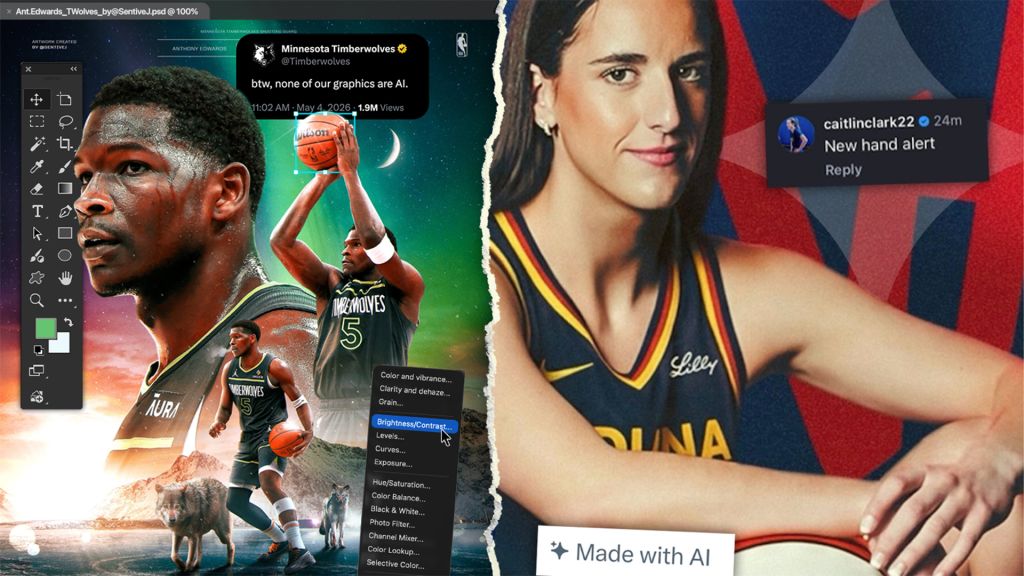
Osborn, who says he “loves negativity toward AI,” has built up 17,000 X followers with his sports designs. AI social media discourse made its way into the pro sports sphere as well, with various teams like the Timberwolves, Borussia Dortmund, and the Saints denouncing AI art.
But amid anti-AI sentiment coming from other sports teams, several major franchises were quietly using it. The Indiana Fever were criticized after Caitlin Clark joked about a graphic that mangled her hand with an AI tool. Though the NHL’s Jets and Blues denounced AI graphics online, the Jets told FOS that they plan on incorporating AI in future creative content, while a source told FOS that the Blues do the same.
Sports designers who spoke with FOS believe their expertise and skill will not be replicated by AI—at least for now. The concern is, in an era of consolidating and cost-cutting, whether their bosses value their work in the same way.
AI Art Is “Soulless”
Jason Matheson, director of college sports creative talent headhunter SkullSparks, tells FOS that in the wake of teams being cut now that schools can pay athletes directly, he worries college creatives could also fall victim. Cal Athletics already laid off dozens of its employees in its marketing and communications department and replaced it with the new Strawberry Creek Studios—with roles that former Cal employees were encouraged to apply for.
“There are a lot of athletic departments that I don’t think really value designers and creatives, because a lot of them have a bad mindset of ‘it’s an honor for you to work for us,’” Johnny Smiley, Oklahoma athletics’s director of creative content, tells FOS. “I [could] see some of the smaller schools, like the ones you’re seeing cut sports, think that AI is a solution to their problem, but I think they’ll learn through trial and error that they’ve probably created more problems for themselves.”
AI is often error-prone. But even if it became spotless, it cannot replace a graphic that emotionally resonates with fans, designers say.
Smiley brings up the example of a post he made celebrating Oklahoma softball for breaking the NCAA single-season home run record, which required extensive specific knowledge of each of the players involved, from their handedness to their celebrations.
“I put a lot of weight on my shoulders to make graphics that make people feel good about the brand they represent,” Smiley says. “And that’s the thing I hate about AI the most, people are trying to take out that human nature.”
Both Osborn and Smiley think AI-generated art lacks the distinct identity that a designer brings. Many AI graphics take on the same “grungy” style with a “spray-painted font” that lacks originality, Smiley notes.
“Sure, you could have somebody put in some very specific prompts and come back with a specific-looking image,” Matheson says. “However, it’s soulless.”
An Uncertain Future
According to Smiley, Oklahoma doesn’t have a specific generative AI policy, but he says nobody in the athletic department uses it for graphic design.
Bleacher Report, EA, and Oklahoma did not immediately answer questions about their generative AI policies.
However, designers worry that not every team or organization will care the same way about human art. Smiley recalls asking four men’s basketball recruits whether his graphic made a difference to them; all said no.
The real concern lies in where the industry will be years down the road if AI’s capabilities grow—or if budgets shrink.
“I don’t think that it will ever directly be able to do exactly what I do, but it’ll get pretty dang close, and people won’t really have much of an option in a few years when it comes to budgetary reasons or just the speed of which it can create things,” Osborn says. “I’m worried of the fact that there will be some cultural shift that people are just like, ‘We give up, we’re just going to start using AI.’”
There’s also the question of how much AI is “acceptable” to designers.
Certain AI tools on Photoshop, like Generative Fill, are still frequently used by designers. Osborn says he is a “traditional” designer who won’t use AI at all. But Matheson and Smiley are both open to experimenting with tools, with the former believing that utilizing AI in some capacity is required to get ahead of the curve.
When too many of these distinctions regarding what is acceptable are made, things can get murky.
“I don’t know if there’s ever going to be any proper terminology, because we’re all just learning about this stuff as we go on,” Smiley says. “Are we ever going to have an actual line drawn? What is bad AI, what is good AI?”
Download the FOS App
The business of sports, in your pocket.



Scan the QR code to get the app now.