Want more from Front Office Sports
in your search results?
Since December, the U.S. has spent $250 million arming World Cup host cities against drone threats across the country. Even so, the Trump Administration said it might not have been enough.
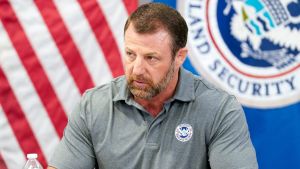
“On the counter-drone measures, everybody’s a little behind,” Secretary of Homeland Security Markwayne Mullin told a House Homeland Security Committee hearing Tuesday, a striking admission given months of federal preparation. “Drones are my biggest concern. … Every single day, we improve,” he said. “But that is a huge concern that we have.”
Unauthorized drones, he added, continue to regularly breach restricted airspace around high-profile venues, with threats ranging from “nuisance flights” to more serious breaches that put crowds at risk.
On match days, all aircraft including drones will be prohibited below 3,000 feet and within roughly 3.5 miles of stadiums. Drone operators who violate that restriction will face fines of up to $100,000, according to FBI Assistant Director Patrick Grandy. The FAA has also implemented temporary flight restrictions around all 11 stadiums, unless aircraft have been authorized by air traffic control.
The 11 World Cup host states and Washington, D.C., each received a portion of a $250 million grant from the Federal Emergency Management Agency (FEMA). The funding, distributed through the Counter-Unmanned Aircraft Systems Grant Program created under President Trump’s One Big Beautiful Bill enacted in July 2025, is to be used to detect, track, and take down unauthorized aircrafts.
FEMA divided grant recipients into two risk tiers, with Tier 1 going to states and jurisdictions hosting the highest-profile matches and Tier 2 covering the rest.
| Risk Tier | State | Amount Received |
|---|---|---|
| Tier 1 | Washington, D.C. (on behalf of D.C., Maryland, and Virginia) | $28,266,328 |
| Tier 1 | Florida | $23,636,511 |
| Tier 1 | New Jersey | $21,764,005 |
| Tier 1 | New York | $17,731,725 |
| Tier 1 | Texas | $30,276,431 |
| Tier 1 | California | $34,591,628 |
| Tier 1 | Georgia | $20,284,936 |
| Tier 1 | Kansas | $5,341,058 |
| Tier 2 | Massachusetts | $21,891,527 |
| Tier 2 | Missouri | $14,240,568 |
| Tier 2 | Pennsylvania | $12,470,777 |
| Tier 2 | Washington | $19,504,506 |
“We knew we needed to act quickly to keep the World Cup safe from the rising threat of unmanned aircraft systems and that’s exactly what we did,” FEMA acting administrator Karen Evans said in a December press release announcing the program.
The 11 states that received the federal funding in December were then able to distribute the funding based on their needs.
New York received more than $17.7 million, split among four agencies: the New York State Police, the Metropolitan Transportation Agency, the Port Authority of New York & New Jersey, and the New York City Police Department.
New Jersey, where the matches themselves will be played at MetLife Stadium, received roughly $21.8 million from FEMA, and drone mitigation measures will extend across both states.
The NYPD and New York State Police were awarded the largest shares of New York’s funding, $6.46 million and $6.65 million respectively, while the MTA and Port Authority received $2.6 million and $1.5 million.
“The grant funding is being used to buy equipment, software, and to provide training in support of our Counter-UAS program,” the New York State Police said in a statement to Front Office Sports.
“With the evolution of technology comes new ways it can be used to harm others,” Gov. Kathy Hochul said in a February announcement of the initial grant. “This funding will go a long way to keep New Yorkers safe while allowing historic events like the 2026 World Cup and our nation’s 250th birthday to be celebrated safely and securely.”
Massachusetts received $21.9 million to monitor its seven matches at Gillette Stadium in Foxboro. Boston Police took the largest share at $10.9 million, followed by Massachusetts State Police at $6.5 million, and Foxboro PD at $3.5 million. But this distribution of funds is complicated by geography, as Gillette is located 30 miles outside Boston, creating potential coordination gaps between city and state officials.
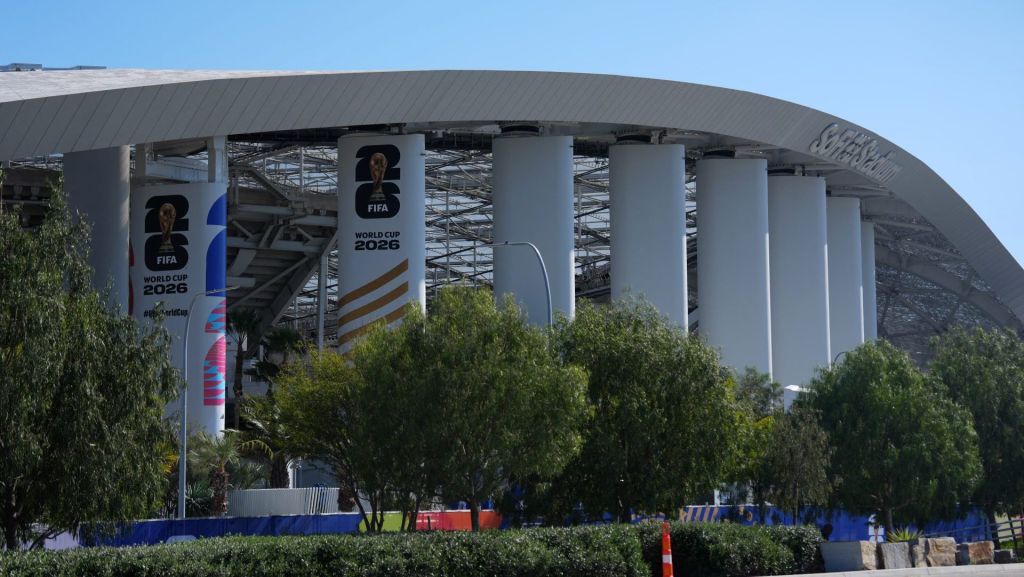
California received the largest single allocation of any host state at $34.6 million. Inglewood’s SoFi Stadium will host eight matches of the World Cup, including a quarterfinal on July 10.
In a statement to FOS, the Los Angeles Police Department said it “acquired a comprehensive, multi-layered detection and mitigation system to address the threats posed by unauthorized drones.” This equipment will build upon the significant investments the Department has already made in training, readiness exercises, partnership development, and strategic planning.”
Training officials on using the new equipment is just as important as the funding itself. White House FIFA Task Force coordinator Andrew Giuliani said, “You can’t just give counter-UAS mitigation equipment to law enforcement that hasn’t learned how to use it yet.”
Download the FOS App
The business of sports, in your pocket.



Scan the QR code to get the app now.