Want more from Front Office Sports
in your search results?
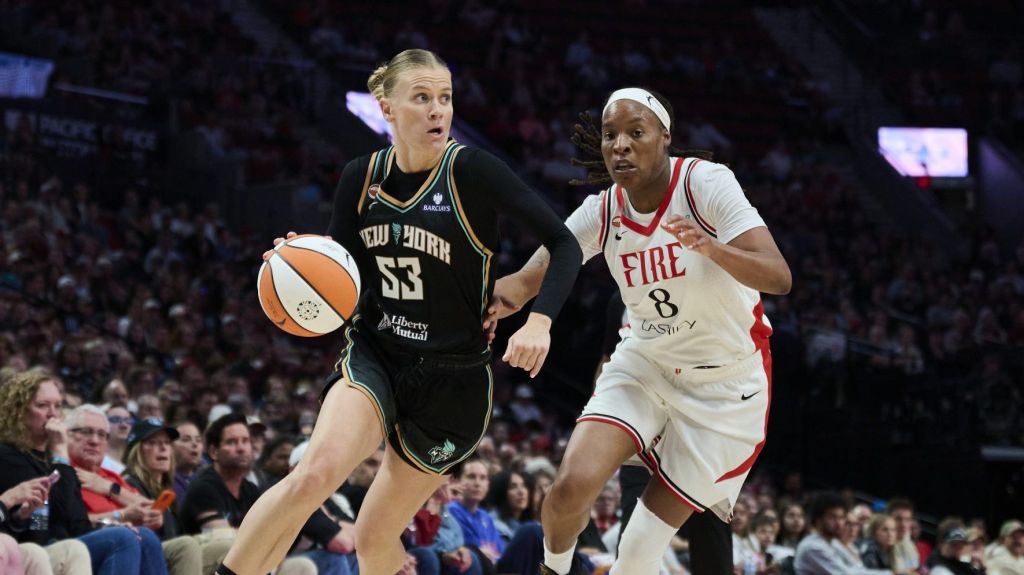
Not even a week into the WNBA season, several teams are already shorthanded—and a couple have already secured salary cap hardship exceptions.
Hours before their season opener Friday, the New York Liberty signed Julie Vanloo and Aubrey Griffin to hardship contracts. New York had only seven players available with some out due to injury (Sabrina Ionescu, Rebecca Allen, Satou Sabally) and overseas commitments (Raquel Carrera, Leonie Fiebich).
On Sunday, the Golden State Valkyries signed Ashten Prechtel to a hardship contract. Justé Jocyté, their 2025 first-round pick, is still overseas and Iliana Rupert is pregnant. Tiffany Hayes and Cecilia Zandalasini are also out with short-term injuries.
Both the Liberty and Valkyries received emergency hardship exceptions, which are granted when a team has fewer than 10 available players on their roster, whether through injury, illness, or other reasons—including overseas commitments.
Under the new CBA, the WNBA added two developmental roster spots this season to assist with midseason roster flux. Several coaches last year pleaded for more roster spots as teams faced mounting injuries. Developmental players are not included in a team’s salary cap and may be activated for a maximum of 12 games per season.
A league source told Front Office Sports that developmental players are not counted when determining hardship eligibility. It’s why hardship exceptions are already being used—and will likely be continued to be used frequently.
Teams can be granted two types of hardship exceptions: A regular hardship may be granted to teams with at least two players out with injury, illness, or other conditions for at least three weeks—and the second injured player must have already missed at least two games. Or an emergency hardship, like those granted to the Liberty and Valkyries. A league source told FOS that the hardship exception rules remain mostly the same under the new CBA.
The only difference for hardship contracts under the new CBA is salary. Previous seven-day hardship contracts are worth 75% of the minimum base salary, pro-rated by each day a player is with the team. Hardship contracts are now pro-rated to 100% of the minimum, which is worth $270,000 for a rookie and goes up to $300,000 for a player with 10+ years of service.
Based on the deal, a hardship player will make around $2,200–$2,440 per day.
Theoretically, an injury-riddled team could use their developmental players to get to at least 10 available players and still apply for a hardship contract. That should be a significant advantage for teams compared to last season as they could still backfill a 12-person roster with both hardship and developmental players.
But there are complications with filling out the developmental players spots. The Liberty and Valkyries have each only signed one developmental player, and the Liberty’s Marine Fauthoux is out recovering from an ACL tear.
Teams that signed players to training camp deals had to first waive those players and hope they clear waivers before they are allowed to re-sign as a developmental player. But those players may also be picked up by other teams.
Australian forward Anneli Maley, who the Liberty were reportedly interested in after training camp, was picked up by the Phoenix Mercury on waivers. The Mercury also picked up Marta Suárez, the No. 16 pick in this year’s draft. The Valkyries waived Suárez after acquiring her in a controversial draft-night trade.
The early-season roster issues show that there’s still room to improve roster expansion beyond the two developmental slots, through tweaking developmental spot rules or simply adding more roster spots.
In the NBA, teams have 15 roster spots plus an additional three for two-way players, the NBA’s version of the developmental contract. Two-way players can play up to 50 games, which is more than half the season.
The NBA also has a G League, a developmental league where teams can easily plug roster holes by picking up and signing players who are already in-market. The WNBA does not have its own developmental league.
Download the FOS App
The business of sports, in your pocket.



Scan the QR code to get the app now.