Want more from Front Office Sports
in your search results?
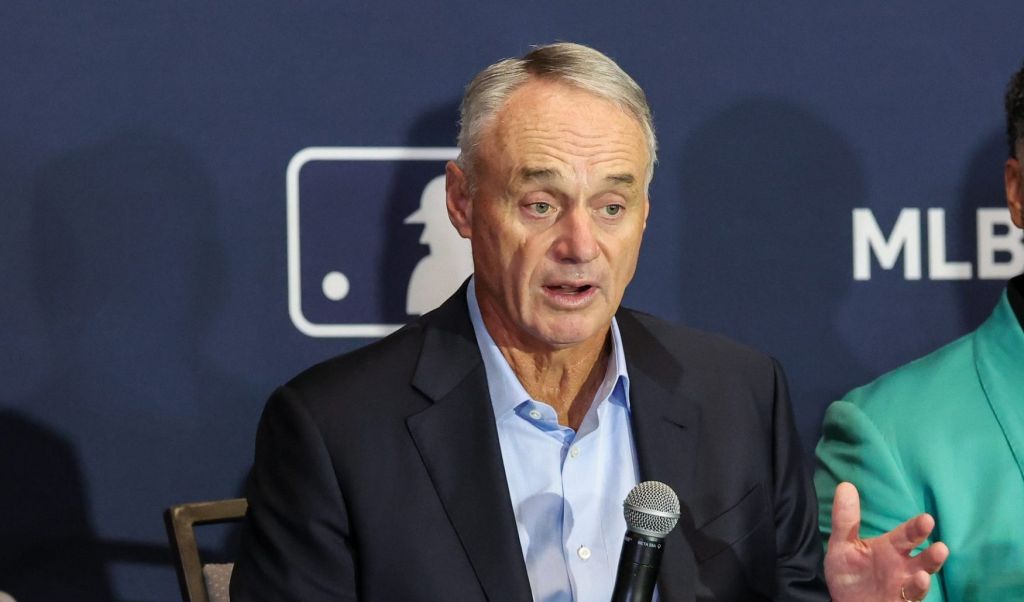
NEW YORK — MLB team owners are still going full bore after a hard salary cap in labor talks with the MLB Players Association, as league commissioner Rob Manfred said the sport’s existing luxury tax has “failed.”
Marking some of his most direct comments on the subject, Manfred said that more than two decades’ worth of attempts to make the tax an engine for greater competitive and economic balance have been increasingly ineffective.
“We have tried mightily over several rounds of bargaining to use a competitive balance tax to address competitive concerns, and sometimes you’ve got to admit you failed,” Manfred said as the league is holding an owners’ meeting this week here.
To that end, a record nine teams paid luxury-tax penalties following the 2024 and 2025 seasons. The Dodgers by themselves paid $169.4 million in the tax last year.
“When you see more and more tax getting paid, you realize that is not the kind of speed bump that would help on the issue of competitive balance,” he said.
Labor Dynamics
Manfred’s remarks also arrive as the league and union remain squarely at odds after each side presented its initial proposal last week. The players are seeking a broad expansion of the current market-based economic system, including enhanced provisions for free agency and arbitration and a significant increase in minimum salaries.
Management responded a day later with its hard salary cap proposal, topping at $245.3 million per team in 2027. MLBPA interim executive director Bruce Meyer said on Monday that under the cap system, players would collectively lose at least $500 million annually from reduced compensation. Manfred, however, took direct aim at that assertion.
“Our initial proposal was specifically constructed to ensure that in the first year of the contract, major league players would make more than they made in 2026,” Manfred said. “To the extent that somebody is suggesting something other than that, it’s just not accurate.”
While the Dodgers last fall became the first repeat World Series champion in a quarter century, MLB says postseason entry, and particularly playoff success, vastly favors large-revenue teams. As a result, the owners see the cap proposal as a key means to leveling the economic playing field.
“The perception among our fans is really strong that we have a lack of competitiveness,” Manfred said.
The commissioner also acknowledged he does have concerns of a repeat of the bitter, cap-related labor fight of more than 30 years ago, when the 1994 World Series was wiped out as a result. And echoing then, players are again vowing to fight a cap for as long as it takes.
“Of course [I worry]. We want to make an agreement,” Manfred said. “We’re open to whatever ideas people have, but we need a realistic framework that addresses the fans’ concerns about competitive balance and you just can’t ignore that financial penalties have not gotten it done for us.”
Media Matters
A critical component of the owners’ cap proposal is a dramatically reimagined revenue system in which all local media revenues would be centralized and shared equally across the league. That represents a major pivot for large-market clubs such as the Dodgers, Yankees, and Mets that currently enjoy disproportionate income from that revenue stream.
Manfred, however, said even the well-heeled and two-time defending champion Dodgers agreed to the concept, in large part because of the greater returns that the league sees in a cap system.
“The Dodgers understand that there is a need to update the overall economic model in the industry, and that the upside associated with that, in terms of growing the industry, growing the popularity of the sport, is big for large markets, small markets, owners, and players,” he said. “In every way, that upside is bigger than any issue that separates us at the bargaining table.”
Download the FOS App
The business of sports, in your pocket.



Scan the QR code to get the app now.