Want more from Front Office Sports
in your search results?
RALEIGH — The NHL is in line to post another revenue record, but league commissioner Gary Bettman said the new milestone will be short-lived as the sport’s boom times continue.
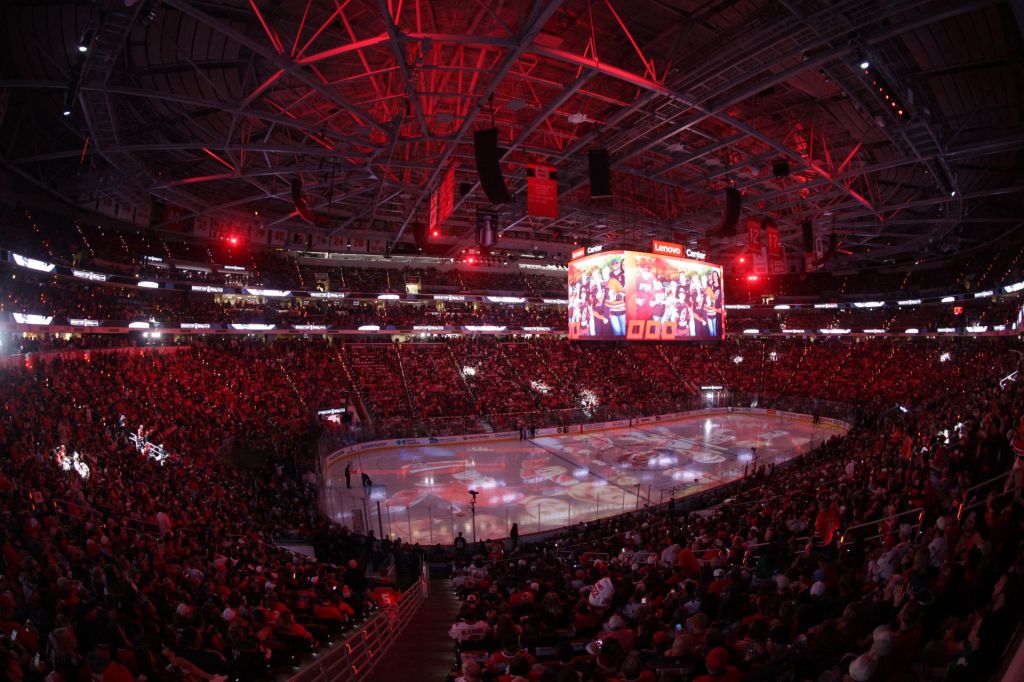
Speaking before an electric Game 1 of the Stanley Cup Final, won 5–4 by the Golden Knights over the Hurricanes, Bettman said the league is projecting $7.5 billion to $8 billion in mixed U.S. and Canadian currency for the 2025–26 season.
That’s up from a comparable figure of about $6.5 billion in the prior season, and arrives as the league had record attendance of 23.16 million during the regular season while playing to near-capacity levels. The NHL has also been on a postseason viewership heater that is expanding the NHL’s aspirations for the next set of U.S. media rights deals. Other key revenue drivers such as sponsorships and special events continue to grow as well.
“Every platform, every source of revenue is growing,” Bettman said. “It’s going to be even better next year because the new media deal in Canada kicks in.”
That pact is a 12-year English-language rights deal with Rogers Communications worth $7.7 billion, will run through the 2037–38 season, and will inform upcoming rights deals not only in the U.S. but a separate French-language pact in Canada now under development.
“For us, I think we’re experiencing a particular moment in time,” Bettman said. “The game has never been better, never been more competitive … I think we’re experiencing a moment in time where our players and our game are truly getting the recognition that they deserve, and it’s being reflected in engagement by fans.”
Standing Up for Dundon
Bettman, meanwhile, had strong praise for Hurricanes owner Tom Dundon, though he acknowledged that there’s a very different situation unfolding in Portland for Dundon.
In Carolina, and boosted in part by the intellect of GM Eric Tulsky, Dundon has built one of the NHL’s most consistently competitive franchises—as seen in part by eight straight years with at least one playoff series win. Newly installed as the owner of the NBA’s Trail Blazers, the situation has been quite different, with immediate staff cuts and widespread accusations that Dundon is “cheap.”
“Tom Dundon has been an extraordinary owner in terms of what he’s brought to this operation of this franchise. Obviously, his work in terms of creating a competitive and successful team is the reason we’re here,” Bettman said. “Tom may not always be—because we’re hearing this out of a different market—the most conventional owner, but nobody can argue with his commitment to [hockey] … He’s been great for us all the way.”
A Different Kind of Olympic Podium
As the league continues to lean into its global profile and has implemented an internationally based format for the 2027 All-Star Game in New York, Bettman lauded the presence of NHL players in the 2026 Winter Olympics.
That participation was the first time that happened in 12 years, and only happened after years of negotiations between the NHL, NHL Players’ Association, IIHF, and International Olympic Committee. It was rewarded, though, with massive fan interest around the globe, including a U.S.-Canada gold-medal game that set viewership records in an unusual Sunday-morning time slot for American viewers.
“While there, the players did what only NHL players can do. They staged an astounding display of best-on-best competition that restored the men’s hockey tournament to its rightful place as the marquee Winter Olympics event,” Bettman said.
Playoff Formats
Bettman also defended the league’s current playoff format, in which teams are seeded within divisions instead of across the conference on a one-through-eight basis.
While that structure frequently produces longer-running series in the earlier rounds, it also is seen in some corners of the sport as something that knocks out top teams prematurely.
“I believe in the history of the league there have been 16 different playoff formats,” the commissioner said, rejecting any notion that conference-based seeding is traditional. “If you look at the body of work since 2013 [when the current format began], you statistically get closer games, more games, and more competitive games. … It’s not at all clear-cut that change is required.”
Download the FOS App
The business of sports, in your pocket.



Scan the QR code to get the app now.