Want more from Front Office Sports
in your search results?
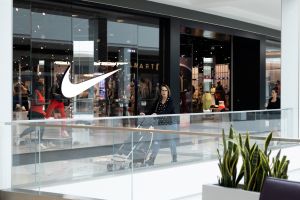
Nike is reportedly considering a significant strategic shift in the way it will allow products to be sold online in China, and some industry analysts aren’t convinced it’s a smart move.
A recent report from China’s Economic Observer said Nike may stop allowing distributors in the country to sell Nike products online beginning in January 2027. The goal would be to push consumers toward Nike’s own digital storefronts and give the company greater control over pricing and inventory (the company reported a 10% decrease in sales in China during its most recent earnings back in April).
But experts say that if Nike goes through with the move, it could backfire. Analysts at Jefferies, Bernstein SG, Deutsche Bank, and BNP Paribas all touched on the report in recent research notes. Deutsche Bank is approaching Nike’s upcoming June 30 earnings call “with a cautious stance,” in part because of a “potential sharper-than-expected pullback from wholesale partners” in China. BNP said “we believe that if Nike did ultimately terminate online sales by its Chinese retail partners it would be a strategic misstep.”
Laurent Vasilescu of BNP Paribas elaborated, telling Front Office Sports that Nike—which in recent years has been losing market share in China to domestic competitors like Anta and Li-Ning, as well as other companies like Lululemon and Swiss brand On—may be misunderstanding its problem.
“It’s a product problem,” Vasilescu says.
Nike’s challenge in China is less about where its products are sold and more about whether they are compelling enough to command full-price demand in an increasingly crowded market, Vasilescu says. By restricting where consumers can go online to buy Nike products, the company risks losing even more apparel sales to competitors because of the way the e-commerce industry works in the region.
“They are light years ahead of us in terms of digital commerce,” Vasilescu tells FOS.
There is an aspect to Chinese e-commerce that can be compared to infomercials, he explains; online distributors host livestreams that offer special deals on certain products, including, for example, Nike shoes, but to get the discounted price, a buyer typically has to act within a tight timeframe.
Currently, Nike products are primarily sold via two main players in China: Topsports and Pou Sheng. They would be most affected by the potential move.

On Thursday, Topsports addressed the report, informing shareholders that it “has not received any official notice from Nike” about the rumored change. As part of that disclosure, the company said Nike products accounted for about 22% of its total revenue for the most recent financial year.
Ultimately, if Nike does restrict Chinese companies from selling its products online, it could open up space for competing brands to gain stronger footholds in the region, which is what happened when Nike tried a similar, although slightly different, strategy in North America. In 2017, Nike began focusing more on direct-to-consumer sales in North America, removing products from stores like Dick’s and Foot Locker. The idea was to drive consumers to physical Nike stores, but in 2024, then-new Nike president and CEO Elliott Hill (who is still at the helm) reversed course as part of the turnaround plan that’s still in motion.
BNP’s recent research note estimated that, if Nike does go through with the plan to stop Chinese retail partners from selling its products online, “our back of the envelope math” shows the company could lose up to $1 billion in sales.
Vasilescu says it’s notable that neither Topsports nor Nike has directly refuted the report, especially considering Topsports stock has dropped by about 30% since it came out.
“If there’s a market rumor, Nike can put out an 8K [filing] and say no, this isn’t true,” Vasilescu tells FOS. “Topsports can refute it. They didn’t. They actually quantified that Nike accounts for 22% of its online sales. They didn’t have to do that.”
A representative for Nike did not respond to requests for comment.
Nike’s Problems Extend Beyond China
In April, after Nike posted modest earnings, the market reacted negatively, with shares tumbling roughly 14% that day. Shares are down about 36% year-to-date. Nike has been in the midst of a long-term turnaround that analysts have generally said is working but will take longer than originally expected.
In December, Hill said the company was in the “middle innings” of its comeback, and in April he said the “comeback is within reach.”
But the company is clearly still figuring some things out. On June 23, Nike announced CFO Matthew Friend is leaving the company, with Pfizer executive David Denton taking his place beginning in August. BNP said the news “was a surprise in terms of timing considering 4Q26 earnings is scheduled” for June 30, and interpreted the move to suggest Nike’s calendar 2026 guidance will likely be cut on the upcoming call.
Analysts at Telsey Advisory Group were also surprised, writing in a June 24 note that Friend was “a figure the investor community was familiar with,” because he has been a longtime Nike employee, including a stint as VP of investor relations.
“Overall, Nike is making the right strategic moves by cleaning up inventory, rebalancing the product portfolio by increasing newness and reducing the focus on classic franchises, and strengthening relationships with wholesale partners,” the Telsey note said. “However, the turnaround is progressing at a slow pace and there remains significant work to revitalize the entire product portfolio and right size its international businesses.”