Want more from Front Office Sports
in your search results?
One of MLB’s most aggressive spenders this decade is suggesting that a financial belt tightening could soon arrive, something likely to have large-scale impacts across the league.
José E. Feliciano and Kwanza Jones, the new Padres owners, were formally introduced late Monday, heralding their arrival after recently completing a $3.9 billion acquisition that shattered the league record for a valuation in a control transfer.
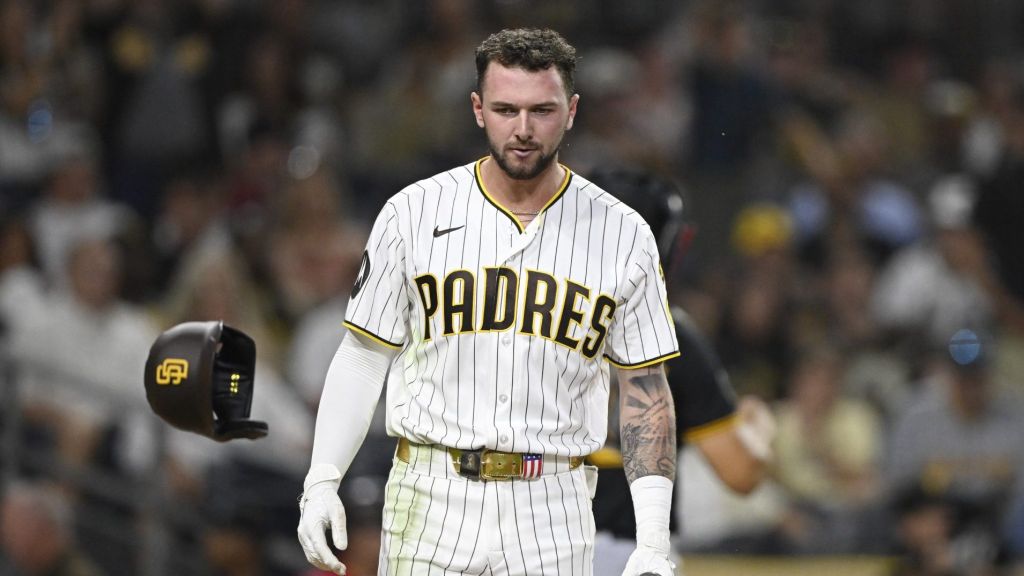
Operating in one of MLB’s smallest and more geographically isolated markets, the Padres often conducted themselves like a high-revenue club under the club’s prior owner, the late Peter Seidler. Prior to Seidler’s death in November 2023, the Padres frequently had a top-10 luxury tax payroll, and even ranked No. 2 behind only the Dodgers in 2021. Even after some more recent retooling, the Padres still rank seventh in the league with a 2026 outlay of $263.8 million.
While Feliciano and Jones promised a vigorous pursuit of the club’s first World Series title, something that eluded the Padres since their 1969 formation, they also signaled a more disciplined financial approach.
“We are going to live within our means, and that could mean different things in different years,” Feliciano said. “But again, we want to win, and we’re going to continue supporting that goal in many different ways, and that means at some moments, we’re going to be aggressive, but we’re always going to do it with the long-term health of the team in mind.”
Financial Matters
The Seidler era, extended to somewhat more measured degree by his family and estate after his death, included four Padres playoff berths between 2020 and 2025, and the club is currently in position for another return to the postseason this year. It also was marked by signing the seventh, ninth, and 18th largest contracts in MLB history with Manny Machado, Fernando Tatis Jr., and Xander Bogaerts, respectively, which helped elevate salaries across the league.
But the team also generated undisclosed operating losses under Seidler estimated to be well into eight figures. In early 2023, the Padres were the first MLB club to lose its local media rights tie with Main Street Sports Group, now not broadcasting, and San Diego remains part of the league’s in-house program for local game production and distribution.
The Padres’ willingness to spend aggressively in pursuit of championship glory has been repeatedly cited by the MLB Players Association as a model for others around the league—but also is an approach under threat as the union and league are engaged in a fractious labor fight that includes a management proposal for a hard salary cap.
“San Diego is a small-market team. They went out, decided to compete, signed a lot of players, turned around their franchise,” MLBPA interim executive director Bruce Meyer said in June regarding the Padres. “They’ve grown attendance. They’ve grown interest, and we’ve all seen the exploding in their franchise value. They went under our revenue-sharing system from a revenue-sharing recipient to a revenue-sharing payor because they went out and tried to compete.”
The husband-and-wife team of Feliciano and Jones, meanwhile, pledged to continue the robust attendance patterns of their ownership predecessors. The Padres set a franchise attendance record of 3.4 million at Petco Park last season, and now solidly rank as the game’s second-best draw behind the rival Dodgers.
“We have been blessed with a team in a city that is supporting us in a way that is allowing us to invest back in the team, in the stadium, and in the city,” Feliciano said.
The Padres’ new owners remain on the hook to Machado, Bogaerts, and Tatis Jr. well into the 2030s, and by 2029, that trio alone will be owed more than $100 million annually.
Feliciano, the cofounder of private investment firm Clearlake Capital, is also a part-owner of the Premier League’s Chelsea F.C., and is joined in that franchise with Dodgers owners Mark Walter and Todd Boehly.
Download the FOS App
The business of sports, in your pocket.



Scan the QR code to get the app now.