
Want more from Front Office Sports
in your search results?
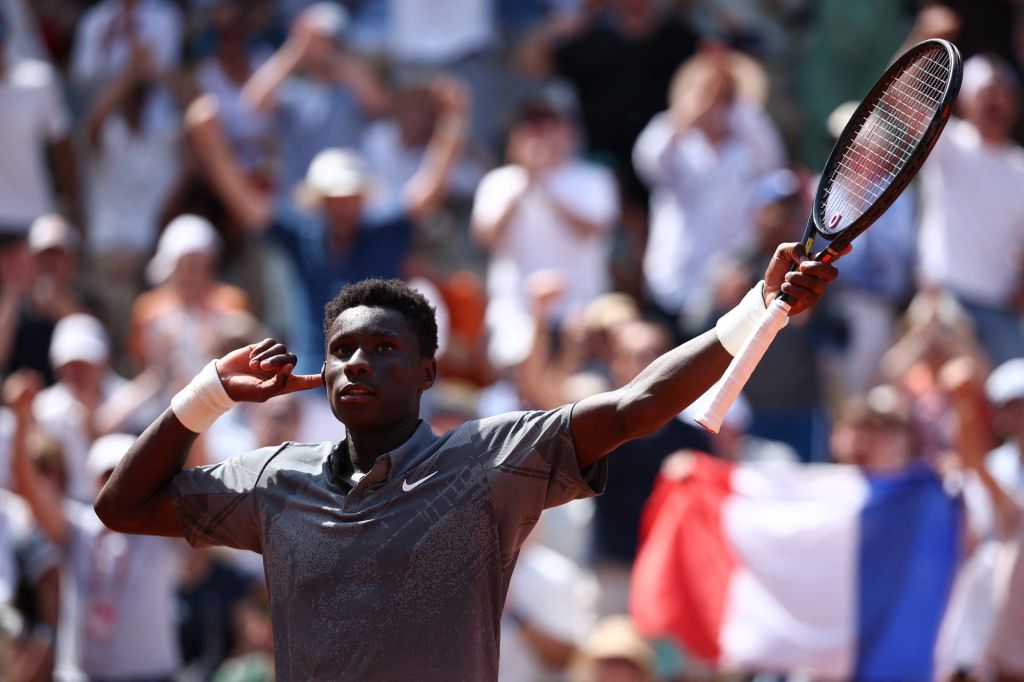
Soon after the stunning loss of Jannik Sinner on Thursday came a hometown triumph. Moïse Kouamé, the 17-year-old Frenchman, advanced to the third round at Roland-Garros after defeating Adolfo Daniel Vallejo in a near five-hour match.
The win guarantees Kouamé will take home nearly $220,000 in winnings (€187,000), already more than his career earnings of $175,637. But soon after the win, reports began to surface that Kouamé may not be able to collect his winnings.
“He can’t even collect his winnings cause he’s not 18 yet,” Mike Hayden, the producer of the Served podcast with Andy Roddick, said Thursday. “There’s a French law that you can’t collect the prize money until you turn 18.”
“He better be getting a fucking interest rate while the government keeps that bag,” Roddick said.
Kouamé’s agent, Daryl Monfils, who is also the brother of French tennis veteran Gaël Monfils, described the report as “wrong information” in an email to Front Office Sports. Monfils did not provide additional explanation as to where exactly Kouamé’s prize money will go.
Multiple French law experts tell FOS that Kouamé probably won’t directly receive the money because French Civil Code prohibits minors (anyone below the age of 18) from managing their assets. The exception is if he has received legal emancipation from his parents or parental authority.
Article 382 of the Civil Code states: “Legal administration belongs to the parents. If parental authority is exercised jointly by both parents, each of them is a legal administrator. In other cases, legal administration belongs to the parent who exercises parental authority.”
Additionally, Claire Germain, a France-educated lawyer and the associate dean for legal information at the University of Florida, said Kouamé’s case may fall under Article L. 7124-9 of the French Labor Code, which “governs the financial protection of minors who work in the entertainment, modeling, advertising, audiovisual, and digital content industries.”
Under this provision, the winnings of minors like Kouamé would be placed in a special savings account under their name and be accessible by legal representatives for living or career expenses, with the surplus used as a nest egg (pécule, in French).
Any surplus would be deposited to the Caisse des Dépôts et Consignations, a French public financial institution, and be blocked until the minor is legally emancipated or turns 18. In Kouamé’s case, that would be March 6, 2027.
Alban Bennacer, a French sports lawyer for firm Strategos Avocat, tells FOS that Kouamé may not fall under the provision because tennis prize money “is not a sum received in exchange for the performance of an employment contract.”
Instead, he believes Kouamé’s case is under the general rule of the French Civil Code, though it still means his parents are responsible for the money.
“It is my view that the prize money due to him should be paid to his parents, as the holders of parental authority, who may allocate it to his maintenance and education, with only any surplus reverting to him, and that this parental power should cease upon his reaching majority,” Bennacer said.
It is unclear how the French government determines the cost of “maintenance and education” in these cases. Bennacer said there are no specific thresholds included in the laws.
Legal experts also said that the rules apply to prize money earned both in and outside of France because Kouamé is a French citizen, so the $36,100 he earned for advancing to the second round of the Miami Open in March would fall under this restriction.
Kouamé faces Alejandro Tabilo in the third round Saturday. A win will guarantee him nearly $332,000 (€285,000) in winnings.