Want more from Front Office Sports
in your search results?
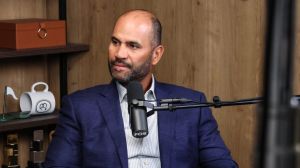
John Isner, co-host of one of the top tennis podcasts, strongly supports tennis players’ current push for a bigger cut of Grand Slam revenue.
The former top-ranked American men’s player told Front Office Sports he was “a fan” of the 15-minute media boycott that current men’s and women’s stars did at the French Open in May.
Players, including world No. 1s Jannik Sinner and Aryna Sabalenka, limited their pre-tournament media availability to 15 minutes at Roland-Garros, which symbolized the 15% share of revenue players typically receive at Grand Slam tournaments. Players are seeking 22% by 2030.
“I do think that revenue on the players’ side needs to come up,” said Isner, who made more than $22.4 million during his playing career. “You look at other pro sports—and I’m not comparing tennis as an individual sport to these team sports—but they have 50–50 splits of these numbers and tennis does not. I think the revenue for the players still needs to go up because at the end of the day, the players are the product.”
Players receive at or close to 50% share of revenue in the NFL, NBA, and NHL, a product of collective bargaining done by a players’ union that tennis does not have. A more apt comparison may be with UFC and its fighters, who historically receive at most 20% of revenue.
Isner, who hosts the Nothing Major tennis podcast recently picked up by Colin Cowherd’s The Volume, said he understands that Grand Slams revenue funds tennis federations. But he believes they rake in enough revenue to still allocate additional prize money to the players.
“As the product and the main driver of that revenue, I think it does need to go up,” Isner said. “So I’m glad that the players are taking this initiative now. And I do think we’ll see that number eventually, I’m hoping, but I do believe that it will get up into the 20, 25% range, which is pretty similar to what the golf numbers are on the PGA Tour.” (The exact revenue share for PGA Tour players is unclear. Similar to tennis, where the Grand Slams are independent entities, golf’s four majors aren’t operated by the PGA Tour.)
The player protests did not continue last month at Wimbledon, the Grand Slam immediately following the French Open. In a statement, representatives for the player group, which also included Americans Coco Gauff and Jessica Pegula, said they would return to “normal media tournament duties” after discussions with Wimbledon organizers.
“The underlying matters remain unresolved and players will carefully evaluate the proposals once received,” the statement read. “Players will also be providing Wimbledon with further information they have requested in connection with those proposals during the course of the tournament.”
Wimbledon increased its purse to $85.7 million (£64.2 million) this year, up 20% from last year. But it was still only about 14.4% of projected revenue. The French Open increased its purse by 9.5% to $71.7 million (€61.72 million), but players’ share of revenue dropped from 15.5% to 15%. The Australian Open purse increased by 16% to $75 million ($111.5 million AUD), but players’ share of revenue remained around 16%.
It’s unclear whether players will protest when the US Open begins next month. The Times reported in June that Sinner is among several stars considering boycotting the revamped Mixed Doubles tournament at the US Open. However, Pegula suggested weeks later that Sinner may be conducting that boycott independent of the broader player group.
The US Open announced its mixed doubles competitors Monday, including six of the top ten women’s players and five of the top ten men’s players. Sinner was not on the list.