Want more from Front Office Sports
in your search results?
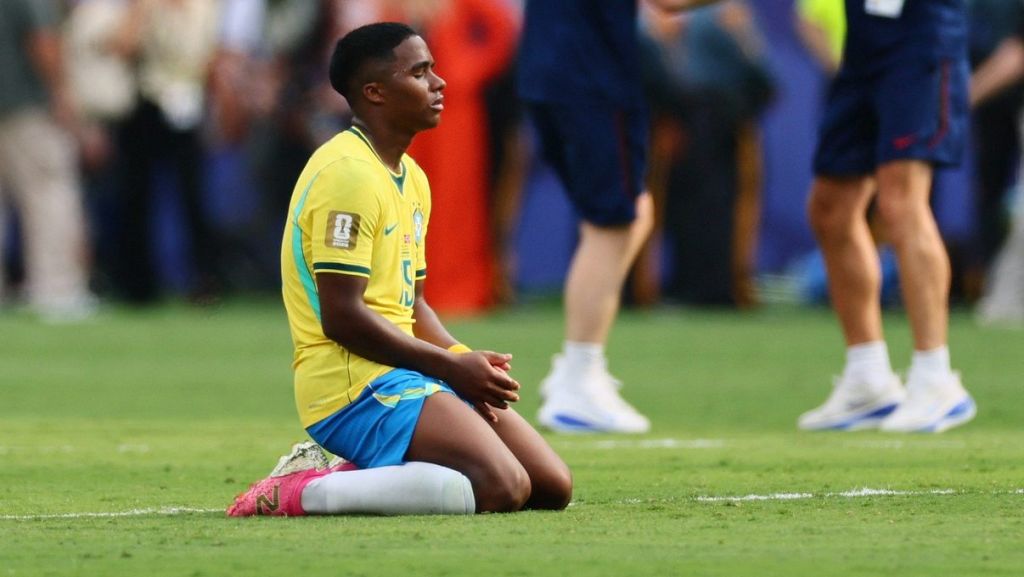
The World Cup creates far more losers than winners. One team will bask in triumph. A few others will have outperformed modest expectations. But most will consider their tournament a failure.
This time around, the pain of an early World Cup exit has hit the Netherlands, Germany, Portugal, and Brazil. Before them, Uruguay, South Korea, and Tunisia all had ambitions beyond the group stage.
The mood around a team can change violently. Darko Jekuac, a professor of sport psychology at the Karlsruhe Institute of Technology, told Front Office Sports that wins in Germany’s first two matches generated a surge of optimism in the country that subsided into dismay and anger after the team’s penalty shoot-out loss to Paraguay. “It was really surprising how fast the emotions and sentiment of the supporters changed,” he said.
Angry fans want there to be a consequence for failure. The most common tactic is to fire the coach. This approach has remained in vogue in 2026; Germany pushed out Julian Nagelsmann, just as Tunisia ditched Sabri Lamouchi after its opening match. Others opted to resign before they could be pushed, including Uruguay’s Marcelo Bielsa, Ronald Koeman of the Netherlands, and Hong Myung-Bo of South Korea.
There is a compelling psychological reason for foisting the blame on the coach. “National associations come under huge pressure from the public and the media to show that they have understood the seriousness of the failure,” explains Jekuac. “As the coach is the most visible person in the system, sacking him becomes the fastest way to demonstrate action and accountability.”
Sometimes the coach’s relationship with the squad breaks down entirely. The most infamous example of this occurred between Raymond Domenech and his French team at the 2010 World Cup, the subject of the recent Netflix documentary The Bus. An analytically rigorous coach who lacked interpersonal skills, Domenech sent home striker Nicolas Anelka for insubordination, a move that prompted the rest of the squad to go on strike. France lost two of its three games and finished bottom of their group.
But typically, sacking the coach is a knee-jerk reaction made with imperfect information. In South Korea, Myung-Bo was a national hero. He captained the national team during its unlikely run to the semifinals of the 2002 World Cup, and managed K League side Ulsan to back-to-back league titles. Under his leadership for this year’s World Cup, South Korea strolled through qualifying. At the tournament itself, it beat Czechia, narrowly lost to Mexico at the Azteca, and was eliminated in the group stage after a lackluster performance against South Africa. Myung-Bo has since been forced out by his association and criticized by the country’s president.
His treatment is a perfect illustration of the “scapegoat culture” that exists within soccer, according to Simon Chadwick, a professor of Eurasian Sport Industry at Emlyon Business School. “In reality, failure is less likely to be the consequence of an individual. There are more likely to be cultural, resource, or organizational issues. It is far better to review and respond than to fire the coach in the heat of the moment,” he argues.
But the mere existence of a review is no guarantee that it will reach useful conclusions.
France was in uproar after the 2010 World Cup. The president, Nicolas Sarkozy, demanded an investigation. His sports minister castigated the team in parliament. The then-FIFA president, Sepp Blatter, threatened to suspend France from its competitions if politicians involved themselves in sporting decisions. A national symposium, held months after the tournament, produced little of consequence.
Instead, the gold standard of such reviews remains what became known as Das Reboot. In 2000, Germany was humbled at the European Championships. The coach resigned immediately, but the Deutscher Fußball-Bund did not stop there. Its review concluded that the country’s development infrastructure was not fit for purpose.
A series of reforms made it compulsory for all top- and second-division clubs to open academies, while the DFB opened 400 regional talent centers to find boys that the academies had missed. A former international captain was appointed as sporting director and tasked with ensuring the academies and the national age-group teams worked together. When Germany won the World Cup in 2014, the core of the team—Mats Hummels, Toni Kroos, and Thomas Muller, among others—all progressed through the academies and national youth teams.
Not every review needs to be this fundamental, but it does need to be precise in identifying which area to fix. When Spain lost in the round of 16 to Russia at the 2018 World Cup, the team had been drifting. The squad was still dominated by the players who had won the tournament eight years earlier. Complicating matters, Real Madrid announced that the national team coach, Julen Lopetegui, had agreed to become the club’s new manager after the tournament three days before Spain’s first match. The Spanish association sacked Lopetegui immediately and appointed a caretaker.
After the Russia game, the Real Federación Española de Fútbol picked a new coach, Luis Enrique, and charged him with turning the squad over. He promoted a generation of youngsters, including Pedri, Gavi, and Dani Olmo. The churn was considerable: only two players who began the 2018 World Cup were on the field four years later. And when Enrique opted to step down, his successor was the under-21 coach, Luis De la Fuente, who then led the team to glory at Euro 2024. Spain maintained its existing structure, which has continued to produce talented youngsters, but it appointed a coach with sufficiently thick skin to move on from a generation that was blocking their path.
The final piece of the puzzle is the most difficult, as it runs counter to the prevailing trends in soccer: accepting a realistic timeline. The more structural the changes, the longer they take to pay off. There were 14 years between Germany’s reboot beginning and its first generation of academy graduates winning a big prize. There were eight years between France’s implosion in South Africa and glory in Russia, once it had settled on a coach—Didier Deschamps—who commanded the respect of the squad. Even without structural changes, Spain remained a work in progress at the 2022 World Cup, losing on penalties to Morocco in the round of 16.
For plenty of this World Cup’s many losers, the path ahead will be difficult. Germany has already shown its hand by reaching for the good vibes promised by Jurgen Klopp. The former Liverpool coach is an inspirational leader,but he is also taking charge after three successive tournament failures, suggesting Germany may need more than another change of leadership. Optimism is even scarcer in Brazil and the Netherlands. These teams have abandoned their unique playing styles that established their World Cup identities in search of more direct ways to win and now have neither style nor substance.
If there is a best way to avoid a World Cup calamity, it is to be proactive. Marcello Lippi won the World Cup with Italy in 2006. Italy then faded at the Euros two years later, and Lippi announced the 2010 World Cup would be his last. Prior to the tournament, the Italian association unveiled Cesare Prandelli as Lippi’s successor. This meant that when the defending champions limped out at the group stage, there was little for fans to rail against. The new era had already begun.
Download the FOS App
The business of sports, in your pocket.



Scan the QR code to get the app now.