Want more from Front Office Sports
in your search results?
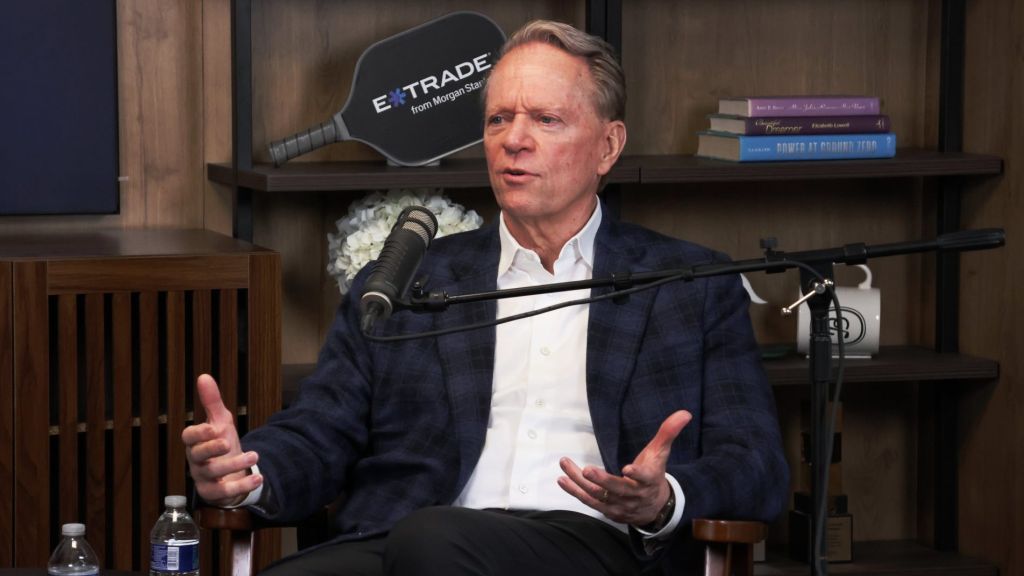
Dave Checketts was working in pro sports when gambling was largely illegal and leagues kept sportsbooks at arm’s length. Now, he worries the proliferation of sports betting—and the industry’s increasing comfort partnering with sportsbooks and prediction markets—isn’t healthy.
“I’m not sure that’s a good thing, this coziness that we’ve established,” the longtime sports executive told Front Office Sports during the latest episode of Portfolio Players.
“I’m kind of old school when it comes to that,” he added.
Checketts was president of the Jazz in the 1980s and the Knicks in the 1990s, when sports betting was mostly contained to Nevada and the black market. He recalled how sensitive the NBA was to gambling exposure during that era. When the Jazz played a series of games in Las Vegas in the 1980s, he said he “had this fight” with the Nevada Gaming Commission “because we had to pull all of the NBA games off their books.”
Las Vegas wasn’t happy about that, because revenue from sports betting has long been a main source of income for the city. “It’s why they have no state income tax,” Checketts said.
The Jazz ended their Las Vegas experiment after just 11 games. “We were completely barking up the wrong wall to get any support in Vegas,” Checketts told FOS.
In another sign of how much things have changed, today the NBA is actively exploring a potential expansion team in Las Vegas.
Checketts had a front row seat to this dramatic evolution. Since the U.S. Supreme Court’s 2018 decision striking down the Professional and Amateur Sports Protection Act (PASPA), 40 states and Washington, D.C., have legalized some form of online sports betting.
In tandem, leagues have entered into big-money partnerships with sportsbooks like FanDuel and DraftKings, consumers are blitzed with ads for those and other companies, and apps allow fans to bet on everything from the outcome of a game and whether a given player will score more than 20 points to micro-events inside games, down to the outcome of a single possession or the next pitch.
The proliferation of wagering on sports took center stage last year with major scandals across the NBA, MLB, and college basketball. Checketts acknowledged that advancements in technology have made it easier for leagues to “track unusual patterns” and catch alleged perpetrators—like the NBA’s Terry Rozier and MLB’s Emmanuel Clase. But that doesn’t mean opening up sports betting even further is a positive outcome, he said.
Checketts, who nowadays runs a private-equity fund that is seeking to raise $1.2 billion to invest in a range of sports-related areas, isn’t blind to the scale or staying power of sports betting. He’s similarly uneasy about the rise of prediction-market companies like Kalshi and Polymarket, which took the country by storm last year. Their platforms allow users to put money on sports in all 50 states, minus Nevada right now, which has scored tentative legal victories prohibiting those companies from offering sports event contracts in the state. Many other states have contested platforms’ right to offer what they view as synonymous with sports betting, and experts expect the issue will eventually reach the Supreme Court.
Despite the controversy around prediction markets, leagues have begun to embrace them. The NHL, MLB, and MLS all have deals with platforms, while the NBA is in discussions with Kalshi and Polymarket. The NBA on April 30 issued a letter to the Commodity Futures Trading Commission saying that protecting game integrity is its “highest priority” and outlining a list of requests it has as the federal regulator prepares to propose new rules for the prediction-market industry.
“It’s just one more bedfellow, just cozying it up,” Checketts told FOS.
Download the FOS App
The business of sports, in your pocket.



Scan the QR code to get the app now.