Want more from Front Office Sports
in your search results?
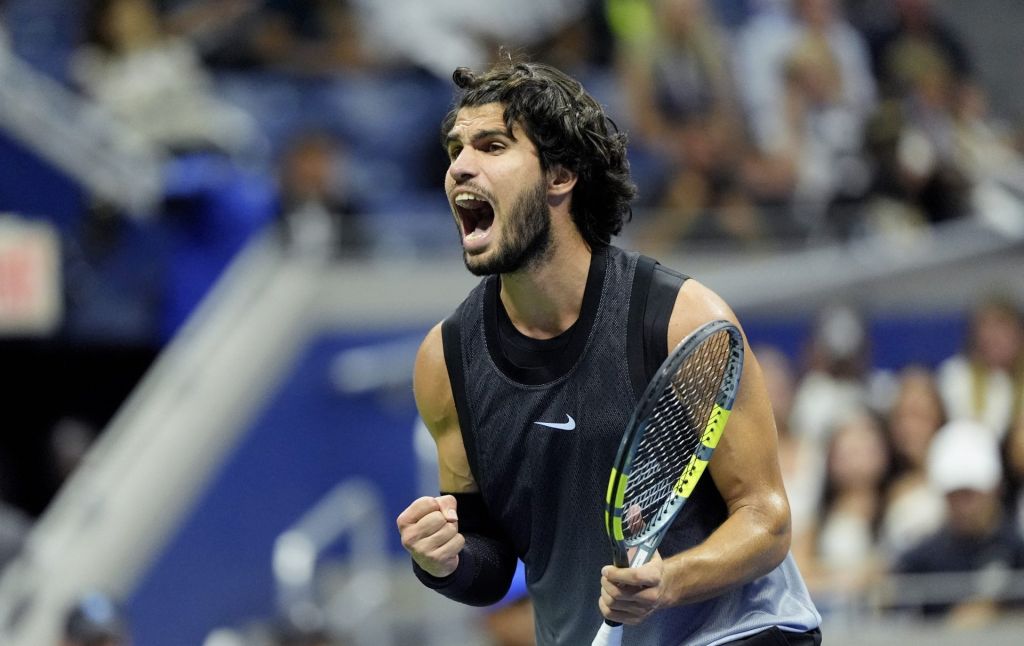
Carlos Alcaraz called on tennis tournament organizers to end the increasingly common practice of playing into the early hours of the morning. Earlier this month, Alcaraz lost to Ben Shelton in a US Open quarterfinal that ended at 3:33 a.m., the latest finish in tournament history.
“It is too much,” Alcaraz told reporters in London on Thursday, a day before the Laver Cup begins. “They are going to have to do something. I’m not saying 3:30, but [even] finishing at 12 is too late already.”
There’s been an explosion of late finishes at Grand Slams in recent years. Alcaraz and Jannik Sinner previously set the US Open mark with a 2:50 a.m. finish in 2022, while Novak Djokovic and Lorenzo Musetti broke new ground at the French Open when they concluded a 2024 match at 3:06 a.m.
At this year’s US Open, Venus Williams and Sofia Kenin also set a new tournament record for the latest start time, getting underway at 12:13 a.m.
“For an athlete finishing at 3:30 in the morning, it means we had to leave the courts at 4:30, then back to the hotel,” Alcaraz said of his after-dark encounter with Shelton. “You don’t go to bed until 6:30 or 7 in the morning. To recover for the next match, the person you play has an advantage.”
The US Open schedules one men’s and one women’s night-session match each evening, the first of which is meant to begin shortly after 7:00 p.m. But during this year’s quarterfinals, two day-session matches on Tuesday ended in final-set tiebreaks, pushing the start time of the first night match to roughly 8:20 p.m. and creating a domino effect that ended in Alcaraz and Shelton’s early-hours five-set thriller.
The USTA did not return Front Office Sports’s request for comment. In an interview during the tournament, USTA director Craig Tiley stood by the scheduling, saying, “I hear from a lot of people that it finishes too late, and then I say, ‘Okay, and your suggestion is?’ I don’t get anything.”
Other Grand Slams have also struggled to conclude play before midnight. The Australian Open has a similar two-match night-session schedule and has seen three finishes even later than Shelton-Alcaraz, including the latest finish in Grand Slam history at 4:34 a.m.—between Lleyton Hewitt and Marcos Baghdatis in 2008.
Roland-Garros added a night session for the first time in 2021, which includes just one match and begins at 8:15 p.m. local time. But the French Open has repeatedly come under fire for almost exclusively scheduling men’s matches in the evening slot.
Of the four Grand Slams, only Wimbledon, which has an 11 p.m. curfew mandated by a neighborhood ordinance, has avoided late finishes of the sort Alcaraz decried.
“It is a shame a match like this didn’t reach a lot of people because they have to go to bed, they have to work in the morning,” Alcaraz added. “If that match had started at 7 or 8 p.m., at the maximum finishing at 11, the stadium would have been packed. A lot had to miss it because of the schedule.”
Download the FOS App
The business of sports, in your pocket.



Scan the QR code to get the app now.