Want more from Front Office Sports
in your search results?
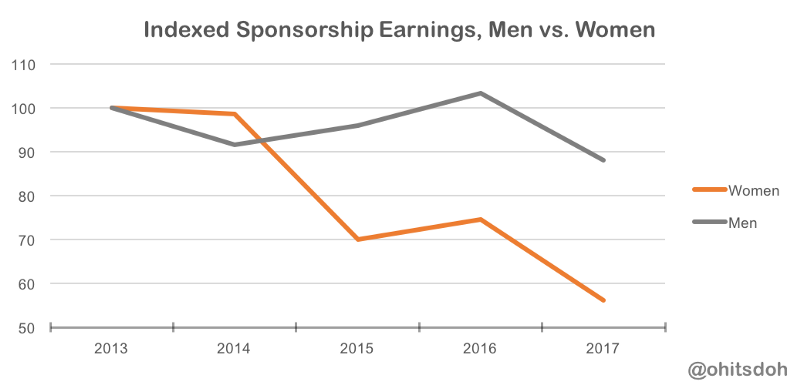
Unfortunately, the gap has been growing over the years.

While the broader topic of the gender pay gap is one that has been exhausted in the media and academic papers, articles such as these paint a picture that the pay gap is improving.
Statements like this:
“Peter Laatz, evp of sports marketing firm Repucom, attributes advertisers’ growing interest in female athletes to the potent purchasing power of women — who control 70–80 percent of consumer purchases — coupled with the growth of the women’s activewear market, with $18 billion in annual sales, per NPD Group.”
Remain true — showing that there is a massive market to be had in targeting women with their messaging.
But here’s the thing: since 2014, the pay gap has actually gotten worse — especially in sports sponsorships.
Why Is This Happening?
Any athlete sponsorship happens for two primary reasons: brand equity or brand exposure.
Brands have yet to leverage any type of comparative advantage that women’s sports may hold, compared to men’s sports. Nor, is there significant evidence that this exists (though, as Reuters reports here, Serena Williams’s pregnancy could boost her sponsorship earnings — meaning one of two things: that there is indeed a significant comparative advantage, or that it only exists for relatively rare events).
The most observable advantage that men’s sports has are its viewership numbers, which leads to, among other things, an increased following on social media. For example, if a brand were to sponsor Alex Morgan, they would (all things being equal) not receive the same amount of brand exposure as if they sponsored Cristiano Ronaldo.
But even if women were more likely to watch women’s sports, sponsorship may not be the most effective strategy in reaching women. As Matt Powell of NPD Group has reported, women’s sports apparel sales, relative to men’s apparel sales, has been increasing.
While this may be due to the fact that smaller numbers are easier to grow, it also may suggest that athletic wear brands in particular have found that the more efficient strategy is not to sponsor female athletes, but instead to opt for different strategies to target women.
Another point: treating sponsorship as a market, there is a large supply of athletes, and a limited number of prospective sponsors. In other words, brands hold a large amount of leverage over commoditized athletes (which holds true until the upper echelon of stardom), allowing for them to pay lower prices. This is especially true for young female athletes, for whom there is little opportunity to build a following.
Particularly in sponsorship, where valuations are largely based on subjectivity at similar levels of talent or fame, the amount paid out to many female athletes is determined by the same brands who own said leverage.
Little wonder, perhaps, that female athletes end up getting paid much less than their male counterparts.
How Can We Solve This?
Luckily, the Internet is here to save the day.
Women’s sports are a victim of linear programming. Where networks only have a limited amount of time allotted for live sports, it is necessary to determine which program, for a given time slot, would maximize viewership.
As a result of linear programming, female athletes were relegated to either suboptimal timeslots, or simply no timeslots at all.
While this is clearly bad for viewership, it is also bad for leagues — who base many of their scheduling decisions on television networks’ schedules.
In a relationship where the network has outsized leverage over a league, leagues will tend to schedule their games to fit a television schedule which may maximize the league’s total viewership within the bounds of a (linear) network.
But given an unbounded, or non-linear network, leagues are unburdened by the limits of time — and are able to maximize their viewership further by scheduling their games at times that will absolutely optimize their viewership. This, among other things, would bring in more sponsorship revenue.
While this will disproportionately help the lower-to-middle class of athletes, these are the female athletes who have been most underfunded. In addition, it opens up the chance to reach more high-value viewers for both leagues and athletes, as a virtue of diminished opportunity costs (with the internet: none!). These viewers act in the same way as fans of other niche sports. With a greater willingness to pay, niche viewers would provide more opportunities for revenue.
So — in conclusion: non-linear programming will give the balance of sponsorship earning power to the lower-to-middle class female athletes.
Does This Matter?
Obviously, this is all dependent on brand properly evaluating athletes. And sponsorship only ends up being a part of an athlete’s total earnings.
A cursory look at the Forbes Top 10 earners paints a much less stark picture:
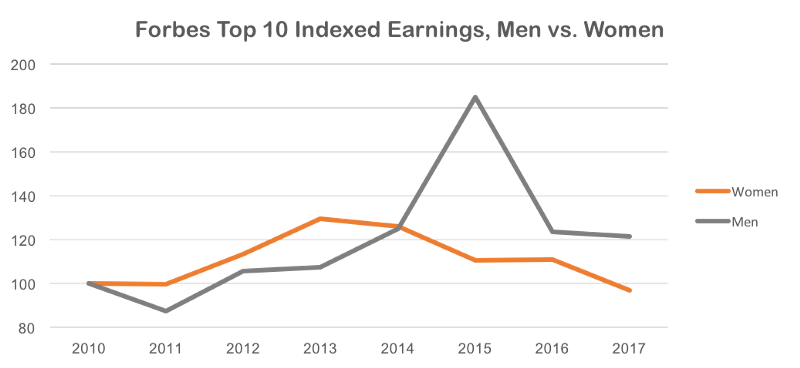
Though the gap has been widening in recent years, the trend is not as concerning as it is for sponsorship.
And given the low exposure of women’s sports, perhaps it does not make sense from the brand perspective to achieve perfect parity.
The question would be whether or not female athletes are only now receiving their true value in sponsorships — which would imply that they were overpaid in years past.
“… the stats are showing that we have much more spectators on the men’s tennis matches. I think that’s one of the reasons why maybe we should get awarded more.”
I am wholly unqualified to determine whether men have a right to more prize money. However, I can tell Djokovic that he can rest easy. Earning $28M in endorsements in 2017, his earnings have far exceeded those of even Serena Williams, who only earned $19M in endorsements in 2017.
The reason why this is important is because subjective valuations are susceptible to changes in perception. If nothing else, sponsorship can act as an indication of the underlying issues in gender disparities in sports, and if female athletes, relative to men, are experiencing a decreasing yearly rate of endorsement dollars, we may be observing a bigger issue at stake.
This piece has been presented to you by SMU’s Master of Science in Sport Management.
Front Office Sports is a leading multi-platform publication and industry resource that covers the intersection of business and sports.
Want to learn more, or have a story featured about you or your organization? Contact us today.
Download the FOS App
The business of sports, in your pocket.



Scan the QR code to get the app now.