Want more from Front Office Sports
in your search results?
Some Group of 6 conference leaders are concerned that the College Football Playoff’s expansion to 24 teams will lead to their teams getting boxed out from scheduling enough Power 4 opponents to be viewed as postseason-worthy.
“I just continue to advocate for not freezing out G6 opponents in the non-conference or being afraid to play against the top of the G6,” Mountain West commissioner Gloria Nevarez tells Front Office Sports.
The top-ranked G6 conference champion will still receive an automatic CFP bid under the upcoming 24-team model. But other teams seeking at-large bids in the 24-team bracket will likely need strong out-of-conference résumés to keep up with the Power 4 counterparts, which will now be required to play at least 10 qualifying regular-season games—either conference opponents, nonconference Power 4 teams, or Notre Dame. But the landscape is already shifting.
“I don’t think there will be as many available,” Conference USA commissioner Judy MacLeod tells FOS. “We’ve had a number of teams that have been dropped from schedules already.”
The G6 has a similar scheduling requirement to play at least 10 qualifying regular-season games—conference opponents and nonconference opponents against other Group of 6 or Power 4 opponents, Notre Dame, or another independent school.
Most G6 leagues currently only play eight conference matchups within their 12-game schedules—the Mid-American (MAC) is moving to nine in 2028—but MacLeod says many of the CUSA ADs “have tried and tried and they just can’t get games” against Power 4 teams.
“Scheduling is always the most difficult thing coaches and ADs face,” Nevarez says. “And at the top of the G6, having games against the Autonomous Four is important—so you get that cross-pollination, you increase your strength of schedule. So, continuing to have access to play against those teams is going to be important—and difficult.”
If finding Power 4 opponents remains difficult, MacLeod says the G6 “has to be more strategic in matching our top teams against each other for some quality games.”
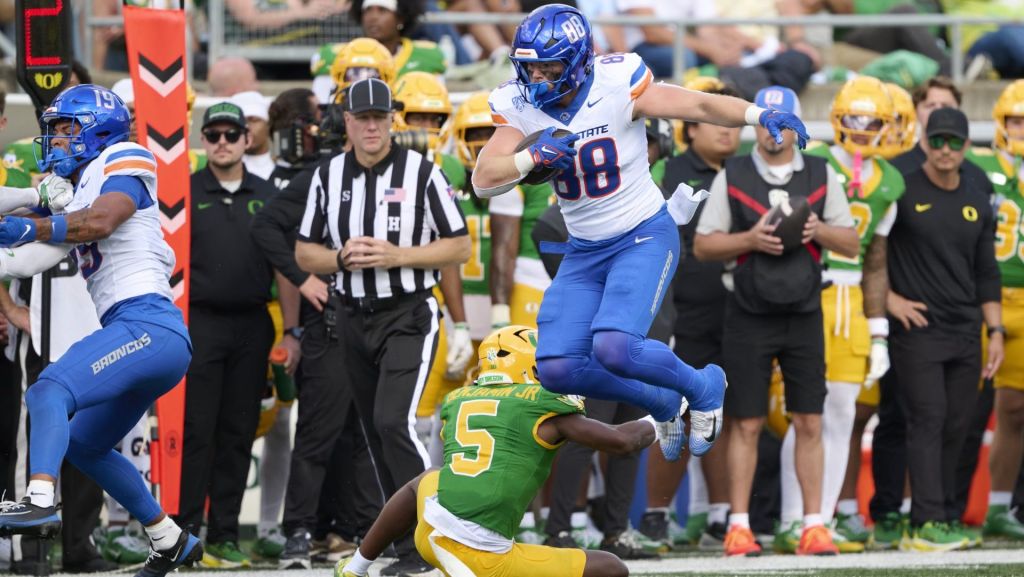
Ryan Leaf, the lead Pac-12 analyst for USA Sports, said the G6 only being guaranteed one automatic CFP bid in the 24-team model is “troublesome” moving forward. “The fact that the first College Football Playoff rankings had Boise State at No. 25, they’re already setting you up for the idea that you’re not one of the top 24 teams in the country,” Leaf said in a recent interview with FOS. “And that was a little bit disappointing.”
Nevarez echoes that sentiment.
“My concern is that we get a fair shake in the committee selection room,” she says. “That they do not give predictive measurements of weight in the room. That they don’t weigh brand affiliation or historic success, but truly look at the résumés and body of work from a particular team in that season.”
Future of Conference Championship Games
While the ACC, Big Ten, Big 12, and SEC will no longer play conference championship games once the 24-team Playoff is implemented in 2027, the G6 leagues remain undecided on how they will crown their champions.
“Our coaches, a lot of our schools would prefer to have a championship,” MacLeod says, while also admitting “timing might not allow us that opportunity.”
If the CFP decides to hold its Selection Sunday on the day after the Power 4 regular seasons end on Thanksgiving weekend, then any G6 championship games would in all likelihood need to be moved up from their traditional dates on the first weekend of December. The Mountain West currently has two bye weeks and eliminating one to facilitate a championship game is possible. But other circumstances, such as exposure with media partners, must be considered as well.
“The football season gets really compacted really quickly,” Nevarez says.
A Group of 6 Playoff?
Maximum G6 inclusion in the CFP remains the top priority for the conferences, despite the aforementioned concerns about the new landscape. To that end, the non-power leagues have not seriously considered a separate G6 playoff at this point.
“I’m never going to say never, but we think it’s really important that we’re involved and have an opportunity to play in the CFP,” MacLeod says.
As postseason play evolves, the future of non-CFP bowl games has also come into focus. There’s interest at multiple levels to keep bowls going. Before the idea of a separate playoff, Nevarez proposes a revamped bowl pairing system.
“I would prefer that we were all part of a what’s next after the CFP field is selected,” Nevarez says. “That would be my first option. The next several best teams, regardless of your affiliation, G6, Power 4, have some kind of bowl grouping to play in.”
However, Nevarez says she would also “be very open to ’the best of the rest” having a conversation about what we do in the postseason.” MacLeod suggests exploring ideas “that would match champions and like teams.”
Bowl Season organizers previously told FOS they would support a G6 playoff if those conferences were interested in creating one. Now that Playoff expansion is confirmed, hypothetical conversations between conference commissioners can become more tangible.
“We have constantly talked about this and tried to pencil out models,” Nevarez says. “I think up until this point, its been very hard to get a conversation going because there was just so much unknown. Given now that we do know that the 24-team Playoff is happening, I think those conversations can start to get real.”
When reached for comment by FOS for this story, the American Conference deferred to commissioner Tim Pernetti’s statement supporting CFP expansion. The MAC, Pac-12, and Sun Belt did not respond to recent interview requests.
Download the FOS App
The business of sports, in your pocket.



Scan the QR code to get the app now.