Want more from Front Office Sports
in your search results?
In MLB’s final four, one team is not like the others.
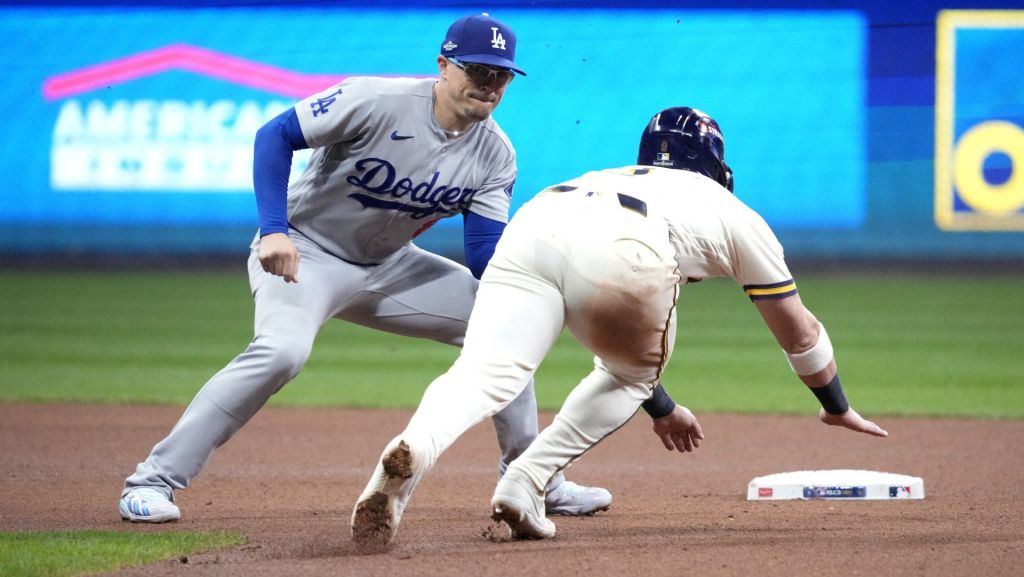
The two-time defending champion Dodgers are back in the National League Championship Series for the eighth time in the last 11 seasons, though they dropped Sunday’s Game 1 to the Brewers. The Dodgers’ $433.1 million luxury tax payroll, however, is not only the highest in the league but is far greater than the combined $360.5 million spending by the other three remaining teams: the Brewers, Guardians, and Rays.
The contrast showcases the revenue and spending imbalance that is at the center of the ongoing labor battle between owners and players.
The American League Championship Series beginning Monday between the Guardians and Rays in particular will be a battle of penny pinchers, with Cleveland coming in with MLB’s second-smallest payroll at $92.6 million and Tampa having the fourth-lowest at $113.2 million.
The Brewers, meanwhile, rank No. 19 with a $154.7 million payroll, but continue to operate in the league’s smallest media market.
Talking Points
That disparity between the Dodgers and the rest of the group lies at the heart of a bitter divide between MLB and the MLB Players Association. In pursuing a hard salary cap and strict limitations on free agency, management contends that systemic divides make it impossible for teams such as the Rays and Guardians to compete consistently and have a full chance to advance regularly in the postseason.
To that end, MLB has pointed out that it has not had a small-market World Series winner since the 2015 Royals. Additionally, nearly 80% of League Championship Series participants and 85% of World Series teams over the past decade have come from a top-15 market. Neither the Rays nor the Brewers have a World Series title in their franchise histories, and Cleveland last won it all in 1948.
“It defies human experience to ask a fan to think that the bottom end of that [payroll] gap has the same opportunity to win as the top,” MLB commissioner Rob Manfred said in July. “From our perspective, the more important issue is what is the aggregate data over time? I think our view of the world is that over a very long period of time, there’s a very strong relationship between who gets into the playoffs and who proceeds.”
The union, conversely, argues that the issue is one of owner willingness to spend, and that the sustained success of teams such as Milwaukee are proof of an ability to compete in a free-market system. Meanwhile, several high-revenue, big-market teams such as the Mets continue to miss the postseason.
“We do not accept the premise that there’s some existential crisis going on,” union interim executive director Bruce Meyer said.
While both sides will be looking at many more data points than just year’s playoff field, the presence of teams such as the Brewers, Guardians, and Rays in the LCS round brings greater public focus around the market-based debate.
“Every team in baseball has the ability and resources to be competitive if they have the desire to do so,” Meyer said.
Owners and players remain deeply split on many core economic issues, including the salary cap that players vehemently oppose. A management lockout is expected in December when the current labor pact expires. In the meantime, owners have also proposed several other large-scale changes, including a shortened regular season and expanded Division Series.
Download the FOS App
The business of sports, in your pocket.



Scan the QR code to get the app now.