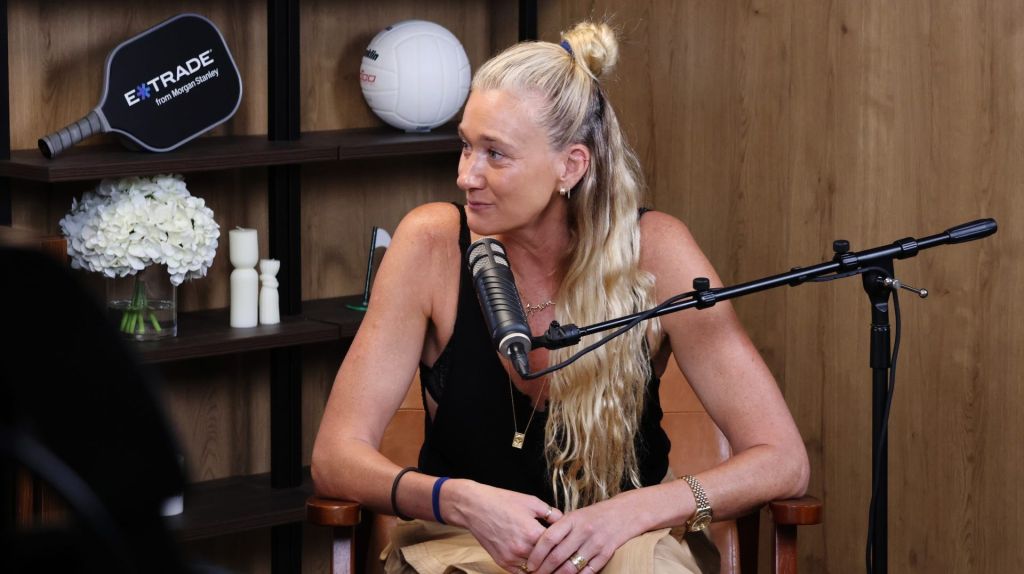
Three-time Olympic gold medalist Kerri Walsh Jennings picked her side of the great volleyball divide, and cites contrasting ownership structures as a big reason why.
Professional volleyball is fractured into two main leagues: Major League Volleyball (MLV) and League One Volleyball (LOVB, pronounced “love.”) In a recent episode of Portfolio Players, Walsh Jennings told Front Office Sports about becoming a co-owner of MLV’s upcoming 2027 expansion team in Northern California, which on Tuesday announced its team identity as the NorCal Rumble.
Walsh Jennings said she chose MLV over LOVB because she appreciates the ownership structure being “more traditional to U.S. sports.” Walsh Jennings, who hails from the Bay Area and played college volleyball at Stanford, owns the franchise alongside venture capitalist Theresia Gouw and Sacramento Kings owner Vivek Ranadivé.
“To me, it would be a shame to not be able to leverage their IP, their wisdom, their competitive spirit, whereas the other league [LOVB] is centrally-owned,” Walsh Jennings said.
MLV teams are individual franchises belonging to owners, while LOVB is a single-entity structure where all teams are owned by the league. The former is a structure used by leagues like the NFL, NBA, WNBA, MLB, and NHL, while the latter can be found in MLS, the NWSL, PWHL, and WPBL.
“Everything is dictated by central casting: the teams, the rosters, the coaches, just go there, they’re being told what to do,” Walsh Jennings said of her competitor. “They’re an amazing marketing machine, but for me, I think long term we are positioned so well to be in the pole position because our structure is sound, the franchises are independent, and we’re going to make each other better.”
LOVB is going through a bit of an off-the-court transformation ahead of next season. The league will own its teams and remain as a single-entity model, but most teams are bringing their business operations in-house, similar to the dynamic in MLS and the NWSL.
The league will still handle national partnerships and media rights, but at least seven of 10 clubs will be in charge of their own local sponsorships and marketing, ticketing, fan experience, and venue logistics.
Team identities are a part of that shift. While teams have historically been called “LOVB Madison,” “LOVB Austin,” and so on, the new Bay Area expansion team unveiled its moniker as the San Francisco Signal.
MLV vs. LOVB
On the sand, Walsh Jennings was one half of an iconic duo alongside Misty May-Treanor. Her former partner was a founding board member of LOVB’s new Los Angeles team.
L.A. is one of four markets, including San Francisco, where LOVB is expanding this December, bringing the league to a total of 10 teams. MLV will also add four teams this offseason, including the Rumble, to expand from eight to 12 teams next year.
Last season, MLV averaged 3,607 fans at its 112 regular season matches, according to data provided by a league spokesperson. With an average of 10,189 fans, Omaha had by far the highest attendance, followed by Indianapolis and Grand Rapids with an average attendance of 4,506 and 3,582 fans, respectively. The remaining five teams averaged fewer than 3,000 fans per match.
A spokesperson for LOVB declined to share exact attendance data for each market.
LOVB operates at both the youth and pro levels, which was a driving reason why Gotham FC governor and New York Giants co-owner Carolyn Tisch Blodgett chose to invest in the league through her firm Next 3 Ventures.
“If you think about it from a fan perspective, you are literally growing up playing in this league, and then you become a fan of that league on top of it,” Tisch Blodgett said last week at the FOS Asset Class event in New York. “So we really liked the vertical infrastructure of it.”
Walsh Jennings said it’s “amazing” that there’s currently two leagues so athletes graduating from NCAA volleyball have more professional opportunities, and because LOVB provides healthy competition.
“But at the pro level,” Walsh Jennings said, “ultimately, yes, one league dominating would kick ass.”