The NFL is promoting the sort of wide-open passing game that could extend the record-matching scoring surge seen in Week 1—when teams scored 791 points, tied for the most ever in an opening weekend.
Week 2 began Thursday night with a 72-point game as the Bills opened their new stadium by beating the Lions, 41–31.
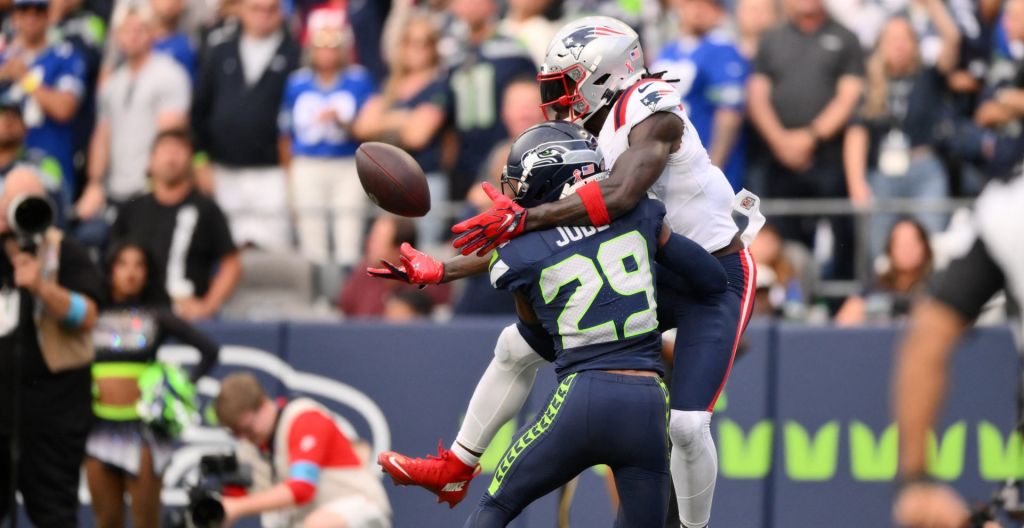
The NFL wants to see wide receivers and defensive backs running freely through secondaries this season without being slowed by tactics involving clutching, grabbing, and pushing off. To accomplish this, the NFL competition committee has made illegal contact by defensive backs beyond five yards from the line of scrimmage and offensive pass interference points of clarification for this season, according to a weekly officiating video.
Such citations by the competition committee were formerly called points of emphasis and represent what the committee and league stress to on-field officials for strict enforcement in a given season.
In previous years, the NFL has stressed illegal contact by defensive backs as a point of emphasis to open up the passing game and boost scoring. League leaders and rule-makers have generally believed that high-scoring games increase fan interest and broadcast viewership. In this case, the league is calling strict enforcement of illegal contact a “continuing” point of clarification by the competition committee.
In its Week 2 officiating video sent to coaches and players midweek, the NFL shows an example of illegal contact by a defensive back and says in its voice-over: “This is a continuing point of clarification by the competition committee in its annual report and our messaging to game officials. … This is a clear illegal contact. … There’s that overt push, clearly beyond [five yards]. Quarterback is still in the pocket. Illegal contact would be the proper call.”
Officials called seven illegal contact penalties during Week 1 games. That was actually down from 10 such penalties league-wide during Week 1 last season. But as with many NFL rules, the question is whether strict enforcement changes players’ on-field behavior and produces the intended result. In this case, if defensive backs cease their clutching-and-grabbing tactics, offenses benefit and scoring likely rises.
Including offensive pass interference as a point of clarification is a concession of sorts to defensive players, who regularly complain that the rules are unfairly tilted in favor of offenses. Six offensive pass interference penalties were called during Week 1, up from only one during last season’s Week 1 games.
In the weekly officiating video, the NFL shows two plays as examples of offensive pass interference and says: “What the receiver cannot do is go to the [defender’s] body. You can take and you can knock those [defender’s] hands up, down, swim across through those hands and arms. But you cannot go to the body and extend and push off. … This [play] will be another example of offensive pass interference. Again, this was a point of clarification by the competition committee in its annual report and in its messaging to game officials. … He [the receiver] cannot go to the body [and] push off like this.”
But the upswing in offensive pass interference calls has not kept scoring in check. The Week 1 scoring-fest went against the general wisdom that defenses are ahead of offenses early in a season, especially when teams often keep their starting quarterbacks out of preseason games.
Some analysts, including former Steelers coach Mike Tomlin and former Seahawks cornerback Richard Sherman, cited defensive shortcomings. Tomlin said during NBC’s broadcast last Sunday night that defenders can’t work on tackling during training camp and other practices, given the current-day limits on practice-field hitting.
Sherman said during Amazon Prime’s postgame show Thursday night: “Guys aren’t tackling well.”
Another factor in the high scoring was kickoff returns. The 3,769 yards on kickoff returns league-wide in Week 1 were the most in any week of play in NFL history. And the 138 kickoff returns were the most ever in a Week 1. About 80.7% of kickoffs were returned in Week 1, up from 75.6% in the opening week last season (and 74% over the full 2025 season).
This is the third season of the NFL’s revised kickoff format, designed to encourage returns instead of touchbacks while aiming to keep the injury rate comparable to that of a play from the line of scrimmage. Returning teams are taking full advantage of the format early this season.
The viewership results were mixed in Week 1. The Week 1 games averaged 19.5 million viewers. That was down 13% from Week 1 last season and down 9% from 2024. But it was still the NFL’s third-most-watched opening week in the last 10 seasons. ESPN had its most-watched Week 1 Monday Night Football game in its 20-year history with the program.
The NFL averaged 18.7 million viewers per game during the 2025 regular season, up 10% from 2024 and its highest such figure since 1989.