Colin Cowherd Buys Stake in EPL’s Ipswich
ATLANTA — England and Argentina will square off in the World Cup semifinal in Atlanta on Wednesday, reigniting a bitter international rivalry.
In the back half of the 20th century, practically every time these prideful footballing nations met, something explosive happened. There were controversial ejections and legendary goals set against the backdrop of seething political tensions.
In 1982, Argentina invaded the Falkland Islands, or the Islas Malvinas, a group of islands off the coast of Argentina in the Southern Atlantic, which was then under British control. England swiftly won the war in two months as Argentina bore the brunt of the bloodshed. The Falklands are still part of the United Kingdom today, though Argentina continues to dispute the matter.
Four years after the war, the countries met in an intense face-off on the pitch in the 1986 World Cup quarterfinal match on a hot day at Mexico City’s Estadio Azteca. Argentina’s Diego Maradona scored both the “Hand of God” goal and then, minutes later, what is widely considered one of the greatest goals in soccer history. Books, Wikipedia pages, and YouTube videos with millions of views are dedicated to this match alone.
The last time England and Argentina met in the World Cup was in 2002, before England star Jude Bellingham was born. The two countries last saw one another in an international friendly in 2005, which Argentina’s Lionel Messi missed due to a red card, so the superstar has never played England.
Wednesday marks their first match in two decades; the rarity of matchups between the two nations only adds to the lore. The Falklands War is a consistent theme throughout Argentine supporters’ songs. FIFA bans English and Argentine referees from officiating matches featuring the other nation due to the conflict.
On the Pitch
Years before the war, after a handful of other meetings, the emotional roller coaster of a soccer rivalry truly began in 1966.
During a World Cup quarterfinal at Wembley Stadium, Argentina captain Antonio Rattín was controversially sent off on a disputed second offense, which he protested by not leaving the pitch, then sitting on a red carpet reserved for Queen Elizabeth II. (Rattín’s controversial ejection led directly to the invention of red and yellow cards for the 1970 World Cup. He died last week.)
England manager Alf Ramsey didn’t let his players swap jerseys with the Argentines after the match and later called his opponents “animals.”
The next history-making clash was the 1986 match. Maradona scored the first goal “a little with the head of Maradona, and a little with the hand of God,” though years later, upon admitting he used his hand to score, called it “symbolic revenge” for the Falklands War. The second goal he scored was all athleticism and technique, blasting past England defenders as he ran half the length of the pitch to find the back of the net again. The commentary by Víctor Hugo Morales is nearly as famous as the Goal of the Century itself. Still, English players and fans felt cheated after the match and the Hand of God goal, after which Maradona arguably should have been sent off.
“That goal was kind of looked like as a middle finger to England, like, ‘We got one over the imperialists,’” CBS Sports Golazo analyst Stefano Fusaro, who inherited his soccer fandom from his Argentine father, tells Front Office Sports.
Maradona, who always hinted he cheated to score the Hand of God goal, fully admitted it in the early 2000s and died in November 2020.
The Next Chapter
The 1998 and 2002 World Cup meetings between the teams were marked by an English celebrity superstar, David Beckham. He was sent off with a controversial red card in the first match and shouldered the blame for England’s loss. Then he became the hero four years later with the lone goal of a group-stage win that contributed to now–U.S. men’s national team coach Mauricio Pochettino and Argentina getting eliminated in the group stage. “Listen, those of [us] who played in 1998 were desperate to win this game,” England’s Paul Scholes said.
Off the Pitch
Argentina coach Lionel Scaloni downplayed the stakes heading into Wednesday’s semifinal. “It’s a soccer match,” he said after beating Switzerland in the quarterfinals. “Period. There’s no more than that.”
But for the rest of Argentina, the national rivalry is still fresh.
Even though the war was decades ago, the Argentine troops—both the 649 people who died in the conflict and the veterans who have given detailed accounts of mistreatment by their own officers—have become icons in Argentina.
“They became heroes in that war where a lot of them went to die against England,” Fusaro says.
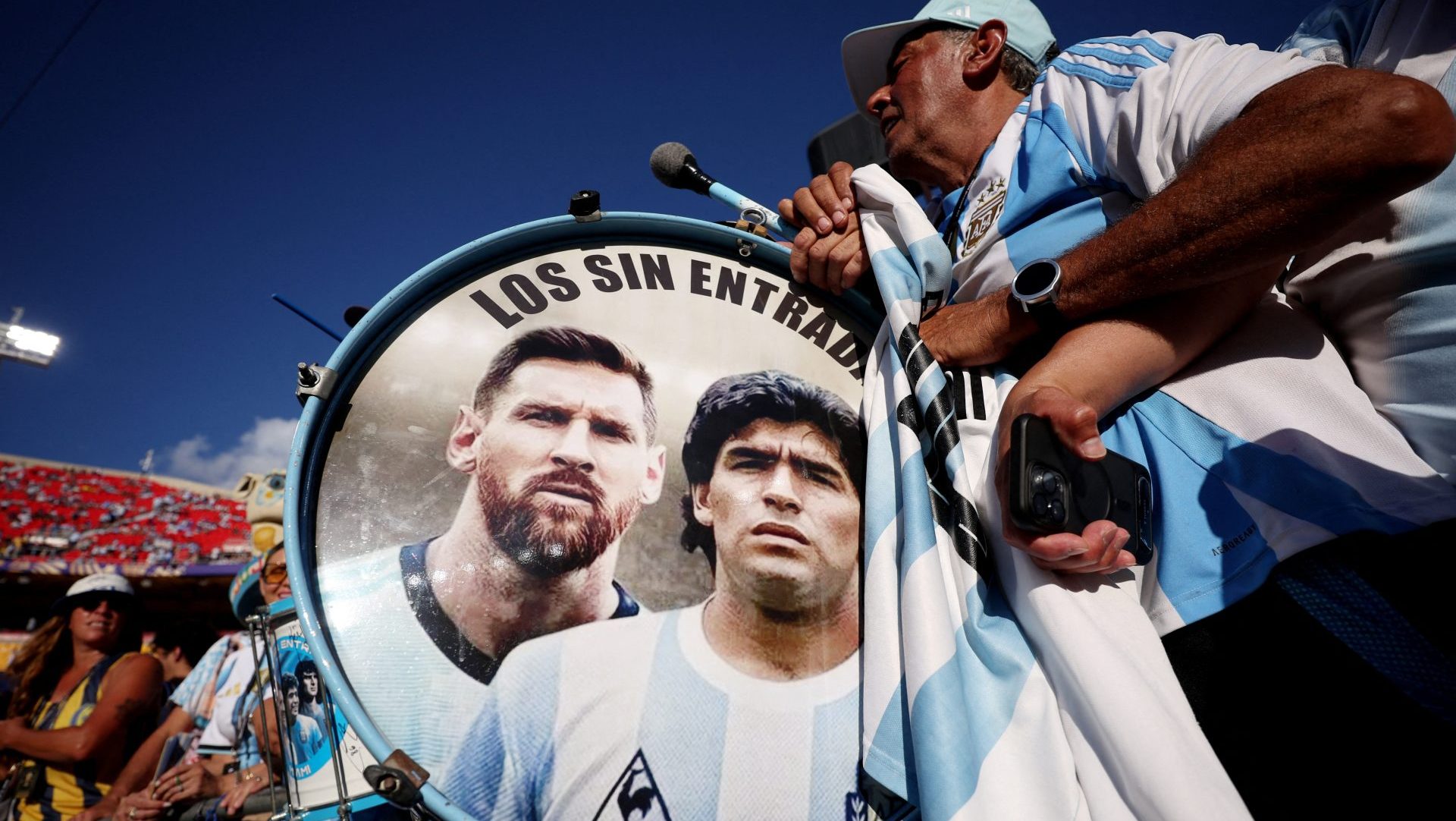
Several lines from popular supporters’ songs sung by both fans and players make references to the Falklands War and the English:
- “El que no salta, es un Inglés!” (“Whoever doesn’t jump is English!”)
- “En Argentina nací, tierra de Diego y Lionel, de los pibes de Malvinas que jamás olvidaré” (“In Argentina I was born, land of Diego and Lionel, of the boys of the Falklands that I will never forget”)
- “Por Malvinas, por el Diego, por la última de Leo” (“For the Falklands, for Diego, for Leo’s last one”)
This week, politicians took things a step further. Argentina foreign affairs minister Pablo Quirno said people in the Falklands have been “artificially implanted by the occupying power,” to which a spokesperson for British Prime Minister Keir Starmer responded that the islanders are “British with a right to determine their own future.”
An Argentine veterans association for the war has asked people to focus on soccer rather than sovereignty claims, saying the semifinal is “not an armed rematch nor historical compensation.”
England defender Ezri Konsa told reporters Tuesday that it’s a special rivalry, but the match was before his time—he was born in 1997—and his team needs to focus on itself. Scaloni gave a similar message in his Tuesday press conference.
He said they remember those lost in the war, but people don’t need to conflate things, and that it would be wrong to impose history onto tomorrow’s match and its players, who have nothing to do with it.
England coach Thomas Tuchel in his press conference was more candid about the history and rivalry.
“I would say it’s irrelevant, but I’m not sure,” Tuchel said. “I think the players are very aware.”
Tuchel said as a coach he tries to say it’s just a match and focus on what he can influence, and that his team hasn’t discussed it.
“I think it does not help if we engage emotionally,” said the German.