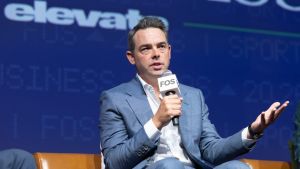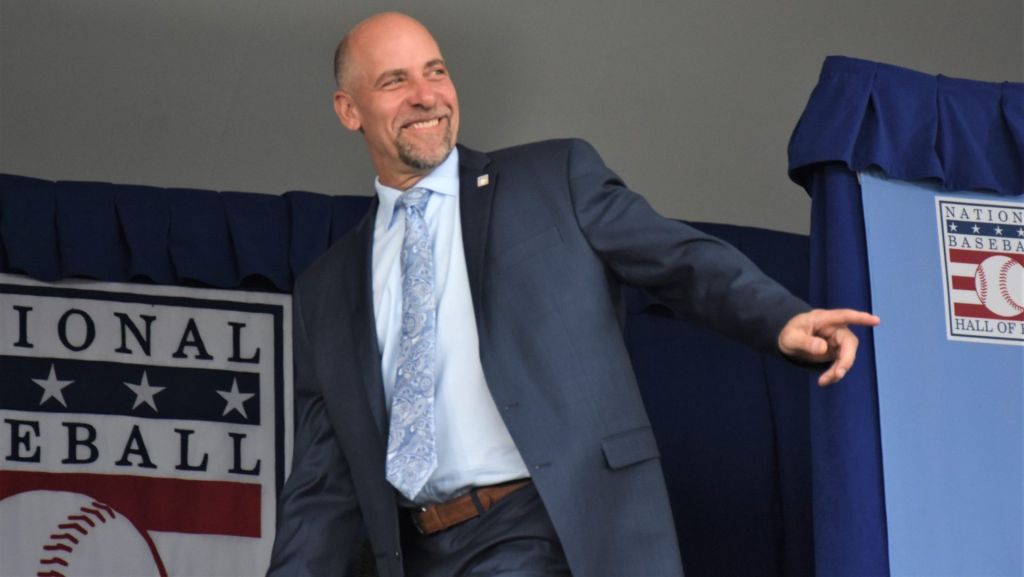
John Smoltz will call the MLB All-Star Game alongside Joe Davis on Fox on Tuesday night.
Ahead of the Midsummer Classic, the Hall of Fame pitcher spoke to Front Office Sports about the culture of baseball players who ultimately appear in the All-Star Game putting forth their full effort, what he thinks about teams positioning their aces to avoid the exhibition, and Davis’s rise. Smoltz also weighed in on looming labor issues and the question of whether MLB can sustain two expansion teams.
Front Office Sports: What is it about baseball, and the culture of the sport, where the players who do play in the All-Star Game really go all out physically relative to the NFL and NBA, where the Pro Bowl and All-Star Game often have so little competition they can’t even be characterized as glorified scrimmages?
John Smoltz: I agree; that’s why it’s unfair how everybody keeps calling for changes to the MLB All-Star Game. It’s the best All-Star Game. It’s absolutely played like a regular-season game. Nobody’s in there throwing 85-mile-per-hour meatballs to see if guys can hit home runs. I think that part has always been an intriguing shining star on our sport.
Now, can we spruce things up and do different things? Yeah, I don’t see why not. But I think that’s the sport that gets lopped in because other sports have had a hard time doing exactly what I just said.
FOS: What do you think about the Brewers and Pirates slotting dynamic young pitchers Jacob Misiorowski and Paul Skenes for the Sunday before the All-Star Game, making them ineligible for the NL Tuesday? [Note: This was recorded before Miz got scrapped from Sunday’s start due to arm fatigue.]
JS: A lot of this has always come down to timing, and we’re in an era where there’s been a ton of injuries. So, you can understand the mindset. We didn’t have that mindset 15 to 20 years ago. Whether you pitched on Sunday or not, you were going to pitch on Tuesday because it was an inning or two. But a lot has changed here and you can understand that, especially with the rate at which everyone’s getting hurt. It just happens to be where a club wants that pitcher to pitch, or where he falls in the lineup, so that part I completely understand.
FOS: When you pitched in an All-Star Game, what was your mindset in terms of wanting to compete but also not wanting to disrupt your regular-season routine?
JS: It was an honor to be selected to showcase the kind of year you’re having, and you want to be at your best. You can adopt the mindset that it doesn’t matter, but any player that does that doesn’t have a heartbeat for what this game represents.
Now, at the end of the day, if it doesn’t go well, it shouldn’t ruin your season, but in 1996 I got the win in Philadelphia the last time they had the All-Star Game, so that’s going to be a pretty cool moment for me just remembering how that was and the amount of fun that I had playing against the other league.
We didn’t have interleague play for the longest time. Seeing guys on the other side was way more different than it is today where there’s more familiarity.
FOS: You’ve been working with Joe Davis for several years now. He got this job calling the World Series a lot younger than a lot of the people who are calling championship-level events in other sports right now. What is it about him that made him so special to be an outlier like this?
JS: The very first thing he did was replace Vin Scully, so if you’re going to replace him you’re going to be able to replace anybody. Then all he did was replace Joe Buck, so his shoes have to be pretty big because he’s jumped in full to an industry that’s really hard and he’s done an incredible job. I can’t imagine or speak to what that must be like.
For me, obviously there’s one thing I know I’ll never forget, and that’s the first name—I’ve only worked with Joes. So I’ve got that going for me as I get older.
FOS: As someone who played the game at such a high level, what about Davis’s understanding of it has stood out to you?
JS: Play-by-play guys are creating a narrative. They understand the nuances of the game and steering broadcasts and setting up the analyst to do his part—that’s the gift that both Joe Buck and Joe Davis have had.
Davis is a great athlete. He grew up 15 miles from where I did in Michigan, obviously at different times. He was a great athlete; he understands how things work. He’s delivered as good as it gets in the big moments. He’s totally prepared.
FOS: You went through the 1994 strike as a player. With this looming labor issue hanging over this season, what do you think about what the owners have been proposing as far as a salary cap goes?
JS: That’s never gonna go away. That’s been a topic for a long time. Posturing in negotiations is part of the deal. Thankfully, it doesn’t happen every year, but those are the things that the representatives on each side are trying to work out. You hope as a player when you’re going through it that the best-case scenario works out so that everybody can get to a point where an agreement is behind you and you continue to spread the momentum that baseball has going.
Everyone’s aware of it, but like anything else you go through the process. And the process will lead us one way or another to an agreement. Now, I hope the agreement comes before there’s any kind of stoppage. That would be ideal, but it will be interesting to see how many more meetings and how much energy they get moving towards the end of the season.
FOS: There have been stories kicking around about the idea of MLB expansion. Do you think there’s enough talent to support one or two more teams, and if it does happen what cities do you think would be good destinations?
JS: I hope it happens. I think baseball has shown what young, talented players there are. I would love to see us get to 32 teams. I’d love to see four divisions of eight. I’d love to see realignment. I’d love to see the schedule be more palatable for teams that are in really tough geographical places.
I’ve heard Utah, I’ve heard New Mexico, I’ve heard Nashville. I just think that discussion will come fairly soon after a labor agreement is signed and I think baseball would be vibrant in a lot of cities with the young talent that’s being mass-produced.
The one thing baseball’s gotta do a better job is the injury prevention part. Aside from that, the game has never been more dynamic with young talent, and I think you could make the argument that two more teams would not dilute that.