Want more from Front Office Sports
in your search results?
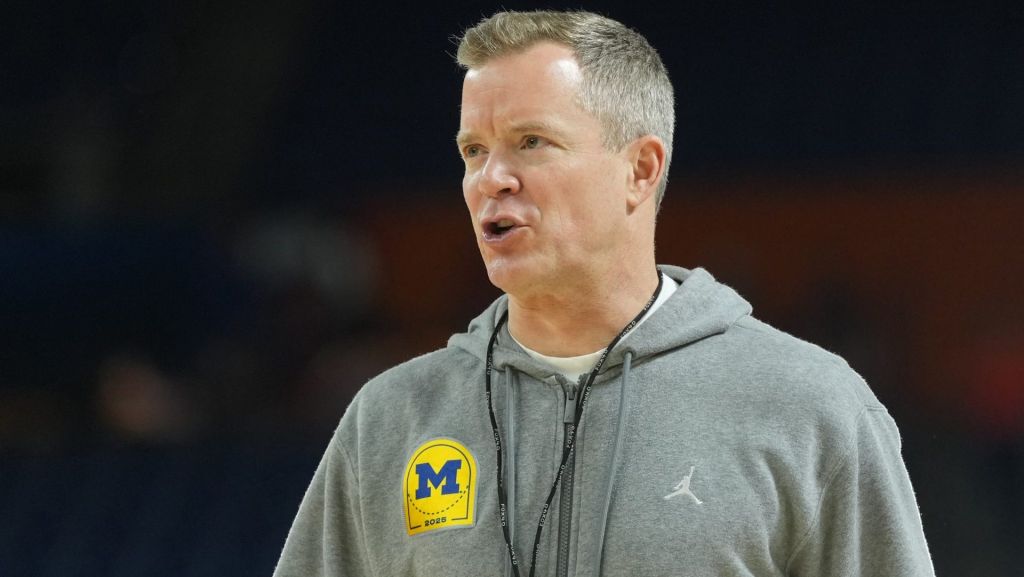
Dusty May is aware of the track record—or lack thereof—for college basketball coaches leaping to the NBA.
But he had something his preps-to-pros predecessors didn’t: an NCAA landscape that nearly mirrors the pros, giving him an advantage they didn’t possess.
“The last five years of the NIL era is a segue into the NBA,” May said during his introductory press conference with the Mavericks on Monday. “We weren’t coaching professional players per se where they’re under contract. But they were getting paid. The same problems, not at the same scale, but similar problems, similar issues, similar challenges. The game is closer than ever. College, NBA, the G League. Stylistically they all look very, very similar.”
May was hired on June 22 after leading the Wolverines to the national championship in April. At the Final Four in Indianapolis, he said he would not seek any other college jobs, which first began speculation that he was interested in the NBA.
Michigan AD Warde Manuel said at the team’s on-campus championship celebration a few days later that he and May agreed to a new deal. The head coach, however, told Front Office Sports later in the month that he wouldn’t sign it until July, calling it “a formality.”
Despite FOS’s reporting that there was mutual interest between May and multiple NBA teams, the 49-year-old said Monday he fully intended to return to Michigan until Mavericks president Masai Ujiri and general manager Mike Schmitz approached him at the NBA draft combine to gauge his interest in the job.
“The Mavs checked every box,” May said of the job.
May has never coached in the NBA. He said his Mavericks coaching staff will have a “college flavor,” but will include coaches with NBA experience and some retention from Jason Kidd’s previous staff.
Unlike other notable coaches who slammed the state of college basketball on their way out, May did not follow their lead. But he did hint that the state of the sport wasn’t irrelevant to his decision to leave.
“[College basketball] is much more complicated than it used to be,” he said. “I love teaching. I love coaching. I love being part of a team. And in college basketball you don’t get to do near as much of that as you used to. There are some things about college basketball that I won’t miss.”
To this point, it’s been a mixed bag for college coaches who went on to the NBA. Larry Brown remains the only coach to win both an NCAA and an NBA title. Former Michigan coach John Beilein didn’t last a full season when he was hired by the Cavaliers in 2019. Brad Stevens (Celtics) and Billy Donovan (Thunder and Bulls) have both had regular-season success but failed to make the NBA Finals as coaches.
May was asked about the inconsistent trend of college coaches and cited others, such as Hawks coach Quin Snyder (Missouri) and Thunder coach Mark Daigneault, who worked for Donovan at Florida as “college guys” who successfully transitioned, while noting that they had stops in the G League before coaching in the NBA.
“There actually has been success,” May said of Snyder and Daigneault. “It just hasn’t been framed in a way where it was an immediate success.”
The Indiana graduate takes over a roster with several foundational building blocks in Rookie of the Year Cooper Flagg, Derrick Lively II, and Morez Johnson Jr., who starred at Michigan with May and went No. 9 overall in last week’s NBA draft. Despite their Ann Arbor ties, May said he had no input in drafting Johnson.
Dallas’s roster also has veterans such as Kyrie Irving and Klay Thompson. May doesn’t think he will need a years-long rebuild to make the team relevant again.
“Sooner than later,” he said of the Mavericks playoff chances. “We have some veterans that have done it before in pivotal moments and we have some young guys who are on the cusp of breakthrough seasons.”
Download the FOS App
The business of sports, in your pocket.



Scan the QR code to get the app now.