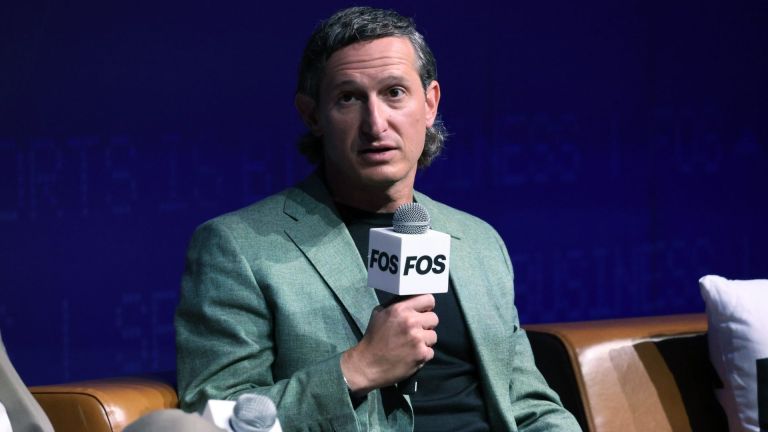

DraftKings cofounder Matt Kalish has been openly critical of Kalshi, but says his concerns are with the company’s approach, not prediction markets broadly, which he sees as an enormous opportunity for the sports betting industry.
Kalish, who cofounded DraftKings in 2012, stepped down from his executive role in March to form a new “content creator agency” called Hardscope, although he remains on the betting giant’s board of directors. He has spent the past few weeks torching Kalshi on social media for what he views as misleading marketing tactics and trading mechanics.
He went back and forth with many users, and his claims have included that Kalshi remains years away from developing a consumer product that is on par with the apps offered by traditional sportsbooks, as well as that Kalshi has inflated the perception of its popularity through both public relations campaigns and users, investors, and employees driving online engagement.
He has leaned into building a public persona online, including through a 25-minute video focused on why sportsbooks limit bettors, as well as a 21-minute video about why he thinks Kalshi’s $22 billion valuation is overstated.
In a wide-ranging interview last week, Front Office Sports asked Kalish whether he was predisposed to having negative views of Kalshi, or prediction markets generally, because of his traditional sports-betting background and continued financial interest in DraftKings.
“Hell no,” he said. “I love prediction markets. I think it’s one of the most exciting things going on in gambling right now.”
The reason he has attacked Kalshi and not its main rival, Polymarket, is simple. “I’ve never used Polymarket,” Kalish told FOS. He also thinks Polymarket’s founder, Shayne Coplan, “has a little bit more instinct for the communities, for the culture,” compared to Kalshi cofounder Tarek Mansour, who Kalish has personally criticized on social media.
“But also, though, I’m just seeing Polymarket getting their behinds handed to them in mainstream media every single day,” he said.
Polymarket has come under fire twice recently due to alleged insider trading on its international platform. First, in April, a U.S. soldier was indicted by the U.S. Department of Justice for allegedly using inside information to make more than $400,000 betting on when the U.S. military would capture Venezuelan President Nicolás Maduro. Last month, a Google software engineer was indicted for allegedly using confidential internal information to make more than $1.2 million on Polymarket betting on markets related to who the most-searched person of 2025 would be.
Kalshi has sought to stay out of the fray; in the aftermath of Kalish’s posting spree, a representative for the company responded to a request for comment with a GIF from the movie “Mean Girls,” in which the character Regina George asks “why are you so obsessed with me?”
“We Don’t Have to Be the First Mover”
The rise of prediction markets has had an undeniable impact on sports betting. DraftKings stock is down roughly 24% over the past year, while shares of Flutter Entertainment—the parent of FanDuel—are down about 60% over the same time period. Both companies have launched prediction-market platforms to compete and are even getting into market-making (market makers provide liquidity by posting bid and ask prices for contracts to enable trading).
According to Kalish, the sports-betting industry has done a “lousy job getting focused up on this.” Since prediction markets currently fall under a federal regulatory framework instead of state-by-state, Kalish said they represent a “massive” opportunity for sports betting companies that can offer their platforms in states where sports betting remains illegal, including Texas, Georgia, and California.
Although companies like DraftKings, FanDuel, Fanatics, and BetMGM “are in the absolute best position to have the most market share,” Kalish says they have allowed “fake narratives,” such as the idea that “Kalshi is eating our lunch,” to proliferate.
“I mean, that is not happening,” he told FOS. “I think the way the industry handled investor relations overall here was not good. I’m not very impressed by it.”
For all of his critiques, Kalish does give Kalshi credit for taking on the expensive and risky legal and lobbying work for the industry. “Kalshi is amazing in certain ways,” he told FOS. The company is fighting dozens of lawsuits, some filed against the platform by state regulators and others filed by the platform against those same regulators. It also faces multiple consumer class actions and lawsuits from Native American tribes that claim prediction markets are encroaching on their sovereignty over gaming in parts of the country.
“It’s great to have Kalshi on the front line, spending all the money so we could just tail it,” he says. “We don’t have to be the first mover.”
As to what will ultimately happen with sports event contracts, Kalish doesn’t pretend to know. Many expect the issue will eventually reach the U.S. Supreme Court. Asked what he thinks about the arguments being made in court over sports event contracts, Kalish was blunt.
“Love it,” he told FOS. “I mean, it’s goofy in a certain sense. We know that sports betting isn’t like stocks, so it’s goofy on its face. But from a business opportunity standpoint, nothing could possibly be better.”