ESPN senior writer Wright Thompson is in the midst of hosting a series, Where It Lies, which explores the world of municipal golf courses.
Earlier this week, he spoke with Front Office Sports about a wide range of topics, including the inspiration for the series, his last meal on Earth, why he’s bullish on a “renaissance” for literary magazine-style sports journalism, his white-whale profile subjects, and why he left X/Twitter.
Front Office Sports: You’re doing this series on municipal courses, Where It Lies. What was the inspiration and what’s the coolest thing you’ve discovered in the process?
Wright Thompson: The inspiration was Tim Horgan, who runs a production company called Bluefoot. Every TV show I’ve ever made, I’ve made with him. He loves muni golf. He’s been talking for years about how his bucket list was we need to do this show. We make a show together called True South on SEC Network. We’ve been making that for 10 years. The joking title of the golf show for a long time was True Golf.
It’s basically taking the things we’ve learned doing the show about the South and then going and finding these worlds of municipal golf courses. My favorite thing I’ve learned is that every one of them is an ecosystem unto itself. The stories feel naturally different in a way that’s pleasing. My big silent worry was that a thing like this goes to die if we go different places but they all feel the same. But they don’t!
FOS: You have one coming out about a muni course at Augusta. What’s that like, being in the shadows of Augusta National, but a course that anyone can go play?
WT: The fascinating thing about that is we got to really talk about the history of Augusta, Ga. and Augusta National, and frame it for people in a way that people who watch the Masters every year have probably never thought about.
The course was conceived in one America, rose to prominence in another one, and is now sort of trying to find its way in a world that’s remaking itself. You see the Masters going from being a tournament that this club of private American power brokers sort of reluctantly opens their club once a year so the world can come in, to now, with that America fading into the past and a new one replacing it.
You almost get the sense that Augusta National was a club without a reason to exist and they’ve found a new reason to exist, which is to transform themselves into the American RNA. They’re going to be ambassadors for growing the game of golf. You see all these tournaments that they’re putting on all around the world. They footed the bill for renovating the Patch [the Augusta muni course]. It’s part of the club reinventing itself in this post-American century.
FOS: On the topic of the Masters, if you could rent a house for the tournament, what group of people would you do it with?
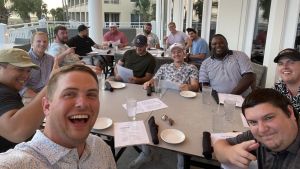
WT: It would be the people that I did it with before—Steve Politi from the Newark Star-Ledger (NJ.com), Dan Wetzel (now at ESPN), and Jay Busbee and Jay Hart from Yahoo Sports. The house is way more fun than the tournament. Several years in a row, we had [Old Rip Van Winkle Distillery president] Julian Van Winkle staying with us. He brought a bunch of Pappy.
Because I’m on magazine deadlines, I could always leave when the tournament ended [each day], and I’d become the house cook. We had these huge, fabulous dinners and people would come over. Barry [Svrluga] from the Washington Post [now The Athletic], Mike Rosenberg [from Sports Illustrated], and Rachel Nichols would come over all the time. Kaylee Hartung and her mom would come. We had this great crew. It was just magic.
FOS: On the writing path, what are some of the pieces you’ve written over the years that people come up to you and tell you how they remember them as great stories?
WT: You probably could guess. It’s the Holy Ground about the Masters about my dad. It’s both Michael Jordan stories, Tiger Woods. I get a lot of Pat Riley—people seemed to really like that one—and a lot of Caitlin Clark. Everybody has a different one, which is interesting. I certainly have my favorites, and it’s definitely interesting what people respond to.
FOS: You mentioned the magazine deadlines, when everyone else is scurrying for the immediacy of the internet or even newspaper print. Do you ever feel like you caught the last chopper out of Saigon that you get to be one of these literary sports magazine writers? Like with Augusta and how America’s changed, it’s not really a common format anymore.
WT: There’s a group of us at ESPN who still do it, and a couple other people—Mirin Fader [at The Athletic]. I firmly believe that the sports magazine is a minor yet totally American art form. I sort of think we’re just keeping our hand over the flame while this moment sorts itself out. Call me optimistic, but I firmly believe that a renaissance is coming.
What matters more and more to people is authenticity and truth. I think we all instinctively believe that sports documentaries are so heavily curated by the athletes themselves, that they’re the modern version of what we used to call jockographies in the ‘80s, we’re just keeping it alive until somebody smarter than us figures out how to monetize it again. But I think these stories have existed as long as American sports have existed, and I really do see a renaissance of them coming again.
FOS: What’s an elusive subject that you’ve wanted to write about but you just haven’t been able to get him or her to sit down and bare their soul?
WT: There’s so many. How much time do you have? Gregg Popovich. I’ve tried over and over to get Tiger Woods. I’m currently chasing Wemby. It’s harder to find than you think. They can’t just be a white whale. If the only reason for being there is nobody can get them, there’s something fundamentally flawed about it. It has to be the intersection of someone elusive, but also somebody I have a real authentic question about.
The last one I just did was Steve Kerr. I was genuinely curious about him and would have been if he’d have been somebody you’ve never heard of. That’s the bar.
FOS: There’s not as many of those figures out there anymore, with the erosion of the monoculture.
WT: I was just about to say that! I saw this interview with Weird Al, he’s struggling to do song parodies because there’s no monoculture where everybody would get the joke. That’s real. Nobody’s famous in a world where everybody’s famous.
One of these issues with these stories that you’re talking about is how many people are iconic enough to make it work? It’s an ever-shrinking number.
FOS: Your last meal on Earth would be…?
WT: A porterhouse at Doe’s Eat Place in Greenville, Miss. … The room is magic. It’s full of ghosts. The steak is perfect. You bring your own wine and whiskey. You’re always there with people you love and because it’s kind of a road trip to get there, it always feels celebratory. It’s where I would go as a kid to celebrate big things, so I always feel like a vapor trail of my father is still in the room.
FOS: If Van Winkle is unavailable, what bottle of bourbon are you buying?
WT: Makers Mark.
FOS: What’s a sporting event that you haven’t been to that’s high on your bucket list?
WT: The Ashes … I want to go to a Boxing Day Test Match at the Melbourne Cricket Grounds. I want to do that bad. I’ve almost done it a couple times. I get a lot of leeway about where to go, but the deal is you can never take advantage of it. If the story isn’t there, you can’t go there just because you want to go. That is betraying a real sacred trust. You have to police yourself.
The story has never been good enough where I feel comfortable walking into [ESPN VP] Chris Buckle’s office and saying, “I’d really like you to fly me to Australia.” It’s never risen to the level where the juice was worth the squeeze.
FOS: When you get contacted by young writers, what do you tell them for advice?
WT: The whole game is reps, reps, reps, reps. Before you write a bunch of 12,000-word stories, you have to write a bunch of 8,000-word stories. Before you do that, you’ve gotta do 4,500-word ones. Before that, 2,800-word ones. It’s just a process. Put your nose down and work.
FOS: Why did you leave Twitter?
WT: Because it’s a cesspool of the worst of humanity … All social media’s the worst. One of the things I think about all the time is when you’re getting gas at a gas station or buying a coffee or drink or something, you have to spend so much time staring at the keypad. There’s another human being separated by a thin counter from you, and in many instances you almost never interact with them.
I just feel like something vital about being a human being is being lost.