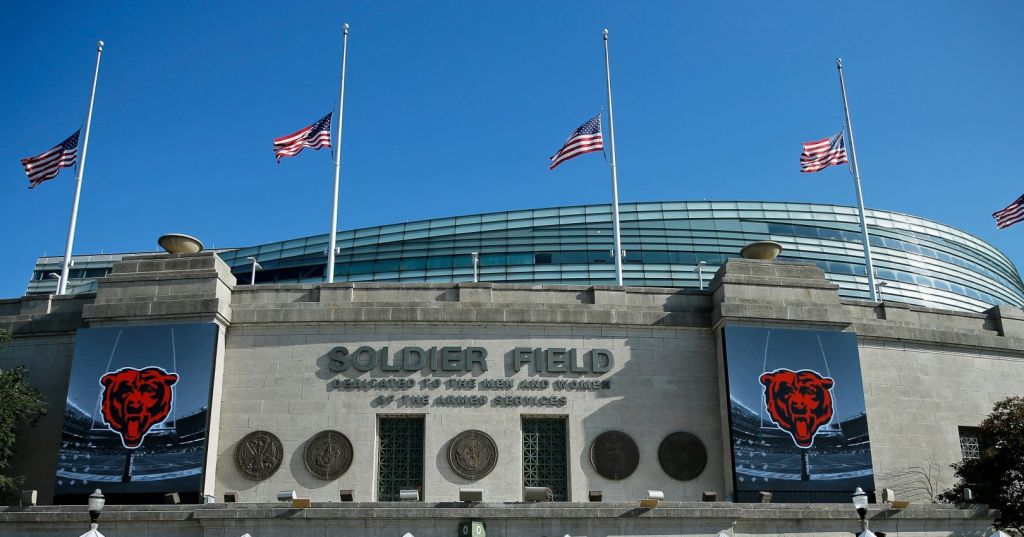
The Bears could reap more than $1.5 billion in long-term tax savings from a “megaprojects” bill under consideration in Illinois, according to a new report from the Cook County treasurer. That finding could further complicate the already delicate politics of the NFL’s team stadium efforts there.
A study released Tuesday by Cook County treasurer Maria Pappas said the benefits of the bill under consideration are clear to the Bears, as it would allow the team to negotiate their own property taxes for a $5 billion stadium and mixed-use development under consideration in suburban Arlington Heights, and freeze the assessed value of that property for 25 years.
The upside for taxpayers, in the view of Pappas’s office, is far less clear, and could siphon away “money that would otherwise go to fund schools and other local governments,” the report read in part.
The study estimates that under the megaprojects bill, the Bears could glean more than $39 million in annual property tax savings on the new stadium, compared to paying on normal assessed values—with that break surpassing $1.5 billion in total value over 40 years.
“Huge real estate projects can create jobs, boost sales tax revenue, and provide other benefits to their surrounding communities,” the treasurer’s study continued. “But property tax breaks for megaprojects would, for decades, severely limit one key goal of economic development: expansion of the property tax base that provides relief to other taxpayers who get no tax certainty. … And if there’s no expansion of the property tax base and only limited sales tax benefits, how do taxpayers benefit? That’s the multibillion-dollar question.”
Down to the Wire
The latest report provides an extra wrinkle in what has already been a fractious political situation surrounding the Bears stadium saga. The team has long insisted it needs this megaprojects legislation to make the Arlington Heights site option work, as it would give critical cost certainty and aid the Bears’ borrowing to support private funding for much of the project.
The bill passed in the Illinois House of Representatives more than a month ago, but progress since then has stalled in the state Senate as legislators there have grappled with the ramifications, both politically and on individual homeowners. With just five days left in the Illinois spring legislative session, pressure around the megaprojects issue is quickly rising.
Meanwhile, a public back-and-forth has erupted between Illinois Gov. J.B. Pritzker and Chicago Mayor Brandon Johnson, in part stemming from the latter’s insistence that the Bears stay in the city. That stance from Johnson, and many state legislators from the Chicago area, is happening despite assertions for months from the team, league, and governor that the stadium choice is down to either Arlington Heights or a competing option in Hammond, Ind., that already has legislative approval.
Notably, Pappas intends to run for Chicago mayor next year.
The Bears have not commented on the county treasurer’s report. The team, however, has been consistent it intends to make a final stadium choice by early summer, and a lack of firm progress in Illinois would certainly heighten the chances of the Bears moving to Hammond. In addition to the megaprojects legislation, the Bears are also asking Illinois for $855 million in infrastructure improvements.
Last week at the NFL’s spring meeting in Orlando, league commissioner Roger Goodell said, “That [political] process is going on. The legislature in Illinois is obviously focused on that. They’re getting into the final days of their session. I’ve spoken to [Pritzker] recently. I think there’s a focus on trying to get something done there, and then they’ll have two viable sites that the Bears can make their decision from.”
For that to happen, though, the megaprojects bill during the next five days must not only clear the Senate but also go back to the House for reconciliation and then to Pritzker for his signature.