
How House Republicans Could Make or Break College Sports Bill
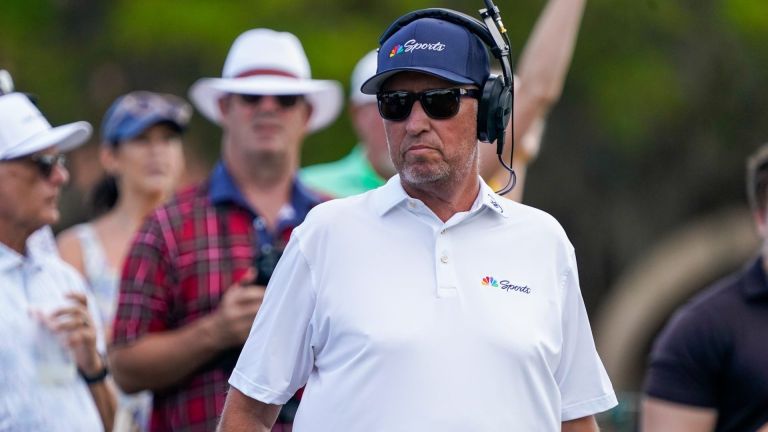
When it comes to calling the Masters, warns golf analyst Peter Kostis, the wisest strategy for sportscasters is to adhere to the Latin phrase “primum non nocere”—first, do no harm.
Broadcasting the Masters is a death or glory affair. One great call can etch an announcer’s name into history. Just ask Jim Nantz (above, right) and Verne Lundquist, whose long careers at CBS date back to a pair of famous calls at the 1986 Masters.
But one wrong remark can leave you excommunicated from the country’s most-watched tournament. Pour one out for Gary McCord, who was banned from CBS’s coverage after joking about “body bags” and Augusta National Golf Club “bikini-waxing” its lightning-fast greens. And pour another one out for the late Jack Whitaker, who was barred for calling the crowd coming up the 18th fairway a “mob.”
So go the dual identities of the Masters. This week, as usual, CBS and ESPN outdid themselves portraying Augusta National as an oasis of Southern gentility and the arena for epic drama from golf greats like Tiger Woods (above left), Jack Nicklaus, and Arnold Palmer.
But behind the blooming azaleas, towering Georgia pines, and flowering dogwoods lies a secretive private club that highly prioritizes being portrayed exactly—exactly—as it prefers. Does that extend to what announcers say? You bet, says Kostis.
“They do if you say something wrong,” Kostis, whose contract CBS did not renew in 2019 after he’d called 30 Masters, tells Front Office Sports. “And my buddy Gary McCord can attest to that. You always have to be careful. Augusta is unique in the golf world. Who wouldn’t want to work the Masters?”
Unique is an understatement when it comes to the Masters. It’s the only one of golf’s four major tournaments played on the same majestic course every year. For all its tradition, it’s the youngest major. Despite its carefully cultivated image as a throwback to the antebellum South, the club was originally bankrolled, and mostly run, by rich Yankees. (To its shame, it remained an exclusively all-white, all-male club until admitting its first Black and female members in 1990 and 2012, respectively.)
This is the 69th straight year the tournament has been broadcast on CBS, making it the longest-running sporting event on any network. The 64-year-old Nantz will host for the 37th straight year, while the 83-year-old Lundquist will call his 40th and final tournament. ESPN, meanwhile, will cover the tournament’s early rounds for the 17th straight year, with Scott Van Pelt hosting the network’s coverage for the eighth straight year.
The two networks have done an outstanding job covering the Masters, but the arrangement is always tenuous: Augusta National has kept CBS and ESPN dangling on one-year contracts for decades. By keeping its partners on a short leash, the club controls how they cover the Masters. (Both CBS and ESPN declined to comment.)
The result is that the networks know they must call the action the club’s way—and using its own arcane language. There are no Masters spectators; they’re “patrons.” There is no rough lining the manicured fairways; it’s the “second cut.” There are no sand traps within the hallowed grounds; they’re “bunkers.” There is no “front nine” and “back nine.” Instead, it’s a “first nine” and “second nine.” Get any of it wrong and a sportscaster can expect a Code Red to be called in from Butler Cabin to their bosses in New York or Bristol.
McCord’s attempt to joke about the speed of the greens backfired in 1994 when Tom Watson, the ’77 and ’81 champion, wrote a scathing letter to the club saying that the “Howard Stern of golf” needed to be “eradicated” from CBS’s coverage. For CBS brass, the choice between defending its analyst over an innocuous remark or possibly angering the powerful club was no choice at all. In a podcast with Kostis, McCord recalled how his network threw him under the bus.
“They go, ‘You’re out. Gone,’” he said.
Whitaker also learned the hard way to choose his words carefully. After being banned for his “mob” quip in 1966, it took him six long years to return to Magnolia Lane.
Augusta National has always been brilliant at manipulating its image. When legendary amateur champion Bobby Jones and Wall Street investment banker Clifford Roberts launched the Masters in 1934, it was just another tournament. But famed sportswriter Grantland Rice was a founding member. The trio convinced sportswriters returning by train from baseball spring training in Florida to cover the fledgling event on their way back north. That’s why the Masters is always scheduled for the first full week in April. The club also stroked the writers by inviting them to play the course—a tradition that continues to this day. In return, smitten scribes gave the tournament glowing coverage, also now a long and continuing tradition. (“The Masters is more like a vast Edwardian garden party than a golf tournament,” claimed the writer Alistair Cooke in ’83.) From that point, the Masters secured its place on the sports calendar as a rite of spring, along with baseball’s Opening Day, the Kentucky Derby, and March Madness.
“It is held at a wonderful time of the year, when practically every golfer, after a long hibernation, finds his fancy turning to [the Masters],” wrote Herbert Warren Wind in The New Yorker in 1962.
CBS first broadcast the final four holes of the Masters in 1956. But for decades, Augusta National limited TV coverage, leaving hundreds of millions of dollars in rights fees on the table, as Jones and Roberts stayed loyal to the golf writers who helped build the Masters. Why not? They played a key role in creating Masters lore. The local Augusta Chronicle newspaper came up with the term “Arnie’s Army” to describe the legions of Palmer fans, many of them soldiers from nearby Fort Gordon, who followed their hero around the course. Wind coined the term “Amen Corner” in a ’58 Sports Illustrated article about “The Fateful Corner.” Fast-forward 30 years and it was the turn of TV journalists to turbocharge their careers through some of the most famous TV calls in Masters history.
A 26-year-old Nantz was working his first Masters tournament in 1986. As Jack “The Golden Bear” Nicklaus launched a back nine charge, Nantz rose to the occasion. “And there’s no doubt about it. The Bear has come out of hibernation,” said Nantz, after Nicklaus rolled in a birdie on the 16th hole.
That did it. One of sportscasting’s great careers was born. Within three years, Nantz was hosting CBS’s Masters coverage. Within four years, CBS dumped Brent Musburger after a contract dispute, opening the door for the younger Nantz to lead the network’s Masters, NFL, and NCAA coverage. Augusta National has trademarked Nantz’s memorable description, “A Tradition Unlike Any Other.” While Nantz gave up his NCAA role this year, he wants to call 50 Masters or more, including the 100th tournament in 2036. (Due to World War II, the Masters wasn’t played from 1943 through ’45, so the 100th tournament is distinct from the 100th anniversary.)
Lundquist himself was working the 17th hole at the 1986 Masters. As Nicklaus’s birdie putt neared the hole, he told viewers, “Maybe … yes sir!” Short, succinct, perfect. It’s still Lundquist’s favorite Masters call, topping his “In your life, have you seen anything like that?” narration of Woods’s miraculous chip-in at number 16 in 2005.
“I can remember thinking to myself as he walked up, ‘Keep it simple and get your butt out of the way.’ And I managed to do that,” Lundquist remembered on a press call.
For those calls alone, Lundquist will live in Masters history, Nantz said on that same call. “Verne’s always going to always have a home in Augusta. He’s going to be a part of Augusta forever. Those calls that he’s made, they’re going to be played back 50, 100, 200 years from now.”
If covering the iconic tournament can be an announcer’s golden ticket, it can also make them a cautionary tale. Media partners working the Masters know the drill by now.
On a preview call, Van Pelt recoiled at the idea of ESPN lobbying Augusta National for more air time. “Everyone knows that we’re there to cover it however they want,” he said.
Once they step into the artificial and carefully controlled atmosphere of Augusta National, media partners know there’s nothing more important than extolling the tournament’s history, the bucolic beauty of the course, and how lucky they are to be part of it. One former TV executive who worked the tournament likened it to high school kids sitting up at attention when the school principal walks into the classroom.
To be fair, CBS and ESPN sportscasters and executives talk about Augusta National not with anxiety but with an almost religious reverence. Nantz said he can practically feel the ghosts of Masters champs like Palmer, Ben Hogan, and Gene Sarazen. (“It’s sacred, this tournament,” he said on CBS this week. “The sacred sod of Augusta. Everybody longs to play in this tournament. The course is the greatest stage in golf.”) Retiring CBS chairman Sean McManus talks to his late father, sportscaster Jim McKay, at his dad’s favorite spot: Amen Corner. ESPN’s Mike Greenberg calls it, simply, his favorite place on Earth.
“Everybody’s on their best behavior,” said Van Pelt. “Everybody’s in a good mood.” And if they’re not, you can be sure they’ll do their best to fake it.”