Want more from Front Office Sports
in your search results?
EAST RUTHERFORD, New Jersey, and PHILADELPHIA — Severe weather threatened to upend two World Cup matches Monday night as thunderstorms moved across the mid-Atlantic.
France–Iraq in Philadelphia, scheduled for 5 p.m. ET, and Norway–Senegal in New Jersey, scheduled for 8 p.m. ET, were the first two matches of the tournament that dealt with significant weather concerns. The matches in outdoor stadiums had to contend with a storm system bringing high humidity and the possibility of damaging winds and tornadoes.
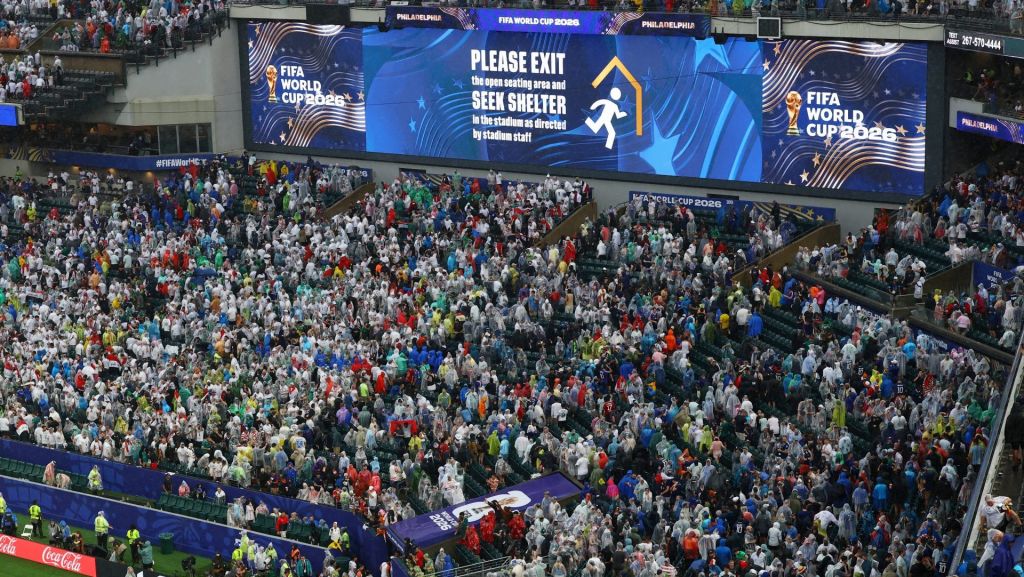
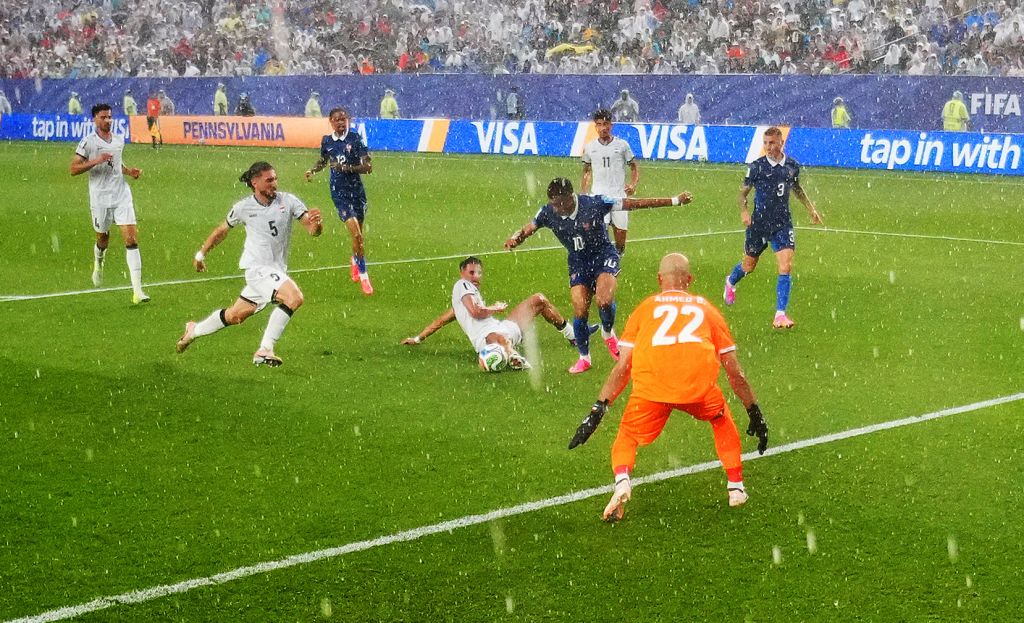
France and Iraq completed their first half without incident, with a Kylian Mbappé screamer giving the French a 1–0 halftime lead. But the rain picked up around 5:30 p.m., about 37 minutes into the match, and fans donned ponchos, but did not move from their seats. At halftime, a seek-shelter notice was announced in the stadium due to lightning in the area, and fans were directed out of the open stands and into the covered concourse.
The National Weather Service issued a severe thunderstorm warning for Philadelphia until 6:45 p.m., and the start of the second half was delayed. Fox aired an extended segment from Rebecca Lowe, Zlatan Ibrahimović, Thierry Henry, and Alexi Lalas before switching to a replay of the U.S.–Australia match as the delay stretched into its second hour.
The grounds crew cleared some of the excess water from the field, and play resumed shortly after 8 p.m. The delay caused Fox to temporarily move the broadcast of Norway–Senegal to FS1. France went on to win 3–0.
It was the first time the tournament was disrupted by weather after last summer’s Club World Cup was riddled with weather delays.
A FIFA spokesperson said in a statement to Front Office Sports that FIFA will monitor weather conditions and “stands ready to apply established contingency protocols should extreme weather events occur.”
“A comprehensive, tournament-wide preparedness exercise focusing on severe weather scenarios has further strengthened cross-agency coordination and operational readiness,” the spokesperson said. “Stadiums are required to maintain robust risk management and evacuation procedures, including lightning and severe weather protocols aligned with local legislation and international best practice.”
In the U.S., stadiums are supposed to issue delays if there is lightning within an eight-mile radius of the stadium, and cannot resume play until half an hour after any reported lightning strikes.
Before the match, Philadelphia Stadium briefly delayed opening gates, but fans were able to begin filtering in around 2:30 p.m. ET. Trains on SEPTA’s B Line were filled with fans, with multiple trains bypassing several stations before delivering thousands of fans to NRG Station in South Philadelphia.
About 100 miles Northeast, a large portion of the northern part of New Jersey was under a flood advisory (including Bergen County, where MetLife Stadium is) and severe thunderstorm watch. New York City was also under flood watch.
Fans faced on-and-off rainfall heading to East Rutherford for the Norway–Senegal match. For fans riding the $98 NJ Transit train to the stadium, the power briefly went out at Secaucus station, the transfer point between Penn Station and MetLife, which has been renamed New York New Jersey Stadium for the tournament. One NJ Transit rider told FOS they were “drenched” on the way to the stadium.
“Weather could pose some challenges and NJ Transit’s mobility plan incorporates the potential for inclement weather,” a spokesperson for NJ Transit said in a statement to FOS. “We will adapt accordingly to minimize the impact to both World Cup fans and our regular commuters, alike.”
The rain lightened up before the start of the match, and Norway–Senegal kicked off on time at 8 p.m., about the same time France–Iraq resumed in Philadelphia. Senegal supporters were heavily outnumbered by Norwegians and neutral fans. The country is one of four World Cup participants under a travel ban from the U.S. that prohibits fans from coming to the U.S. for the tournament.
The game went off without any weather delays, and Norway won 3–2. After the match, players led fans in a Viking row to celebrate the victory.
In Philadelphia, the stadium announced a sell-out of 68,324 fans. MetLife also had an official sell-out with 80,663 people.
Rain started back up in New Jersey shortly after the match ended. Officials announced a severe weather warning about half an hour after the final whistle that forced a brief shelter in place at the stadium due to lightning in the area. The heavy storm passed in under an hour and stadium workers and media were able to safely leave MetLife.
Fan events in both cities were also impacted by the storms. Philadelphia’s Fan Festival in Fairmount Park was closed early in the afternoon due to the weather and did not reopen for the remainder of the day, and around 4 p.m., the FIFA Fan Fest in Queens announced it would also close for the day due to the severe weather.
“Over several years of preparation, the Host Committee, FIFA, and our public safety, transportation, venue, and government partners have developed and exercised plans for a wide range of potential scenarios, including severe weather,” a spokesperson for the NYNJ host committee said in a statement to FOS. “We are actively monitoring conditions and coordinating closely with all stakeholders to ensure we can respond appropriately to any changes while maintaining a safe and positive experience for fans.”
Download the FOS App
The business of sports, in your pocket.



Scan the QR code to get the app now.