Want more from Front Office Sports
in your search results?
Lane Kiffin went viral last week for inflammatory comments, as he is prone to do. Except this time, the comments didn’t come during a press conference, or on a podcast, or via Kiffin’s extremely active personal X/Twitter account.
Instead, they were tucked into the final paragraphs of a nearly 3,000-word profile on the LSU head football coach, published May 11 by Vanity Fair. The writer of the piece, Vanity Fair contributing editor Chris Smith, said he spent more than four hours on campus with Kiffin in April—a rare level of access to one of the biggest names in college sports.
And it paid off.
During their time together, Kiffin recounted certain difficulties he had when trying to recruit Black athletes to his former school, Ole Miss: “‘Hey, coach, we really like you. But my grandparents aren’t letting me move to Oxford, Mississippi,” was a common refrain, he told Smith. “That doesn’t come up when you say Baton Rouge, Louisiana. Parents were sitting here this weekend saying the campus’s diversity feels so great: ‘It feels like there’s no segregation. And we want that for our kid because that’s the real world.’”
The quote instantly spurred a wave of memes, backlash, and general commentary from all corners of the sports media universe. At the time of writing, Vanity Fair’s post on X sharing it (alongside a link to the full article) has nearly 11 million views.
The Condé Nast–owned glossy—best known for its fashion and celebrity coverage—is a rather unusual source of college football news. But that may not be the case moving forward.
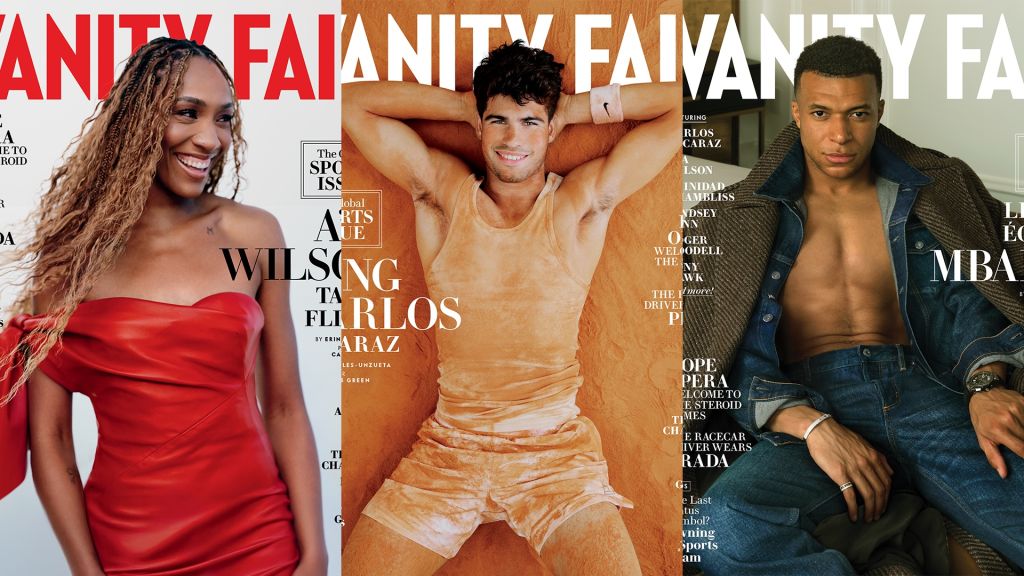
Kiffin’s profile was just one of roughly a dozen sports-related stories published in Vanity Fair in recent weeks—all part of the magazine’s first dedicated sports issue, which featured three covers fronted by Carlos Alcaraz, A’ja Wilson, and Kylian Mbappé.
Deputy editor Claire Howorth told Front Office Sports that the effort was the brainchild of Mark Guiducci, who joined the magazine as global editorial director late last summer.
“We kind of approached it laughingly, because we’re obviously not a sports publication,” she said. “But his vision was really to explore the idea of sports as show business and get into the money, the power, and the culture of sports.”
Cover stars were chosen to spotlight currently in-season sports.
The rest of the issue was “developed organically,” Howorth said, “by having conversations like, ‘What and who are people talking about in the world of sports right now?’”
Vanity Fair’s answers to these questions included dispatches on the upcoming Enhanced Games and the elite equestrian circuit in Wellington, Fla.; additional profiles of major players like NFL commissioner Roger Goodell and New York Liberty owner Clara Wu Tsai; and deep dives on the state of college sports through the eyes of Ole Miss quarterback Trinidad Chambliss and Kiffin.
That a historically highbrow magazine would take such a big swing on sports storytelling underscores a broader shift impacting all media brands. Website traffic is imperiled, in large part because search engines are directing readers to AI-generated summaries instead of news articles. Publishers are desperately searching for loyal, engaged audiences. Vanity Fair is betting that sports—with built-in fandoms, recurring cultural moments, and consistent viewership growth—offer just that.
Condé Nast CEO Roger Lynch spoke about the bleak web environment on a recent episode of the Technology Business Programming Network (TBPN) show. “Every year, our search traffic was down more than we had forecast,” he said. “So last year I told our teams, ‘Assume there’s no search.’ You have to have your businesses planned as if search is zero.”
Recent findings from digital intelligence platform Similarweb underscore this reality. Between March and April, web traffic to vanityfair.com dropped 27%.
Howorth said there wasn’t an internal push for a Vanity Fair sports issue from Lynch’s level, but she noted “the idea of so-called Google Zero” has made it “matter more than ever to have stories that scale to a very engaged, very interested audience.”
Though it’s early—new stories from the package are still being published—the results of Vanity Fair’s sports experiment have been positive. In addition to Kiffin’s comments going viral, the magazine said Alcaraz’s cover story—and supporting social media collateral—“generated millions of impressions.” Mbappé’s comments about French politics in his cover story have also been major international news and were covered in The New York Times on Monday.
Speaking about the issue as a whole, Howorth said it has “beaten expectations” and “definitely netted new subscribers.”
Still, sports’s role elsewhere in the Condé Nast portfolio remains somewhat muddled. GQ, once a prolific producer of sports content, laid off its single remaining sportswriter last week. Days later, Vogue—the company’s flagship title—announced world No. 1 women’s tennis player Aryna Sabalenka as its May digital cover star.
Vanity Fair hasn’t formalized any future plans for sports coverage. But the recent blitz has left editors there at least sports-curious. “Our core interests are power and personality,” Howorth told FOS. “If sports continue to intersect with those, we’ll be there.”
Download the FOS App
The business of sports, in your pocket.



Scan the QR code to get the app now.