Want more from Front Office Sports
in your search results?
NEWARK, N.J. — New Jersey authorities and World Cup organizers said Friday that the main modes of transportation to get to MetLife Stadium during the FIFA tournament will cost $150 round-trip by train and $80 by shuttle bus.
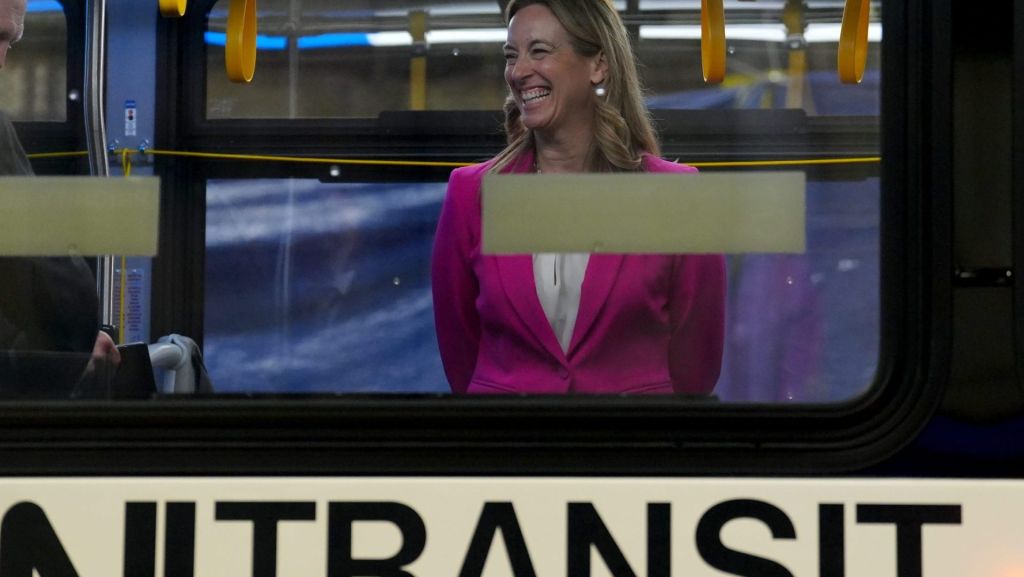
New Jersey Transit, the New York/New Jersey World Cup host committee, and other local organizers held a press briefing in Newark on Friday to unveil security and transit information for the eight matches at MetLife Stadium this summer.
NJ Transit is expecting to move 28,000 people from New York’s Penn Station to MetLife Stadium on match days. The other 12,000 expected riders would come from other parts of New Jersey. All will be charged $150 for their roundtrip ticket. NJ Transit says it will give riders a wristband on the way to the stadium, and fans won’t be allowed back on the train without it.
If New Jersey Transit is able to sell 40,000 round-trip train tickets per match for $150 each, that would wipe out the entire $48 million cost estimated by state officials.
The New York/New Jersey World Cup host committee will also offer a round-trip shuttle bus for 10,000 fans per match, with tickets costing $80 each.
Kris Kolluri, president and CEO NJ Transit, confirmed that his agency won’t be running westbound trains out of New York City’s Penn Station for four hours before match time, potentially inconveniencing commuters.
Later Friday, FIFA released a statement from 2026 World Cup COO Heimo Schirgi blasting NJ Transit’s announcement and praising host cities that have kept public transit prices low. “The NJ Transit current pricing model will have a chilling effect,” Schirgi said.
New Jersey Gov. Mikie Sherrill took aim at FIFA this week saying the soccer governing body should step up to cover some of the transportation costs. FIFA responded back saying it was “quite surprised by the NJ Governor’s approach.” Sherrill said she does not want her regular commuters to bear the cost of World Cup service.
The cost of traveling on NJ Transit to an event at MetLife from New York’s Penn Station normally costs $12.90.
Kolluri said Friday that the total cost for NJ Transit to transport World Cup fans would be $62 million, but $10.6 million of that will be offset by the federal government, and an additional $3.6 million came from the host committee on Thursday, which brought the bill down to $48 million.
“Commuters in New Jersey should not carry the costs years into the future for a wonderful event, no doubt, but the fans that are going to the games should bear the cost, and that’s all we’re trying to say,” Kolluri said.
The tickets represent yet another cost for fans attending the tournament. FIFA’s dynamic pricing model has sent match tickets skyrocketing, including charging more than $10,000 for some seats at the July 19 final in New Jersey.
New Jersey’s $150 train ticket surpasses even Boston’s $80 train for its seven World Cup matches. Boston’s Massachusetts Bay Transportation Authority anticipates 20,000 fans will take the train to Foxborough those games, half of the ridership expected in New Jersey.
The host committee’s shuttle bus will originate from two locations in New York City—Port Authority and east of Grand Central Station—and a park-and-ride location in New Jersey at Hackensack Meridian School of Medicine.
Kolluri asked New Jerseyans to avoid non-essential travel and work from home if possible on matchdays, particularly on June 22 and June 30 when fan travel will overlap with rush hour. Customers who must travel on those days will get discounts, Kolluri said.
Parking near MetLife Stadium will be extremely limited, and completely unavailable at the venue itself. Host committee CEO Alex Lasry said organizers currently have about 5,000 parking spots available at the nearby American Dream mall, but that number could increase based on demand. (The mall is about a mile walk from the stadium.) For fans who use taxis or ridesharing apps, the drop off and pick up area will be about a mile from the stadium at the Meadowlands Racetrack, Lasry said. Anyone working at the stadium will be provided nearby parking and free transportation.
New Jersey will host some of the biggest contenders in the World Cup and their fan bases during the group stage, including Brazil, France, Germany, and England.
In its original agreements with host cities, FIFA required free transportation for World Cup matches. This is routine for FIFA; the national governments of Russia and Qatar subsidized public transportation when hosting the World Cup in 2018 and 2022, respectively. But that policy was amended in 2023, allowing host cities to charge fans for transportation to and from matches, as FIFA realized “the financial strain this placed on the host cities.”
In its statement earlier this week responding to Sherrill’s social media video, FIFA said it has “worked for years with host cities on their transportation and mobility plans, including advocating for millions of dollars in federal funding to support host cities for transportation.”
On Friday, FIFA compiled a list of World Cup transit costs in other cities and noted several of their assurances that they will not raise prices. In Atlanta, Houston, Los Angeles, and Philadelphia, round-trip train tickets to matches will cost less than $6, FIFA said.
“Elevated fares inevitably push fans toward alternative transportation options,” COO Schirgi said. “This increases concerns of congestion, late arrivals, and creates broader ripple effects that ultimately diminish the economic benefit and lasting legacy the entire region stands to gain from hosting the World Cup.”
Schirgi called it “unprecedented” for New Jersey to “arbitrarily set elevated prices and demand FIFA absorb these costs,” and said that FIFA’s anticipated $11 billion revenue—“not profit, as the Governor incorrectly claims”—will be reinvested into global soccer efforts “particularly for youth and women.”
Lieutenant colonel David Sierotowicz of the New Jersey State Police said at Friday’s media briefing that there will be more than 600 troopers at MetLife Stadium and surrounding areas for World Cup matches, up from about 350 that usually staff an NFL game.
“This is a public safety effort of the likes we have never seen before,” Sierotowicz said.
When asked about the role of Immigration and Customs Enforcement at the matches, Sierotowicz said state police have coordinated with ICE.
“We have spoken to them as far as having operations in and around our operations,” Sierotowicz said. “That being said, we don’t necessarily control ICE, but we don’t want anything to be interrupted for the games. It seems that we’re all on the same page at this time that our operations won’t connect with their operations, and we’re focused on the safety and security of this event specifically.”
Several members of Congress have pushed to have ICE banned from the World Cup, and FIFA has also considered asking the Trump administration to completely halt ICE raids during the World Cup, according to The Athletic.
When MetLife Stadium hosted Super Bowl XLVIII in February 2014, fans spent hours waiting for NJ Transit trains, particularly in the rain after the game. Kolluri said on Friday there was a “fundamental miscalculation on supply and demand” for that game, and said his agency is focused on having “the capacity, the resources, and the ability” to move the number of people it says it will for the World Cup.
Download the FOS App
The business of sports, in your pocket.



Scan the QR code to get the app now.