Want more from Front Office Sports
in your search results?
Claims that FIFA had banned tailgating at this summer’s World Cup rocketed around social media on Tuesday.
It started with prediction market, aggregator, and occasional shitposter Polymarket.
“JUST IN: FIFA has banned tailgating before World Cup matches at major U.S. stadiums. Tailgates are normally free to attend,” the Polymarket Sports handle posted midday Tuesday.
The post was widely imitated and aggregated, and FIFA found itself replying to accounts like Eagles Nation, Barstool Sports, a local Boston TV station, German broadcaster DW Sports, and the aggregator account Pubity.
“FIFA does not have a formal policy that restricts tailgating (eating and drinking around parked cars in stadium areas),” FIFA Media said in its replies to Polymarket Sports and others. “However, site-specific restrictions may be imposed in alignment with host city public safety authorities in certain venues based on local regulations. Additional fan information for all FIFA World Cup 2026 matches will be communicated in advance of the tournament.”
In other words: FIFA hasn’t banned tailgating at the World Cup. But the truth is slightly more complicated.
FIFA controls the stadiums during the World Cup, and local host committees are tasked with security operations. FIFA requires a wider security perimeter around stadiums than are normally required for events like NFL games, which will cut into parking lots. In New Jersey, the parking lots will also have areas “dedicated to fan engagement” on top of increased security measures, a host committee spokesperson told NJ.com. Eliminating parking could functionally eliminate tailgating.
Last summer, the local host committee told The Kansas City Star that Arrowhead Stadium’s parking lots will “look and feel different” for the World Cup. The host committee’s website says “parking will be extremely limited.”
Earlier this month, NJ.com reported that parking won’t be allowed at all at MetLife Stadium during the World Cup “because the lots are being used for other purposes, according to the host committee.” (With driving banned, it appears that fans’ only option for getting home from the game will be the $100 New Jersey Transit ticket reported by The Athletic.)
Then, local media in New England reported that the local host committee, Boston Soccer 26, posted a “match day check list” on its website that said: “Please note that the traditional ‘tailgating’ (eating and drinking around parked cars) is not permitted for these events per FIFA policy.” That language has since been updated to read “Please note that the traditional “tailgating” (eating and drinking around parked cars) is not permitted for these events.” The group did not respond to questions.
On April 27, Boston Soccer 26 released a statement acknowledging the miscommunication, saying the host committee and Gillette Stadium had both thought “based on prior information” from FIFA that banning tailgating was a “tournament-wide” rule.
“We are pleased to share that tailgating will be permitted at Boston Stadium like any other event hosted at the stadium as there are no venue restrictions or local public safety restrictions in place that would prohibit it,” the host committee said.
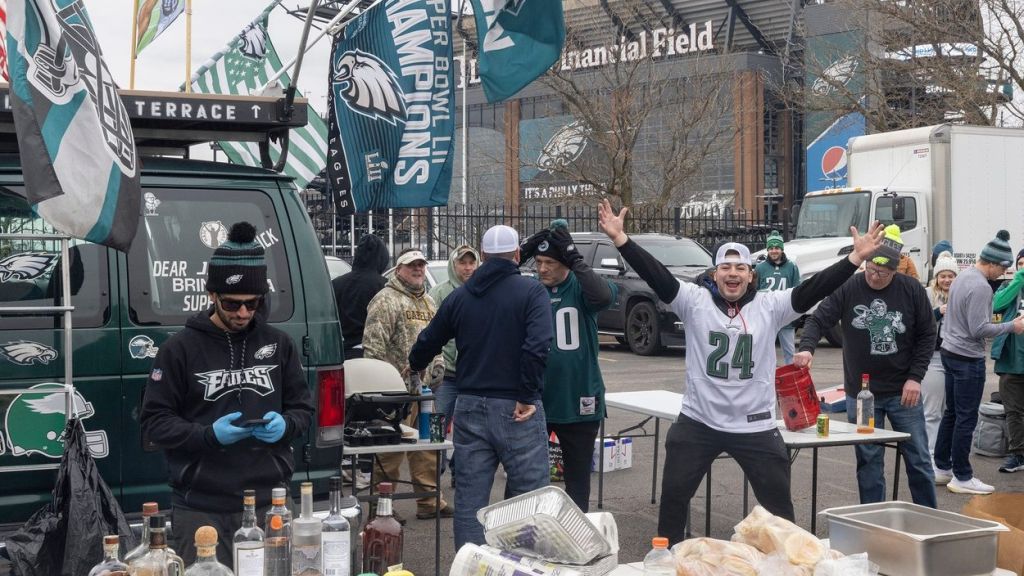
The idea of a tailgating ban was perhaps most offensive to Philadelphians. Local organizers there said they haven’t made any final decisions.
“Philadelphia is a city defined by its fans and its traditions, and that will not change when the world arrives for FIFA World Cup 2026,” Philadelphia Soccer 2026, the city’s World Cup host committee, said in a statement to Front Office Sports. “While our fan experience plans are still being finalized with our partners, we are committed to delivering a World Cup that is authentically Philadelphia — and that means celebrating the passion, the energy, and the game-day culture that makes this city unlike any other.”
An Eagles spokesperson told The Philadelphia Inquirer: “The event day experience for the World Cup will be consistent with all major ticketed events we host at Lincoln Financial Field.”
FIFA is selling official parking passes through a platform called JustPark for 10 of the 11 U.S. host cities, except Seattle, which says “parking will be available soon.” (The host committee did not respond to questions.) None of the available tickets are for the parking lots closest to stadiums, outside of some ADA- accessible passes.
The reality of the parking situation varies by city. In Kansas City, Philadelphia, and Houston, parking passes are still available in several sections within a 10-minute walk of the stadium. In Los Angeles, the only standard parking option is more than a mile from the match. In Santa Clara, which is hosting the San Francisco Bay Area’s matches, the only available passes are ADA accessible, and even those are an eight-minute walk.
But there’s a difference between parking availability and tailgating rules. Both Philadelphia and Boston have parking available, but the host committees have made opposite rulings about tailgating.
FOS asked the other nine U.S. host cities whether they would allow tailgating in the parking that is available.
Atlanta has no plans to ban tailgating. Host committees in Dallas, Kansas City, Los Angeles, the San Francisco Bay Area, and Miami deferred to FIFA. New York/New Jersey reiterated that there will be no general parking at the stadium, but did not answer questions about tailgating in other parking areas. Houston did not comment, and Seattle did not respond.
This story has been updated to include a statement from Boston Soccer 26.
Download the FOS App
The business of sports, in your pocket.



Scan the QR code to get the app now.