Want more from Front Office Sports
in your search results?
The record heat wave in Paris that has disrupted the opening days of the French Open on and off the court is expected to last until late this week.
Temperatures at Roland-Garros surpassed 90 degrees Fahrenheit on Sunday and Monday, as the second Grand Slam of the tennis season got underway.
Canadian Gabriel Diallo retired from his opening-round match against Australian James Duckworth on Sunday because of an injury, and attributed the move to the heat: “That’s mainly what it was… It was getting worse and worse,” he said. And after winning his first-round match against Roman Safiullin, world no. 17 Casper Ruud said the heat got to him. “I was close to being on the way home, honestly,” he said. “In the end of the third and fourth set, I felt quite horrible and dizzy. It was really hard to see the ball. I think my body temperature was too high, I was not able to cool it down with the temperature here today.”
At least 20 cities in France have recorded their highest-ever temperatures for the month of May, according to the Météo-France, the country’s national weather service.
Forecasts for Tuesday, Wednesday, and Thursday at the French Open all call for high temperatures of more than 90 degrees, as well. Daily highs are projected to remain in the 80s for Friday and Saturday before cooling off into the 70s on Sunday.
Last year, temperatures for the opening rounds of the French Open were in the 60s, and never reached higher than the mid-80s throughout the tournament, which is more typical for Paris in late spring.
Normally, the French Open and Wimbledon are the cooler of the four Grand Slams, as the Australian and U.S. Opens are each played in near-peak summer heat of Melbourne and New York, respectively. However, Wimbledon also experienced record heat last year, as the temperature during the opening round soared past 90 degrees for the first time in tournament history.
Beating the Heat
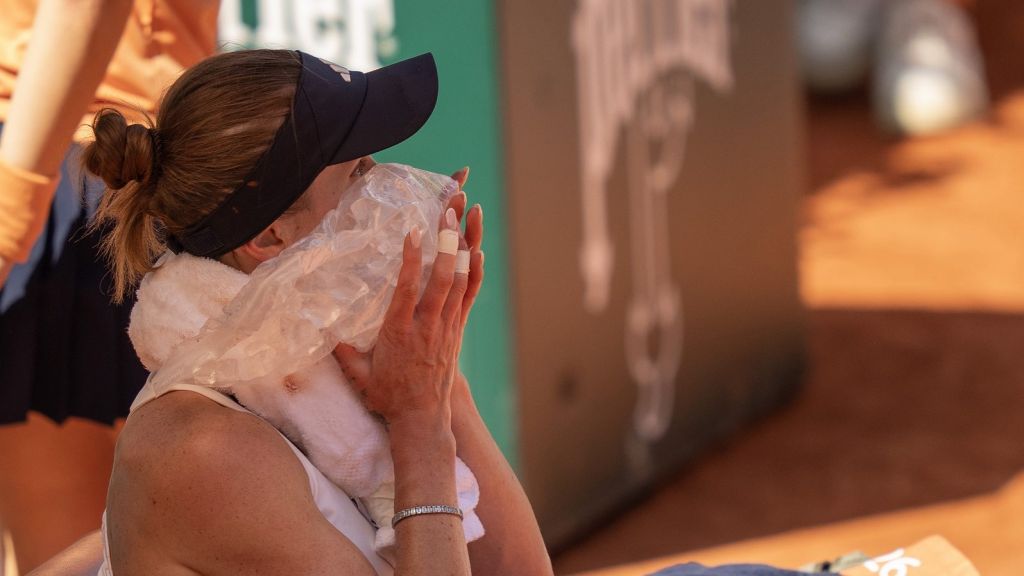
Some players during the first two days put bags of ice on their heads, necks, and shoulders to cool off between games during their matches. A ball girl working one match on Monday nearly fainted.
So far, play has not been delayed or suspended due to the heat.
The French Open’s heat policy uses the Wet Bulb Globe Temperature (WBGT), which takes into account temperature, humidity, sun, wind and other factors, according to the Associated Press.
If the WBGT reaches 86 degrees or higher, 10-minute cooling breaks can be installed between the second and third sets for women’s matches and between the third and fourth sets for men’s matches.
If the WBGT hits 90, play is suspended. It would require an air temperature of about 100 degrees for play to be suspended. The U.S. and Australian Opens use similar heat policies for player safety.
Next month, the FIFA World Cup in North America will include “hydration breaks” in each half of every match for three minutes.
The beginning of the tournament was also marked by player protests over their share of prize money at Grand Slams. While speaking to reporters during Friday’s pre-tournament media day, a group of top players—including Jannik Sinner, Aryna Sabalenka, Coco Gauff, and Iga Świątek —limited their appearance to only 15 minutes, meant to symbolize the 15% of revenue they will be getting from this year’s event at Roland-Garros.
Download the FOS App
The business of sports, in your pocket.



Scan the QR code to get the app now.