Want more from Front Office Sports
in your search results?
The NFL and the NFL Players Association are engaged in discussions to finalize the terms by which interested players would be permitted to participate in flag football at the 2028 Olympics in Los Angeles.
The final policy details have not yet been determined but the talks are ongoing, a source familiar with the state of the negotiations told Front Office Sports.
The league and union have been able to work cooperatively on a series of recent measures. They’re now attempting to remove the final obstacles to NFL players competing for an Olympic gold medal.
NFL team owners unanimously approved a resolution last year in support of players being allowed to play at the Olympics. That was not the final step, however. The owners’ resolution authorized the NFL’s management council and other league committees to negotiate suitable arrangements with the NFLPA, Olympic authorities, and national governing bodies for player participation.
The resolution said the NFL must reach agreements on standards for field surfaces and medical care for players. The participation schedule for players, it said, could not “unreasonably conflict” with team and league commitments. Other issues include establishing injury protections for players via insurance policies and ensuring that an NFL team would receive salary-cap credit if any of its players is injured while participating.
The owners’ resolution proposed limiting Olympic participation to one player per NFL team on a single country’s roster, along with permitting any player in a team’s international program to participate for his country.
It’s not clear when the talks might conclude. Players and teams will likely want to know the policies well in advance of the run-up to the Games. Participating NFL players will presumably have to participate in flag football practices and preparations ahead of the Olympic competition.
The flag football competition at the 2028 Games is scheduled for July 15–22. That creates limited—if any— conflict with NFL training camps, at least under the current offseason structure. The competition includes men’s and women’s tournaments consisting of six teams each. Games will be played at BMO Stadium, home to Los Angeles FC of MLS and Angel City FC of the NWSL.
NFL officials have said recently that more than 200 players have expressed interest in participating.
“They’re very serious about the Olympic opportunity,” Peter O’Reilly, the NFL’s executive vice president of club business, international and league events, said at the league meeting Wednesday in Atlanta.
NFL commissioner Roger Goodell and other league leaders began endorsing the participation of NFL players in Olympic flag football soon after the International Olympic Committee’s 2023 decision to add five sports, including men’s and women’s flag football, to the 2028 Games.
The NFL has leaned heavily into the growth of flag football, believing that the flag version of the sport expands the fan base, boosts youth participation, and furthers the league’s goal of broadening its global appeal.
The NFL is involved in launching professional flag football leagues for men and women. It established an ambitious youth flag football tournament and has promoted the growth of the non-tackle version of the sport at the high school and collegiate levels.
It played its Pro Bowl as a flag football game in recent years before announcing Wednesday that it was eliminating the postseason all-star game. The league said that 88 players still will be selected as Pro Bowl players for this season and honored next year at an event in Los Angeles.
“There’s a lot of flag [football] content that’s going to be out there … including that weekend in Los Angeles and moving forward as we head towards the Olympics,” O’Reilly said Wednesday. “But separating the [Pro Bowl] honor from the flag [game] and the competitive piece of it was the key to it.”
Troy Vincent, the NFL’s executive vice president of football operations, said in Atlanta that players “understand the importance of football being a global sport. And what’s our entry point globally? It’s through flag. And if that’s an important part of growing popularity, we should be doing everything to make sure that the game is being open to all.”
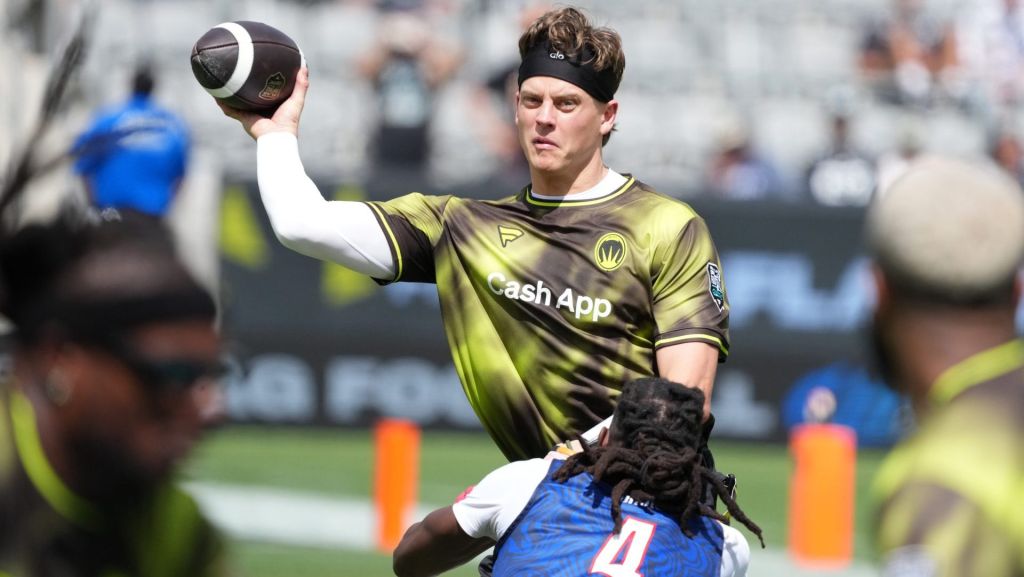
Star quarterbacks Josh Allen of the Bills and Joe Burrow of the Bengals are among the NFL players to have expressed interest publicly in playing in the Olympic flag football competition. Vikings wide receiver Justin Jefferson attended the announcement of the owners’ resolution in May 2025—during a league meeting held at a hotel next to the Vikings’ training facility in Eagan, Minnesota—and said he’d consider playing.
Meanwhile, veteran U.S. flag football players have said they want a fair chance to vie for roster spots.
The NFLPA said the week before that 2025 owners’ meeting that it fully supported “our player members participating in the Olympics and taking this opportunity to represent their country on the highest international stage.” The union added then that it looked forward to discussing the players’ participation with the NFL “to ensure players who choose to compete can do so without detrimental impacts to their health, safety and job.”
The league and NFLPA have a sometimes-combative history, but have been able to work together well in recent months, early in JC Tretter’s tenure as the union’s new executive director. They jointly announced a new player-accountability system Wednesday, by which any player who violates specified player-safety rules three times this season faces an automatic one-game suspension, while any player who has only one such infraction will have half his fine money refunded to him at season’s end. The deliberations on that system occurred over “the last several months,” the NFL and NFLPA said in their joint statement.
The same day, the league and union jointly announced the Sept. 1 launch of a Behavioral Health Network, which they described as an enhancement to the NFL player insurance plan expanding “access to confidential outpatient behavioral health support for eligible current and former players and their eligible dependents.”
Players also had significant input into the decision to eliminate the Pro Bowl, NFL leaders said.
“We’ve got an opportunity to refresh and reimagine with the players, which has been just a beautiful thing,” Vincent said. “So I’m happy we’ve gotten to this point.”
Download the FOS App
The business of sports, in your pocket.



Scan the QR code to get the app now.